
Why the Faceless Digital Products Trend Is Booming in 2026

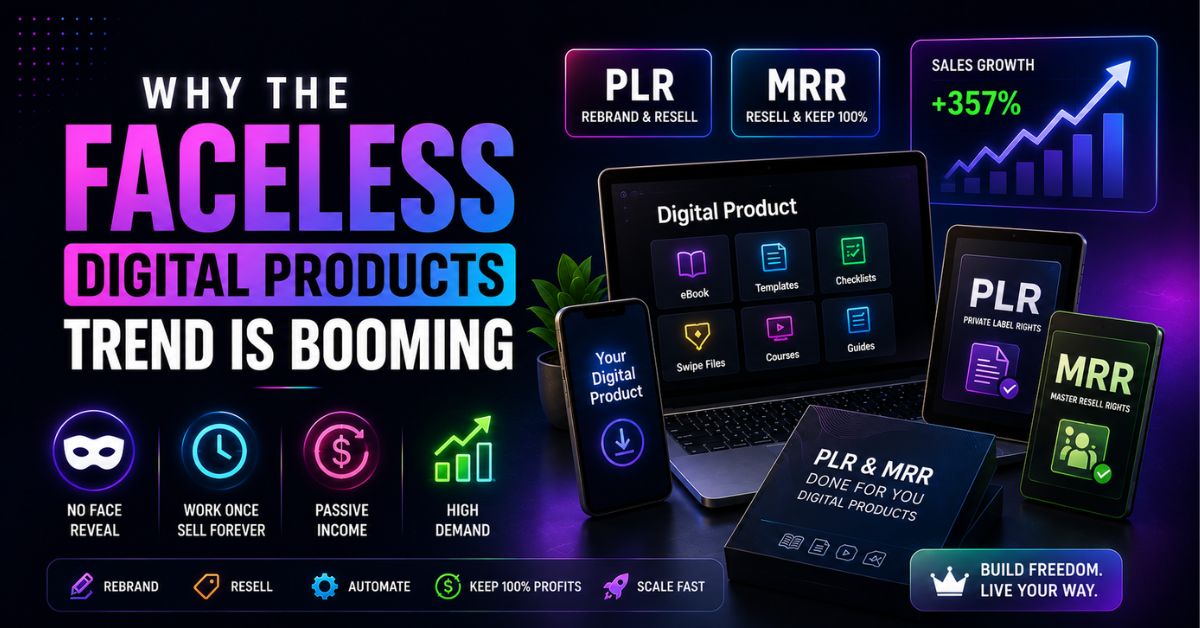
Sellers running 3 or more related listings on Gumroad now average $5,201 per month, according to a dataset of over 146,000 products, and most of them never show their faces to make a single sale. No camera, no personal brand, no daily content grind, just a product that solves 1 clear problem for 1 clear buyer.
This piece breaks down why the faceless digital products trend in 2026 is accelerating right now, which products are actually selling, where to list them, and how to launch one this month without ever showing your face. Stick around for the platform data most articles skip and the one Etsy rule that can get a new shop flagged before it even earns its first sale.
What Counts as a Faceless Digital Product
A faceless digital product is anything a creator sells online that never requires their name, their voice, or their image to close the sale. Templates, printables, ebooks, Notion systems, spreadsheets, AI prompt packs, and mini courses all fit this category. The buyer cares about the outcome the product delivers, not the person who made it.
This is different from faceless content marketing, which is about hiding on camera while still posting videos or reels under a brand account. A faceless digital product goes further. The entire storefront, from the product listing to the checkout page to the delivery email, can run without a personal brand attached to it at all.
That distinction matters for strategy. A faceless YouTube channel still needs a consistent on-screen persona, even if it’s an animated one. A faceless digital product only needs to solve 1 specific problem clearly enough for the listing to sell itself.
The faceless creator economy has grown well past templates and ebooks, too. AI-generated digital products, subscription communities, and even faceless service businesses like done-for-you SOPs now sit inside the same category, since none of them require the seller to appear anywhere in the sales process.
The through line across all of it is delivery, not disclosure. A buyer downloading a template gets the same file whether the seller has 40,000 followers or 0. That is the structural reason faceless digital products scale differently from personal brand content, where the creator themselves is the product being consumed.
Why the Faceless Digital Products Trend Is Booming in 2026
3 forces are converging at once, and each alone would be enough to explain the growth.
1. The first is burnout.
Adobe’s creator economy research found that 48% of creators have already experienced burnout, and that number climbs sharply among those who create content full-time.
A digital product does not need a daily post to keep selling. Once it is built and listed, it earns while the creator sleeps, travels, or takes a week off.
2. The second is privacy.
Industry survey data compiled by the creator analytics site Frameloop show that 61% of new creators cite privacy as their main reason for choosing an anonymous format over a personal brand. Selling a template or a guide does not put a face, a home, or a family in front of strangers online.
3. The third is a genuine shift in buyer behavior.
The same Frameloop research found 72% of Gen Z consumers say content quality matters more to them than who made it, and 74% of digital learners say they trust credible faceless content about as much as content from a recognizable creator. Buyers are paying for the transformation a product delivers, not for a parasocial connection with its maker.
Layered on top of all 3 is AI production tooling. Building a template pack, a cover, or a workbook used to take a design team. Now, a solo seller can write the copy, design the layout, and mock up the product in an afternoon.
That drop in production cost is what turned faceless digital products from a side hustle into a real category. Some 37% of creators now actively sell digital products, according to a 2026 survey by the creator platform Circle.
The broader creator economy is on track to reach $323 billion in 2026, according to Research and Markets, and digital product sales are among the fastest-growing segments of that total.
The Numbers Behind the Trend
The hype around faceless products is easy to find. The actual math is more useful, and it comes from platform data, not opinion.
Analytics firm InsightRaider tracked 146,271 products across Gumroad and found the median seller earns $72 a month, while 44% of listed products earn exactly $0. That is not a discouraging number; it is a filtering number. It shows that a single, generic listing rarely performs, while focused products in a real niche do.
The same dataset shows why. Sellers running 3 or more products in the same niche average $5,201 a month, close to 6 times what single-product sellers make.
Design category products alone generated $8.8 million in tracked revenue across 1,195 listings, averaging $7,365 per product. Writing and publishing products, a category most beginners overlook, averages $15,750 per product across only 226 listings, which means far less competition for a strong entry.
Traffic sources matter just as much as the product itself. On Gumroad, email marketing drives 42% of all sales, social media drives 23%, and organic search drives only 12%.
Etsy flips that model, since it functions as a search engine with roughly 4 times more buyer traffic than Gumroad has built in. A seller with no audience yet will usually find faster traction on Etsy, while a seller with an email list or a following will keep more margin by selling direct.
Scale matters here too. Etsy has roughly 7.5 million active sellers competing for the attention of 95 million active buyers, according to marketplace data reported by the digital product research tool Insight Agent. That ratio still favors sellers who pick a specific niche and stack several related listings, rather than sellers who publish 1 generic product and wait.
The Best Faceless Digital Products to Sell Right Now
Not every digital product idea earns equally. These 5 categories have the clearest demand and the lowest production barrier for a first launch.
1. Notion and Productivity Templates
Project trackers, CRM systems, and habit dashboards sell in the $19 to $79 range and have an active, still-growing buyer base inside the Notion ecosystem. Aesthetic planner dashboards, priced closer to $9 to $49, are one of the fastest-moving sub-niches inside this category right now.
2. Canva Templates and Printables
Social media kits, planners, and business templates require no coding or a design degree. A tool like Canva handles the entire build process, from layout to export, which is why it remains the default starting point for first-time faceless sellers.
3. AI Prompt Packs Built for One Specific Outcome
Generic prompt dumps stopped selling once the market got crowded. Packs built for a narrow use case, like listing descriptions for real estate agents or client emails for coaches, still convert because the result is immediate and specific.
⚠️ One important caveat here: Etsy’s own seller handbook states the platform prohibits selling AI prompt bundles as a standalone product, since Etsy treats the prompt as part of the creative process rather than a finished item. That restriction does not apply to Gumroad or Payhip, so prompt pack sellers need to pick their platform with that rule in mind.
4. Ebooks in a Narrow Niche
A budgeting guide for freelancers outsells a generic money book because it speaks to 1 exact reader. Price bands of $9.99 to $19.99 are common for focused, well-researched guides.
5. Resume, Invoice, and Business Templates
Evergreen demand with steady, repeat sales. Targeting a specific industry, such as healthcare or the creative field, cuts competition sharply compared to a generic version.
6. AI-assisted Mini Courses
A tight, 5- to 7-lesson course that solves 1 specific skill gap, delivered as video or PDF slides, sells well when the content comes from real, tested experience rather than a rehash of free YouTube videos. Buyers pay for the structure and the shortcut, not for information they could not find elsewhere.
7. Seasonal Print Bundles and AI-generated Wall Art
Print-ready art, planners, and seasonal collections tied to holidays or academic calendars sell in short, predictable bursts. Sellers who batch these in advance and schedule listings around the calendar consistently outperform sellers who create reactively.
The best entry point for a first faceless product is a template, not a course. A template ships in days, tests the niche quickly, and can later expand into a course once demand is proven.
A useful way to see how this plays out is by looking at 2 common seller paths. The first is a former nurse who packages a shift handover checklist and a patient intake SOP, sourced directly from her old job, and prices the bundle at $79 for other clinics.
The second is a stay-at-home parent who builds a single Notion budgeting template, sells it for $19 on Etsy, and adds a matching debt-payoff tracker once the first template proves that buyers want it. Neither seller needed an audience, a camera, or a personal brand to start earning.
AI Standard Operating Procedures: A High Ticket Faceless Niche
A newer category that warrants its own section is the AI-assisted Standard Operating Procedure (SOP).
An SOP is a ready-made set of operational checklists and policies that a small business buys instead of hiring a consultant. Restaurant management policies, HR onboarding checklists, and client intake workflows are common examples, and they sell for far more than a $19 template because they solve a business problem, not a personal one.
This niche works well for a faceless seller with real industry experience. A former hotel manager, HR coordinator, or operations lead can package what they already know into a document that a small business owner will pay $47 to $200 for, since it replaces hours of consulting work.
Etsy and Gumroad both work as storefronts for this category, though Etsy’s built-in search traffic tends to surface these listings to small business owners actively searching for a fix, which is exactly the buying moment this product type depends on.
The expertise signal matters more here than in almost any other faceless category. A buyer paying $150 for an SOP wants to see that the document reflects real operational experience, not a generic AI output with the company name swapped in.
Subscription and Membership Models: Recurring Revenue That Resists AI Copying
One-off products are easy for a competitor, or an AI tool, to copy once they sell well. That is pushing more faceless sellers toward subscription and membership models instead.
A membership swaps a single purchase for a recurring fee, often paired with a private community and a weekly group coaching call. The product being sold is not just a file anymore; it is ongoing access and support, which is far harder to replicate than a PDF.
Patreon alone now supports more than 10 million paying members and has paid creators over $10 billion in total, underscoring how large this model has grown even beyond video platforms.
Here is another example of how rapidly community-based businesses are growing. Skool helps more than 200,000 communities connect with over 25 million members, while creators collectively generate more than $1 billion in annual revenue. It shows that building a loyal community around a shared interest can become a powerful long-term business model.

The appeal for a faceless seller is direct: a $29 monthly membership selling to 200 members produces the same monthly income as selling roughly 300 units of a $19 template, without needing new buyers every single month.
The honest caveat belongs here too. Nearly 44% of new memberships cancel within their first 90 days, and the average household is trimming, not adding, monthly subscriptions right now. A membership model works best as a second product layered on top of an already proven template or guide, not as the first thing a new faceless seller tries to build.
Where to Sell Faceless Digital Products
Choosing a platform comes down to 2 questions: does the seller already have an audience, and how much margin matters at scale.
| Platform | Fee (Free Plan) | Best for |
| Etsy | Listing fee plus transaction fee | No existing audience, printables, SOPs, or discovery traffic |
| Gumroad | 10% plus card processing | Simple setup, marketplace discovery via Gumroad Discover |
| Payhip | 5% plus card processing | Sellers who already have traffic and want to keep more margin |
Gumroad’s flat structure is simple, but it is also expensive at scale. A platform like Payhip charges half the platform fee on its free plan, handles EU and UK digital VAT automatically, and still supports templates, courses, and memberships without any coding. For a seller past their first few hundred dollars in monthly sales, that fee gap adds up fast.
Gumroad is a great platform for creators who already have an audience, and Gumroad Discover can add extra reach. Etsy is the better starting point for anyone building from a zero audience, since its search traffic does the discovery work that a brand-new seller has not earned yet. Many established sellers eventually run both, using Etsy for discovery and a lower-fee platform for their core catalog and repeat buyers.
Faceless Social Media Marketing: Driving Traffic Without Showing Your Face
A digital product still needs buyers to find it, and faceless sellers now lean on a specific playbook to get that traffic without ever appearing on camera.
Short, aesthetic carousels built around 7 slides are one of the strongest formats on Instagram right now. Each slide teaches one small point, and the final slide points to the product or the email list, keeping the content useful even for someone who never buys.
AI voiceover videos work the same way on TikTok, Instagram Reels, and YouTube Shorts, pairing stock footage or simple text animation with a script read by a synthetic voice. The seller never appears, yet the video can still hook a viewer in the first 2 seconds and walk them straight to the storefront link.
Pinterest deserves a specific mention here too. A single pin can keep generating clicks for months after it is posted, which makes it the closest thing to free, compounding advertising a faceless seller has access to.
If you’re serious about building a faceless digital product business instead of figuring everything out through trial and error, the AI Creator Cashflow System walks you through the complete process. From choosing a profitable niche to creating products, building automated systems, attracting buyers, and making your first sales, it’s the roadmap I wish I had when I started.
👉 Get the AI Creator Cashflow System: https://successpixel.gumroad.com/l/aicash
How to Launch a Faceless Digital Product Business
1. Pick One Niche You Already Understand
A problem you have personally solved, in your own work or hobby, is faster to write about convincingly than a trending topic you researched last week. Industry experience, even from a job you no longer have, is the fastest shortcut to a product that sounds credible.
2. Build One Tight Product Before Building a Catalog
A single well-made template beats 5 rushed ones. Price it between $15 and $49 to start, since that range converts well without a long sales page.
3. List it on One Platform First
Etsy if you have no audience, Payhip or Gumroad if you already have an email list or a following. Resist the urge to list everywhere at once, since split traffic makes it harder to tell what is actually working.
4. Write for Search, Not for Virality
Blog content and Pinterest pins optimized around what buyers actually type into search bars sell products quietly in the background, long after the post goes live.
5. Add a Second Product Once the First Sells
Buyers who already trust 1 listing convert faster on a second, related one, which is why multi-product sellers consistently out-earn single-product sellers.
6. Layer in Recurring Revenue Later, not First
Once a template or guide proves demand, a matching membership or coaching add-on gives the same buyers a reason to keep paying month after month.
Pricing deserves its own note here, since it is where most beginners underprice out of nerves. A bundle of 3 related templates sold together for $49 almost always outperforms the same 3 templates sold separately at $19 each because bundling raises perceived value without increasing production costs.
The goal is not the lowest price in the category; it is the clearest value at a price that still feels fair for the transformation delivered.
Common Mistakes That Slow a Faceless Launch Down
A few patterns recur among sellers who stall out in their first few months.
1. The most common is building the product before checking if anyone searches for it.
A quick look at Etsy’s own search bar, or a few minutes inside a keyword tool, shows whether real buyers are typing in a phrase close to the product idea. Skipping this step is the single biggest reason a well-made product still earns $0.
2. The second is listing once and walking away.
Etsy and Gumroad both reward accounts that add new, related listings on a steady schedule, since fresh, connected products signal an active shop to both the algorithm and the buyer. A shop with 1 product from 8 months ago reads as abandoned, even if the product itself is good.
3. The third is copying a bestseller instead of narrowing it.
The seller who takes a popular $19 planner and republishes a near-identical version is competing on price alone, and price competition is exactly where the 44% of $ 0-earning listings live. Narrowing the same idea down to 1 specific buyer, such as a planner built only for night shift nurses instead of a generic daily planner, is what actually escapes that crowded middle.
What the Hype Leaves Out
Most articles about faceless products stop at the upside. A full picture needs the caveats, too.
AI-generated content is not the guaranteed trust shortcut it is sometimes sold as. According to an EMARKETER study, only 26% of consumers now prefer AI-generated creator content, down sharply from 60% in 2023.
Animoto’s State of Video survey 2026 found that 77.9% still say they trust content made by real people more. Products built with AI assistance still need a human editing pass and a genuinely useful outcome, not just fast production.
Saturation is real in the most obvious niches. The 44% of Gumroad products earning $0 is proof that copying a trending template without a distinct angle rarely works. The sellers who consistently earn are the ones solving a specific problem for a specific buyer, not the ones chasing whatever category looks hot this month.
Platform dependence is a genuine risk too. Recurring subscription products tied to a single storefront can be difficult to move if pricing or policies change later. Building an email list from day 1, even a small one, is the closest thing to insurance a faceless seller has against relying on any single platform.
Platform rules change fast as well, and the Etsy prompt bundle restriction mentioned earlier is a clear example of a policy shift that caught sellers off guard in 2026.
Where to Go Next
The faceless digital products trend is booming in 2026 because 3 things lined up at once: creators are burned out, buyers care more about outcomes than personalities, and AI tools finally made production fast enough for a solo seller to compete.
The sellers doing well are not the loudest ones. They are the ones who picked one real problem, built one focused product, and listed it where their exact buyer was already searching.
If you want the next step, start with our full guide to the best digital products to sell in 2026 for a deeper breakdown of pricing and niches, or go straight to our guide on how to sell digital products without showing your face for the full setup walkthrough.
Want the shortest path from idea to first sale?
Grab a Payhip account, since it is free to start and keeps more of each sale in your pocket while you test your first product.
Frequently Asked Questions
Q: How do you sell digital products without showing your face?
A: List on a platform like Etsy, Payhip, or Gumroad, use a logo or brand mark instead of a personal photo, and write product descriptions that focus entirely on the buyer’s outcome. Email and Pinterest, rather than talking head video, are the most common faceless traffic sources.
Q: What is the most profitable faceless digital product idea for beginners?
A: Niche templates, such as Notion systems or Canva kits built for 1 specific audience, tend to be the fastest to build and the fastest to validate. Writing and publishing products currently show the highest revenue per listing on Gumroad, with far less competition than design categories.
Q: Can a faceless brand actually build trust with buyers?
A: Yes. Trust comes from consistent branding, clear product descriptions, and visible reviews rather than a personal photo. Research shows 74% of digital learners trust credible faceless content as much as content from a known creator, though that trust still depends on real production quality.
Q: Is Etsy or Gumroad better for a first faceless digital product?
A: Etsy fits sellers with no existing audience, since it functions like a search engine with roughly 4 times more buyer traffic than Gumroad. Gumroad fits sellers who already have an email list or social following, since its fee structure rewards direct, repeat buyers over marketplace discovery.
Q: What AI tools work best for faceless digital product creation?
A: Design tools like Canva cover templates and printable creation without any design background, while writing tools speed up first drafts of ebooks and guides. The products that sell best still get a human editing pass, since AI-only content shows measurably lower buyer trust.
Q: Why are faceless digital products booming specifically in 2026, and not earlier?
A: Production tools matured enough for a solo seller to build a professional-looking product without a team, right as burnout and privacy concerns pushed more creators away from personal branding. Both trends existed before, but 2026 is the first year the tooling and the demand fully lined up.
Q: Do faceless digital products still work in a crowded niche?
A: Yes, but only with a specific angle. Data from Gumroad shows 44% of listed products earn nothing at all, almost always because they copy an existing product instead of solving a narrower version of the same problem for a defined buyer.
Q: How much can a realistic faceless digital product business earn?
A: Median Gumroad sellers earn about $72 a month, but sellers running 3 or more related products average $5,201 a month, nearly 6 times more. The gap comes from niche focus and product count, not from luck or virality.
Q: What are faceless digital marketing bundles, and are they worth buying?
A: These are pre-built kits, usually a mix of templates, prompt scripts, and posting calendars, sold to help a new seller launch faster. They can save real setup time, but the buyer still needs to niche the content down to a specific audience, since a generic bundle rarely sells as well as a customized one.
Q: Should a faceless seller use Master Resell Rights (MRR) or Private Label Rights (PLR) products?
A: PLR and MRR products can work as a fast starting point, but reselling the exact same file everyone else bought puts a seller straight into the crowded, zero-dollar-earning end of the market. Editing the content meaningfully, repackaging it for 1 specific audience, and adding original examples is what separates a real product from a resold file.
