
What are Faceless Digital Products: Real Money or Another Scam?


What Are Faceless Digital Products and How Are They Replacing Side Hustles in 2026
Someone uploads a Canva resume template to Etsy on a Sunday afternoon. By Thursday, they have made $340 — without a single customer interaction, no packaging, no shipping, and no camera in sight. That is a faceless digital product at work.
Faceless digital products are downloadable or deliverable digital assets you create once and sell repeatedly, without building a personal brand or appearing on camera. The business model strips away every obstacle that stops most people from starting online: the fear of being on video, the need for an audience, the logistics of physical inventory. What remains is a low-cost, scalable income stream that runs largely on autopilot.
This guide covers exactly what these products are, which types sell best right now, where to sell them, how to drive traffic through Instagram, Threads, Gumroad, TikTok, and Pinterest without showing your face, and the honest mistakes beginners make early. If you are a blogger, solopreneur, or side-hustler who wants to add digital income without building a personal brand, this is where to start.
What “Faceless” Actually Means in Digital Business
The word gets thrown around loosely, so let us be precise.
A faceless digital business is one where your personal identity — your face, voice, real name, or personal story — is not central to your marketing or product. The brand stands on its own. The product delivers value on its own. Customers find and buy your work without needing to know who made it.
This is not new. Every stock photo library, software plugin, and printable on Envato marketplace or Etsy has operated this way for decades. What changed is how accessible the tools became. Platforms like Canva, ChatGPT, Gumroad, Beacons, and Payhip have lowered the barrier to nearly zero.
A faceless creator might run a Threads account posting niche tips that link to a Gumroad store selling Notion templates. They might publish a Canva template pack on Creative Market under a pen name. They might drive traffic from a faceless Instagram page to a Shopify storefront without ever recording a video. The through line is the same: the product is the brand, not the person.
This matters because most advice about online business assumes you want to build a personal brand. If you do not — if you value privacy, if you are camera-shy, if you simply want income without an audience — faceless digital products are one of the few models built for that reality.
What Are Digital Products? (The Short Answer)
A digital product is any file or deliverable that exists online and can be transferred to a buyer without physical shipping.
The category is wider than most people realize. It includes:
- Ebooks and guides: PDFs covering a specific topic or skill
- Templates: Canva designs, Notion dashboards, social media layouts, resume formats
- Printables: planners, habit trackers, wall art, worksheets, journals
- Online courses: video lessons, audio training, or written modules
- Stock assets: photos, illustrations, fonts, icons, mockups
- Software and tools: plugins, scripts, automation workflows
- PLR and MRR content: licensed products you can resell or rebrand (covered in detail below)
- AI-generated assets: images, prompts, datasets, or training materials
The economics are what make them interesting. According to HTF Market Insights, the global digital products market reached $9.8 billion in 2025 and is forecast to hit $18.3 billion by 2033.
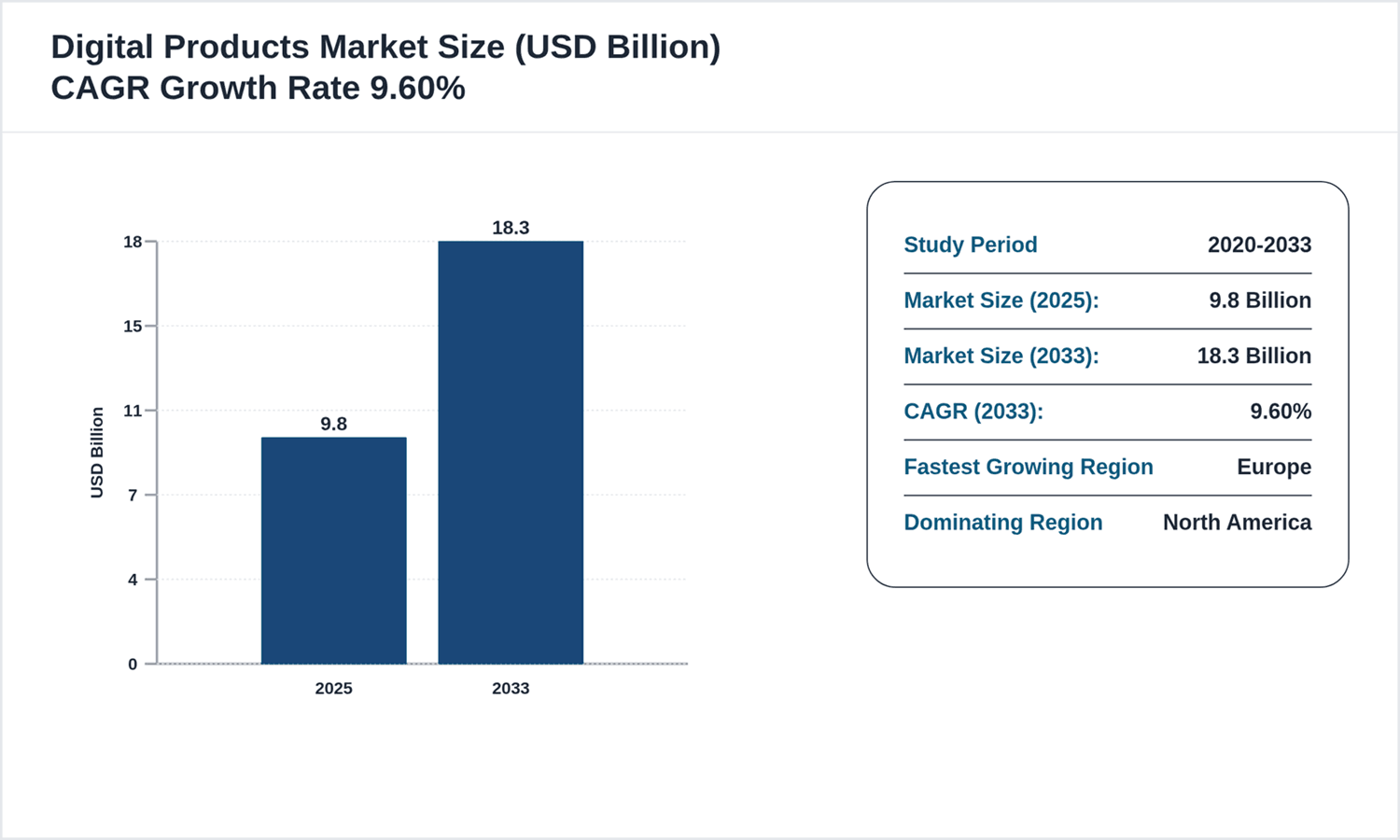
Transaction volumes for digital products grew nearly 70% between 2022 and 2024. That growth is not theoretical — it shows up in real seller revenue on Etsy, Gumroad, and Creative Market every month.
Once a digital product file exists, selling it 1,000 times costs the same as selling it once. That is the core advantage physical product businesses can never fully replicate.
The 7 Types of Faceless Digital Products Worth Knowing
Not all digital products perform equally. Here are the top 7 categories that actually move volume for faceless sellers, along with what makes each work.
1. Canva Templates
Canva has over 170 million users. A meaningful share of those users want professional-looking designs — for Instagram posts, lead magnets, pitch decks, resumes — but lack design skills. Templates fill that gap.
The faceless advantage is significant here. You design once in Canva, upload the shareable link as a product, and the buyer edits their copy themselves. No handholding required. Templates priced between $7 and $27 tend to sell well on Etsy and Creative Market. Bundles of 20 to 50 templates at $37 to $67 generate stronger revenue per transaction.
Faceless Instagram accounts in the “small business tips” and “content creator tools” niches promote these bundles constantly — posting before-and-after template examples, static carousels, or text-based reels, all without showing a face. Gumroad links in the bio or a Stan Store page handle checkout. The most competitive subcategories right now are Instagram content templates for coaches and service businesses, digital planner templates, and media kit templates.
2. Printable Digital Products
Printables are PDF files that the buyer downloads and prints themselves. Planners, habit trackers, budget sheets, affirmation cards, wall art, and educational worksheets all fall here.
Etsy is the primary marketplace. Sellers report that low price points ($2 to $5 per printable) with strong search volume can generate significant passive volume, while premium planner bundles in the $15 to $35 range convert better when the listing includes strong preview images. The key insight most guides skip: your Etsy listing photos do more selling than your product description. A well-photographed mockup of a planner on a desk outperforms a generic product screenshot every time.
Many printable sellers also run faceless Pinterest accounts and faceless Instagram pages — posting styled product mockups, aesthetic flat-lays, and niche content — to drive external traffic to their Etsy stores. The account never shows the seller. The product imagery does all the work.
3. Ebooks and Guides
An ebook is not a book. That distinction matters. A faceless ebook product is typically a 15 to 50-page focused guide on a specific problem. Think “30-Day Instagram Growth Checklist for Service Businesses” rather than a 300-page comprehensive manual.
These sell across Gumroad, Payhip, and Etsy. Gumroad is particularly strong for this format — the platform lets you set a “pay what you want” pricing model, which lowers the barrier for first-time buyers and often results in buyers paying above the minimum. Ebooks also work well as lead magnets — offered free in exchange for an email address, then monetized through a back-end product or email sequence. The faceless creator angle: You do not need credentials to write about a topic you have researched thoroughly. The product speaks for itself.
4. Notion Templates
Notion has carved out a dedicated user base among productivity-focused creators, students, and small teams. Templates for project management, content calendars, personal finance tracking, and habit systems sell consistently on Gumroad and on dedicated storefronts.
Notion templates are genuinely low effort to build once you understand the platform. A useful personal finance dashboard that took 4 hours to create can sell for $15 to $27 indefinitely. Faceless creators promote these on Threads — posting short productivity tips, Notion hacks, and workflow screenshots — with a Gumroad link in their bio. No face required, just useful text-based content. The caveat: competition has increased substantially since 2022. Differentiation through strong design and a specific audience (e.g., “Notion templates for freelance designers”) now matters more than it did.
5. PLR Products (Private Label Rights)
PLR is a licensing model where you purchase content — an ebook, course, social media template pack, or worksheet — and receive the right to modify it, rebrand it, and sell it as your own. You can change the title, add your logo, rewrite sections, and publish under your own brand name.
PLR is ideal for beginners who want to launch quickly without creating a product from scratch. The risk is saturation: many buyers receive the same PLR file, which means identical products circulate on the market. The solution is to actually customize the content meaningfully rather than resell it unchanged. Many PLR sellers use Gumroad as their storefront and Instagram or Threads as their traffic engine — posting niche value content that positions them as knowledgeable, then directing followers to their product page.
6. MRR Products (Master Resell Rights)
MRR differs from PLR in one important way. With MRR, you purchase a product and the right to resell it — but you cannot modify or rebrand the content. The product stays as-is. Buyers of your MRR product can also resell it under the same terms.
MRR works best for speed. If you want to start selling immediately and do not need brand differentiation, MRR products offer a fast entry point. Search Instagram or Threads for “digital products” and a significant portion of what you find are faceless accounts selling MRR courses and bundles — using text slides, mockup images, and automated DM funnels to drive buyers to a Gumroad or Stan Store checkout page.
The trade-off is that you are selling identical content to what many other resellers are offering, which puts pricing pressure on margins and makes it harder to build a distinct brand. The best approach, experienced faceless sellers recommend, is to use MRR for early cash flow and then invest that revenue into creating your own original products.
7. AI-Generated Digital Products
AI tools have opened a new category entirely. Faceless creators now sell AI-generated stock illustrations, prompt libraries (collections of tested ChatGPT or Midjourney prompts), AI-written ebook templates, and automated content workflows.
This is the fastest-moving space and the least stable. Quality standards on platforms like Etsy for AI-generated art have become more selective, and buyers are increasingly savvy about distinguishing AI-generated from human-created work. The opportunity is real, but longevity requires adding human curation and context to what AI generates — not simply dumping raw outputs into a listing.
Where to Sell Faceless Digital Products
Platform choice shapes your entire strategy. Each option below serves a different purpose — some are storefronts, others are marketplaces, and some do both. You do not need all of them. You need the right combination for where you are starting.
1. Etsy
Etsy is the highest-traffic starting point for printables and templates. You benefit from existing buyer search traffic without building an audience. The downside is fees — a 6.5% transaction fee plus listing fees — and increasing competition in popular categories. Etsy works best when your product photography is strong, your titles are keyword-optimized, and you are selling in a specific sub-niche rather than a generic one.
2. Gumroad
Gumroad deserves more attention than most beginner guides give it. It is a direct-to-buyer storefront where you control your product page, pricing, and the post-purchase experience. Setup takes under an hour. Gumroad handles payment processing, file delivery, and basic customer emails automatically.
What makes Gumroad particularly powerful for faceless sellers is its built-in audience discovery feature. Gumroad’s own “Discover” feed surfaces products to buyers browsing the platform, giving you a second traffic channel alongside whatever you build externally. The platform also supports email list building natively — every buyer who purchases from your Gumroad store can be added to your list. For ebooks, Notion templates, guides, and digital bundles, Gumroad is the best combination of simplicity and control available at zero upfront cost. The platform charges a flat 10% fee on sales on the free plan, dropping to around 5% on the paid plan at $10/month.
3. Payhip
Payhip is a Gumroad alternative with a generous free plan and 0% transaction fees on the Plus and Pro paid tiers. It includes affiliate marketing tools built in from day one, which matters when you want others to sell your products for a commission. Payhip also supports memberships and online courses alongside standard digital downloads, making it a strong choice if you plan to expand your product line over time.
4. Stan Store
Stan Store is the go-to link-in-bio storefront for faceless Instagram and TikTok creators. It replaces the standard link-in-bio page with a mini storefront where followers can browse and buy your digital products without leaving a mobile browsing flow. For faceless Instagram accounts driving traffic from Reels or carousel posts, Stan Store removes the friction of sending a follower from a post to a bio link to an external checkout. The entire purchase can happen in under 60 seconds on mobile.
5. Beacons
Beacons functions similarly to Stan Store — a link-in-bio page that doubles as a product storefront. It is more flexible in terms of page design and is popular among faceless Threads and Instagram creators who want to display multiple products, a newsletter signup, and external links all in one place. The free plan is usable but limited; paid plans start at $10/month.
6. Creative Market
Creative Market is the right home for high-quality design assets: fonts, graphic templates, UI kits, Canva template packs, and illustration sets. The audience is professional designers and marketers willing to pay premium prices. Entry standards are higher — Creative Market reviews products before approval — but average order values are significantly higher than Etsy, and buyers are less price-sensitive.
7. WordPress and Shopify
These platforms give you full control over your digital storefront with your own domain and brand. It makes sense once you have 10 or more products and want to build long-term brand equity. The startup cost (from $29/month plus a digital delivery app like Sky Pilot or FetchApp) and setup time are higher than the other options, but you own the customer relationship completely. No marketplace fees, no algorithm dependence.
The honest starting recommendation:
Etsy plus Gumroad.
Etsy brings search-driven traffic from buyers already looking to spend money. Gumroad gives you a direct customer relationship, email list control, and a storefront you fully own. Many experienced faceless sellers run both simultaneously within their first 3 months.
How to Drive Traffic Without Showing Your Face
Having a product and a storefront is not enough. Traffic is where most beginners stall. The good news is that every major social platform has a faceless-friendly format if you know which one to use.
Instagram for Faceless Digital Product Sellers
Instagram is the single most active platform for faceless digital product businesses right now. Search “digital products” or “Canva templates” on Instagram, and you will find hundreds of accounts with 10,000 to 200,000 followers, all running entirely without showing a face.
The formats that work for faceless Instagram accounts are specific. Text-based carousel posts — slides with tips, frameworks, or listicles — perform consistently because they are saveable and shareable without requiring video production. Static product mockup posts show your templates or printables in a lifestyle context. Reels created with screen recordings, stock footage, or text animations drive significant reach without any on-camera presence.
The strategy that converts best on Instagram is to post niche value content — tips your target buyer actually needs — with your Gumroad link or Stan Store in the bio. Every 4 to 5 value posts, add a soft product mention: “I put this into a full template pack — link in bio.” That ratio keeps followers engaged without constantly feeling sold to.
Faceless Instagram accounts in the digital products space commonly use a consistent color palette, a brand-name username (not their personal name), and a bio that describes the niche value they deliver. The account feels like a brand, not a person.
Instagram Threads for Faceless Content Marketing
Threads is underused and underrated for faceless digital product marketing in 2026. The platform rewards text-based value posts — short, punchy observations, practical tips, and opinion takes — which are exactly what a faceless brand can produce without any design tools or video equipment.
The mechanism is straightforward. You post 3 to 5 short Threads per day in your niche. Some of those posts mention your product or link to your Gumroad store. Because Threads distributes content algorithmically rather than only to followers, new accounts can reach thousands of readers within days of posting — something that takes months on Instagram.
Threads also integrates directly with Instagram. Your Instagram followers can find your Threads account automatically, giving an established, faceless Instagram page a head start when launching on Threads. For text-heavy products like ebooks, guides, and prompt libraries, Threads is one of the fastest-growing free traffic sources available to faceless sellers right now.
Pinterest for Long-Term Evergreen Traffic
Pinterest functions as a visual search engine, not a social feed. Pins you create today can drive traffic 12 to 24 months from now. You never need to show your face, post on a consistent daily schedule, or build a following in the traditional sense.
For faceless digital product sellers, Pinterest works by creating pins that link directly to your Etsy listings, Gumroad product pages, or blog posts. Each pin is essentially a search-indexed visual ad for your product. A library of 200 to 500 well-designed pins across a niche builds compounding organic traffic over time.
The faceless advantage on Pinterest is total. Product mockup images, quote graphics, tip carousels, and infographics all perform well, none of which require a face or personal identity. Pinterest is the primary free traffic strategy most experienced faceless Etsy sellers rely on once their stores are past the initial setup phase.
TikTok for Viral Product Discovery
TikTok’s algorithm prioritizes content engagement over creator follower count, which makes it genuinely accessible for new faceless accounts. Faceless TikTok content in the digital products niche typically uses screen recordings of Canva or Notion workflows, text-on-screen tips with voiceover (using AI-generated or anonymous voice), or aesthetic product showcase videos.
The platform’s short attention span rewards hooks — the first 2 seconds of a video determine whether it gets shown to more viewers. A faceless TikTok account that consistently posts 15 to 30-second product tip videos can grow to 10,000 to 50,000 followers in 3 to 6 months in a mid-competition niche.
TikTok Shop has also become a relevant sales channel for digital products in markets where it is available. Sellers list digital products directly on TikTok Shop and fulfill orders through automated delivery — another zero-face-required income layer.
Email Marketing as the Traffic You Own
Every other traffic source listed above depends on a platform you do not control. Instagram can reduce your reach. Etsy can change its algorithm. TikTok can get banned in certain markets. Your email list is the one audience asset you own outright.
A list of even 300 to 500 engaged subscribers — people who downloaded a free lead magnet from your Gumroad page or signed up from your Instagram bio — is worth more than 10,000 social media followers who never check their feed. A new product launch emailed to 500 engaged buyers converts at 2 to 5 times the rate of cold social traffic.
Building an email list from day one is not optional if you are serious about this business. Gumroad, Payhip, and most storefronts integrate with email platforms like ConvertKit (now Kit), MailerLite, and Mailchimp. Set up a simple free product — a template sampler, a mini guide, a checklist — as a lead magnet, link it from your Instagram bio, Threads profile, and Pinterest pins, and collect emails from the start.
How Faceless Digital Products Generate Passive Income
“Passive income” is used carelessly in most online content. Here is what it actually looks like in a digital products business.
The income is passive at the transaction level, not at the business level. You still have to create products, write listings, drive traffic, and update your store. What becomes passive is the individual sale: no fulfillment, no customer hand-holding, no physical delivery. A buyer finds your Gumroad page from a Threads post at 2 am, pays, receives the file automatically, and you wake up to a sale notification.
The mechanism that enables this is digital delivery automation. Platforms like Etsy, Gumroad, and Payhip handle payment processing and file delivery without your involvement in each transaction. A product created once can generate revenue for years.
What separates consistent earners from people who make $12 and give up is volume and iteration. Sellers who build a library of 20 to 50 products across a focused niche report far more stable monthly income than those with 2 or 3 products. Each additional product becomes a new entry point for buyers. Some products will underperform. Others will carry your entire store.
The income ceiling is also genuinely uncapped in ways a service business is not. You cannot bill more hours than you have. But a digital product file has no such constraint. The 50th sale costs you nothing more than the 1st.
The Business Model Behind a Faceless Digital Product Store
Understanding the full flow helps you see how everything connects.
You create a product (or license one via PLR or MRR). You list it on Etsy, Gumroad, or both. Traffic arrives from Etsy’s organic search, Pinterest pins, Instagram posts, Threads content, or email broadcasts. A buyer finds the listing, pays, and receives the file automatically.
From that transaction, you keep the revenue minus platform fees. There is no cost of goods sold. Every sale after the initial creation cost is near-pure margin.
The model becomes more powerful with a digital product sales funnel. A free lead magnet hosted on Gumroad — a smaller version of your main product — captures email addresses. Your email sequence introduces buyers to your paid products with context and trust already established. Repeat buyers convert at significantly higher rates than cold social traffic. This is why email marketing consistently outperforms every other channel for digital product sellers.
Affiliate marketing layers on top cleanly. Gumroad and Payhip both have built-in affiliate program tools. You set a commission rate — typically 20 to 40% for digital products — and affiliates promote your products to their Instagram, Threads, or email audiences. In a faceless business, affiliates effectively do the audience-building you are choosing not to do yourself, and you only pay them when they generate a sale.
What Most Beginners Get Wrong in the Digital Product Business
Here is where most content about this space falls short — either from inexperience or from incentive to oversell the opportunity.
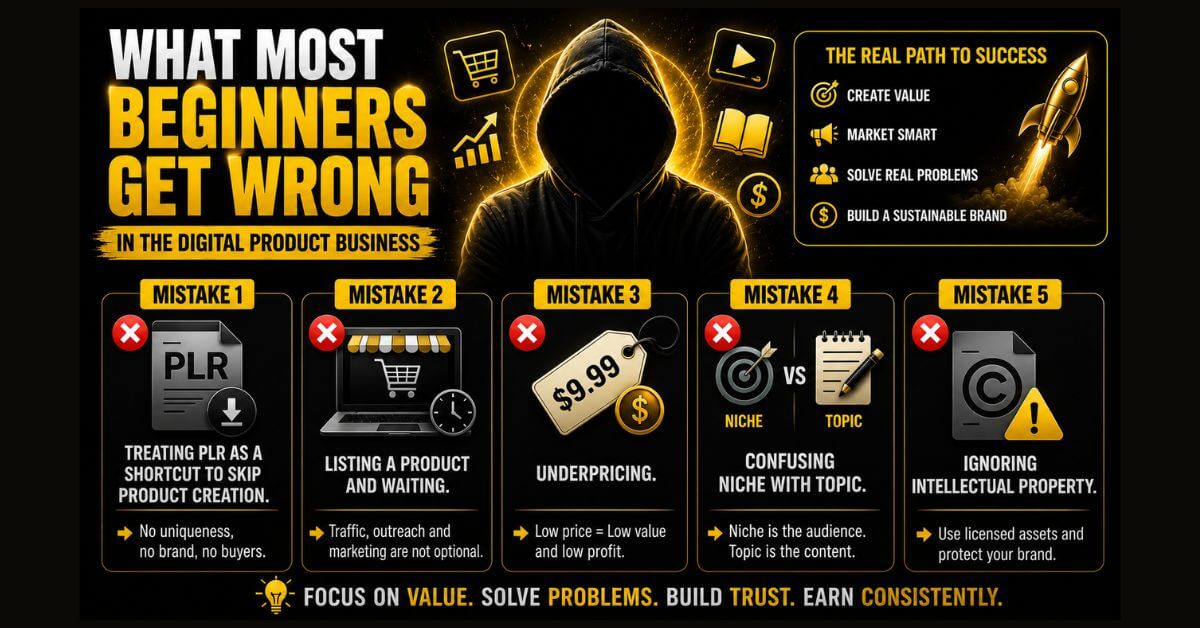
Mistake 1: Treating PLR as a shortcut to skip product creation.
PLR saves time, but selling unmodified PLR files means competing with every other buyer of the same file. The sellers who build real income with PLR customize it substantively: new cover, rewritten sections, updated examples, and renamed product. That takes work.
Mistake 2: Listing a product and waiting.
Marketplaces like Etsy have millions of listings. A new listing with no reviews and no external traffic is invisible. You need a traffic strategy from day one. Posting on Instagram or Threads costs nothing. Creating Pinterest pins costs nothing. Offering a free Gumroad lead magnet to build your email list costs nothing. These are not optional extras — they are the difference between 0 sales and 30 sales in your first month.
Mistake 3: Underpricing.
A $2 printable needs to sell 500 copies to match what a $27 template bundle needs to sell 37 times. Beginners almost universally underprice. The instinct is to compete on price. The reality is that higher-priced products attract more serious buyers, receive fewer refund requests, and generate more revenue per unit of traffic.
Mistake 4: Confusing niche with topic.
“Planners” is not a niche. “Planners for homeschool parents with multiple children” is a niche. The more specifically your product solves one person’s one problem, the easier it is to find that person — whether through an Etsy search, a Threads post, or an Instagram Reel.
Mistake 5: Ignoring intellectual property.
AI-generated images, stock photos used without the right license, and PLR content used outside its license terms can all create legal problems. Always read the license for any asset you use in a product you plan to sell.
Faceless Brand Building Without a Personal Brand
You do not need a face, but you do need a brand. These are different things.
A faceless brand is built around a visual identity, a consistent voice, a named store or product line, and a clear value proposition. Think of Canva template shops on Etsy with a recognizable aesthetic and a store name, or a Gumroad creator page with consistent product cover designs and a defined content niche. The buyer does not know who runs it — but they trust the quality because it is consistent across every touchpoint.
Practically, faceless brand building means choosing a store or account name that reflects your niche rather than your personal name, using consistent colors and fonts across your product previews and social content, and building a reputation through product quality and review accumulation over time.
Your Instagram and Threads accounts are extensions of this brand identity. The same color palette used on your Gumroad product covers should also appear in your Instagram posts. The same voice that writes your product descriptions should write your Threads posts. Consistency signals professionalism without requiring you to be personally visible.
Pinterest remains one of the most powerful long-game tools for faceless brand building. Pins you create today drive traffic for the next 18 months. You never need to show your face, record a video, or post on a daily schedule. A library of well-designed pins pointing to your Etsy listings and Gumroad pages compounds quietly in the background while your Instagram and Threads accounts build social proof.
Email list building is the final layer. Even 300 to 500 engaged subscribers who downloaded a free product from your Gumroad page are a more valuable asset than 5,000 Instagram followers who passively scroll. Every new product launch sent to a warm email list generates immediate revenue — no waiting for algorithm reach.
How to Validate a Product Idea Before Creating It
This is the step most beginners skip — and it is why most beginner products do not sell.
Validation is not asking friends if they would buy something. It is checking whether real buyers are already searching for and spending money on a version of what you plan to create.
For Etsy, use the platform’s own search bar. Products with hundreds or thousands of reviews confirm the market exists. Products with strong sales and weak listing photos or descriptions reveal a gap you can exploit with better execution.
For Gumroad, search creators in your niche. Many publish their sales numbers publicly on their Gumroad profile page, which gives you a real picture of demand without guesswork. If a creator selling a similar product in your niche has made 400 sales on Gumroad, the audience exists and is willing to pay.
On Instagram and Threads, check whether accounts in your niche are posting about the problem your product solves — and whether those posts generate saves, comments, or shares. High engagement on a problem post tells you the audience cares about the topic. That is a strong signal that your product will find buyers.
Google Trends can show you whether interest in your product category is rising or falling. A declining trend is not necessarily a dealbreaker — niches with steady, consistent interest can sustain a product library indefinitely — but a rising trend gives you a tailwind.
The fastest validation of all: build a minimum version of your product, list it on Gumroad for free or $1, post about it once on Instagram or Threads, and see whether anyone downloads it within 72 hours. If they do, the concept has real-world demand. If it gets no traction, adjust the product or the positioning before investing more time in it.
Faceless Digital Products vs. Other Online Business Models
People often compare this model to affiliate marketing, dropshipping, and content creation. Here is an honest comparison.
Faceless Digital Products vs. Affiliate Marketing:
Affiliate marketing requires traffic, which usually requires content creation — blog posts, YouTube videos, or social media posts. The upside is that you do not create the product. The downside is that you earn a commission percentage, not the full sale price. Faceless digital products pay you 100% of the sale minus platform fees. The combination of both — running an Instagram or Threads account that promotes affiliate products alongside your own Gumroad products — is common and logical for faceless creators.
Faceless Digital Products vs. Dropshipping:
Dropshipping involves physical products with logistics, supplier management, and customer service complexity. Margins are typically 15 to 30% versus 80 to 95% for digital products. Digital products win on simplicity and margin every time.
Faceless Digital Products vs. Content Creation (Personal Brand on YouTube, TikTok, or Instagram):
Building a personal brand channel can generate substantial income, but it requires consistent on-camera presence, video production, and platform algorithm dependency. Faceless digital products operate independently of any single platform. Your Gumroad store and email list do not disappear if Instagram changes its algorithm or TikTok gets restricted in your market.
The model that consistently makes sense for privacy-focused creators who want income without audience-building is faceless digital products — specifically, starting with a productized niche listed on Etsy and Gumroad, driving early traffic from Instagram, Threads, or Pinterest, and building an email list from day one.
A Realistic Income Timeline for Faceless Digital Products Business
Setting expectations correctly saves you from abandoning something that would have worked.
Month 1 to 3: You are creating products, setting up Gumroad or Etsy, optimizing listings, and posting early content on Instagram or Threads. Revenue is minimal to zero. This is normal. The exception is creators who start with MRR products and list immediately — even then, the first few months rarely cover more than platform fees.
Month 3 to 6: With 10 to 20 products listed, a growing Instagram or Threads presence, and consistent Pinterest pins pointing to your listings, income in the $50 to $300/month range is realistic. Individual results vary significantly based on niche competition, product quality, and how actively you drive traffic.
Month 6 to 12: Sellers who treat this as a business — iterating on products, building their email list via a Gumroad lead magnet, posting consistently on Instagram or Threads — commonly report $500 to $2,000/month. Some exceed this significantly in high-demand niches.
Year 2 and beyond: With a catalog of 50 or more products, an email list built through Gumroad or Payhip, established Etsy store reviews, and a faceless Instagram or Threads following, the business generates income with significantly less active work per dollar earned. This is the phase where “passive” becomes accurate.
These numbers are grounded in what real Etsy and Gumroad sellers share publicly. They are not guarantees. Niche selection, product quality, and consistent effort over a 6 to 12-month window are the variables that determine which side of the range you land on.
Getting Started: The Practical First Steps
The best entry point depends on what you are willing to invest — time or money.
If you have more time than money:
Create your first original product. Choose one problem your target buyer has. Build a focused solution in Canva, Notion, or as a PDF.
List it on Etsy with keyword-optimized titles and mockup images. Host a free version on Gumroad as a lead magnet to start building your email list. Create a faceless Instagram account or Threads profile in your niche and post 3 times per week with a link to your Gumroad page in the bio. Repeat with a second product within 2 weeks.
If you have more money than time:
Purchase a quality PLR product in your niche (budget $20 to $80 for a reputable source). Customize it substantively — rewrite the introduction, update the examples, replace the cover design using Canva.
List it on Gumroad as your primary storefront and on Etsy for search traffic. Set up a Stan Store or Beacons page for your Instagram bio. Reinvest early revenue into creating original products.
Either way, the priority sequence is: create or source a product, list it on Gumroad and Etsy, set up a faceless Instagram or Threads account, drive initial traffic, collect your first reviews and email subscribers, then expand your catalog.
Every other tactic is secondary until those fundamentals are working.
If you want to explore how to build your first digital product from scratch — including which tools to use and how to price it correctly — the next step is building your first product with the right tools.
FAQ
Q: What are faceless digital products, exactly?
A: They are downloadable digital files — templates, ebooks, printables, courses, or licensed content — sold online without the seller appearing on camera or building a personal brand. Sellers commonly use storefronts like Gumroad, Etsy, or Payhip, and drive traffic through faceless Instagram pages, Threads accounts, and Pinterest without ever revealing their identity.
Q: Can you really make passive income with digital products, or is that overhyped?
A: The income is passive at the transaction level — once a product is listed on Gumroad or Etsy and a buyer finds it, delivery is fully automatic. What is not passive is building and maintaining the business. Creating products, posting on Instagram or Threads, optimizing listings, and growing your email list require real, ongoing effort, particularly in the first 6 to 12 months.
Q: What is the difference between PLR and MRR digital products?
A: PLR (Private Label Rights) lets you buy a digital product, modify it, rebrand it, and sell it as your own creation. MRR (Master Resell Rights) lets you resell the product as-is and pass on the resell rights to buyers, but you cannot edit or rebrand the content. PLR gives you more creative control and brand-building potential. MRR gets you to market on Gumroad or Instagram faster.
Q: Do I need an audience to sell faceless digital products?
A: No. Marketplaces like Etsy and Creative Market have built-in search traffic, so buyers can find your products without you having a following. Gumroad’s Discover feed also surfaces products to browsing buyers. Pinterest generates evergreen traffic without requiring a personal audience. An Instagram or Threads account helps, but is not required to make your first sales.
Q: Which platforms are best for selling digital products without showing your face?
A: Gumroad is the best all-around starting point for direct sales, email list building, and storefront control. Etsy is the best for search-driven traffic on printables and templates. Payhip works well if you want built-in affiliate tools. Stan Store or Beacons is the right choice if your primary traffic comes from Instagram or Threads. Creative Market suits premium design assets. Shopify makes sense once you have multiple products and want full brand control.
Q: How do Instagram and Threads fit into a faceless digital product business?
A: Both platforms drive traffic to your Gumroad or Etsy storefront without requiring you to show your face. Faceless Instagram accounts use text-based carousels, product mockup posts, and screen-recording Reels to build a niche following. Threads rewards short, punchy value posts that reach new readers algorithmically. Both link to your product storefront in the bio. Used together, they form the most accessible free traffic stack for a beginner faceless seller.
Q: How many products do I need to make a consistent income from a faceless digital product store?
A: Sellers consistently report more stable monthly income starting around 20 to 30 products in a focused niche. A catalog of 50 or more products provides multiple entry points for buyers and reduces dependence on any single listing. Each product is also another piece of content you can post about on Instagram, Threads, or Pinterest — expanding your traffic surface area simultaneously. However, you can start a faceless digital products business with a single impactful product and scale later.
Q: Is faceless digital product selling saturated?
A: Generic subcategories — basic Canva social media templates, unmodified PLR ebooks — face real competition. Specific niches within those categories remain far less crowded. A Canva template pack for occupational therapy practices or a Notion system for freelance photographers has a fraction of the competing listings of a generic “Instagram template.” Specificity is the antidote to saturation, both in the product you create and in the Instagram or Threads niche you post in.
Ready to go deeper? Learn how to price your digital products correctly and how to set up your first Gumroad storefront to start collecting revenue this week.
