
How to Start a Skool Community and Make Your First $1,000

How to Start a Skool Community and Make Your First $1,000
Dion Kameron charges $40/month for her Skool community teaching Canva design skills to enthusiasts. You found it last week. 97 paying members. That’s $3880 in monthly recurring revenue. No viral moment. No massive following. Just a clear offer, a simple setup, and the decision to start.
That gap is not talent. It is not even time. It is one structural decision she made, and one you have not yet made.
You also have real knowledge. You have spent years developing a skill, solving a problem, or building something that other people genuinely want to learn. But when you look at your monthly income, it does not reflect any of that. Meanwhile, creators with a fraction of your expertise are running paid communities, charging $9 to $199 per month, and doing it on a platform most people only heard about two years ago.
That platform is Skool. And the reason it keeps showing up in your feed is not hype. It is because the model works when it is set up correctly. Knowing how to start a Skool community is not the hard part. Thousands of guides will walk you through clicking the right buttons. The hard part is knowing which decisions actually determine whether you hit $1,000 in 90 days or spend countless hours building a community nobody joins.
This guide focuses on exactly that. By the time you finish, you will have a validated niche, a founding member offer with a price that makes sense, a pre-launch sequence you can run this week, and a step-by-step path to your first $1,000 in monthly recurring revenue.
Every section is grounded in how Skool actually works in 2026, what separates the communities that compound from the ones that stall at 8 members, and the specific mistakes that kill paid communities before they get traction.
What Skool Is and Why It Is Built for Monetization
Skool is a paid community platform that puts a course library, a discussion feed, a member directory, a live event calendar, and a gamification layer inside a single product. For a member, it feels like a private social network built around a shared goal. For an owner, it functions as a membership site, course host, and community manager without the duct tape.
That distinction matters. Most course platforms give you a course library and an awkward forum bolt-on. Most community platforms give you a discussion feed and no place to put your content. Skool builds both from the same foundation. There are no Zapier integrations holding the two pieces together. You set a price, connect a bank account, and your community is live.
How does it compare to Facebook Groups?
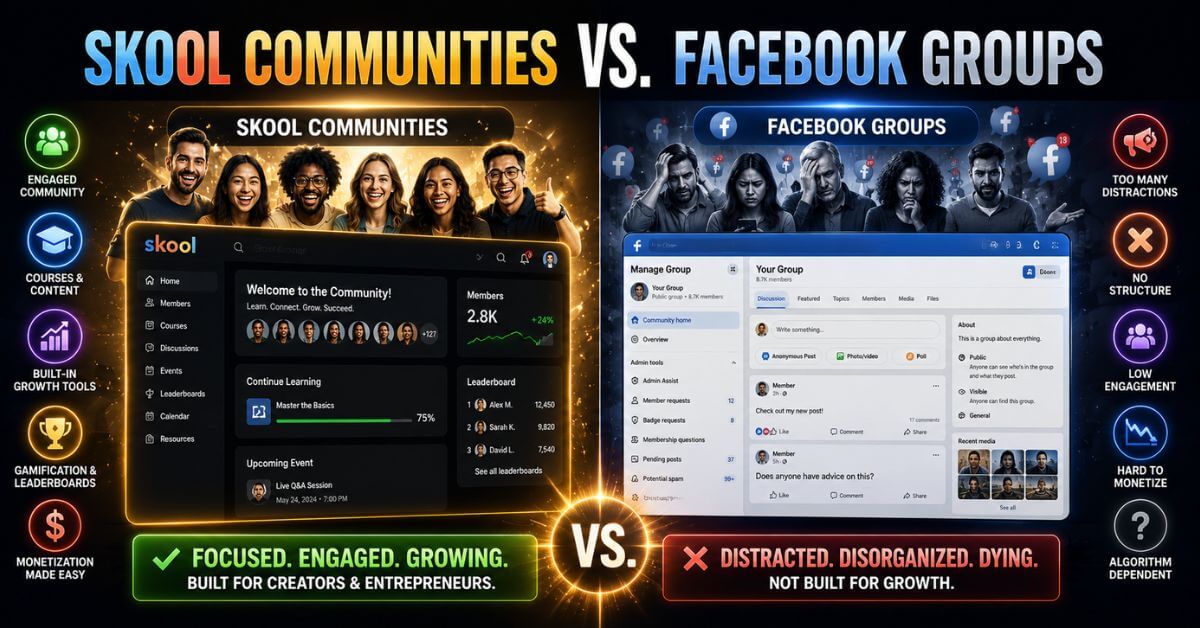
The differences are not cosmetic. Facebook Groups run on Facebook’s algorithm, which means your posts compete with your members’ family photos, political content, and ads. You have no ownership of the audience, no built-in payment layer, and no course hosting. Discoverability inside Facebook is limited to Facebook’s internal search. Skool communities appear in its public Discover feed, which functions as a real acquisition channel. Members earn points for posts, comments, and completions. Those points power a leaderboard that visibly rewards the most engaged people in your group. That gamification element is not decoration. According to the CMX Community Industry Report, communities using gamification retain more members than communities without it.
Skool is built for coaches, consultants, freelancers, digital creators, and agency owners. A fitness coach uses it to host workout programs alongside a community where members post their check-ins. A copywriter uses it to run a group coaching program for SaaS founders. A Canva template creator uses it as a membership where new packs drop monthly. A freelance recruiter uses it to teach sourcing skills to other recruiters. If the business model is “people pay me regularly to get better at something,” Skool is the platform.
As of June 2026, Skool hosts over 200,000 communities and more than 25 million users, and those numbers are growing. That scale means Skool’s Discover section is a real source of organic traffic for public communities. No equivalent exists on Circle, Discord, or Mighty Networks.
Can You Realistically Make $1,000 Per Month on Skool?
Yes. $1,000 per month is one of the more achievable first milestones in the online business space, and Skool’s recurring subscription model is one of the cleaner paths to it.
Here is the math across 5 realistic scenarios, including two that most guides ignore.
Scenario 1: Free community with a paid upgrade tier
You charge $0 to join the base community and $29 to $49/month for a locked premium tier inside the same Skool group. The free tier functions as a top-of-funnel list builder. The paid tier is where the real value lives: weekly calls, course modules, templates, and direct access to you.
This model works exceptionally well in niches where trust is the primary barrier to purchase. Fitness, personal development, beginner investing, and hobby niches all fit this pattern because their audiences are enormous, cost-sensitive, and need to see value before committing. A beginner guitar community might offer free chord lessons and community access at the base level, then charge $29/month for structured lesson plans, tab libraries, and a weekly group practice call. The free tier fills fast because the barrier is zero. Conversion to paid runs between 3 and 8% of free members when the upgrade offer is specific and the free tier genuinely delivers value without giving everything away.
The honest trade-off: free communities attract a lot of people who will never pay. You will have 300 free members and 15 paying ones, and you will spend real time moderating and engaging people who generate no revenue. The model only makes financial sense if your free-to-paid conversion rate is high enough to justify the overhead, or if you treat the free tier purely as a lead list and keep your engagement energy pointed at paid members. Run the numbers before choosing this structure: 15 paid members at $49/month is $735. That is below $1,000. You need either a higher conversion rate, a higher price, or a larger free base to make this scenario hit the target.
Scenario 2: Ultra-low ticket, mass audience ($5 to $17/month)
You charge $9/month. You need 112 paying members to clear $1,000 before fees. At $17/month, that drops to 59. These numbers look manageable until you do the acquisition math: at a 2% conversion rate, a paid community of 112 members requires roughly 5,600 people seeing your offer. Without an existing audience of at least 10,000 engaged followers, this scenario is a slow grind that rarely pays off.
This model is only viable in specific conditions: niches where the audience is genuinely mass-market (fitness motivation, journaling, personal development, beginner guitar), where competing paid alternatives are priced similarly low, and where the founder already has significant organic reach. A journaling community charging $7/month works if you have 50,000 TikTok followers who already trust you. It does not work if you are starting from zero. The other constraint is psychological: at $9/month, most founders lose motivation before they hit breakeven because the revenue per hour of effort is punishing. If you are considering this tier because you are afraid to charge more, that is the wrong reason. If you are considering it because your niche genuinely cannot support higher prices, see Scenario 4 below for a more sustainable version of the same model.
Scenario 3: Low-ticket, higher volume
You charge $29/month. You need 35 paying members to hit $1,015 before fees. At a realistic 2 to 3% conversion rate from a warm audience or organic outreach, that requires 1,200 to 1,700 people seeing your offer across a 60 to 90-day launch period. This model works best for broad interest niches with large addressable communities.
Scenario 4: Mid-ticket, moderate volume
You charge $49/month. You need 21 members. This is where most new Skool creators land because the price is accessible enough to reduce friction but meaningful enough to signal real value. A creator with 3,000 to 5,000 engaged social followers, an email list, or an active presence in a niche subreddit can reach 21 paid members in 60 days with a founding member offer and direct outreach.
Scenario 5: Premium, low volume
You charge $97 to $149/month. You need 7 to 11 members. This works when the community delivers specific, measurable outcomes that justify the price point. A business coach helping agency owners add one client per month, or a recruiter teaching a skill worth $5,000 in salary increases, can charge here without a large audience. The requirement is a very clear promise and the ability to show proof.
The honest caveat: the variable that determines which scenario works for you is not the platform. It is niche demand, offer clarity, and your willingness to do outreach in week one. Skool does not generate members. It holds them. You bring the first 10.
Step 1: Choose a Niche That People Already Pay For
The most common mistake in choosing a niche for a Skool community is picking a topic you are passionate about instead of one that people have already proven they will pay for. Passion gives you energy. Market validation gives you members. You need the second one first.
There are 3 community types that consistently work on Skool, and each reaches revenue at a different speed.
1. Problem-solving communities
They are built around a specific pain point with a clear solution.
Examples:
- Freelancers who want to land higher-paying clients
- Online sellers who want to improve their Etsy conversion rate
- Parents who want a system for teaching kids to read before kindergarten
These communities reach revenue fastest because the buyer already knows they have the problem and is actively searching for the answer.
2. Skill-building communities
They are built around a craft or capability someone wants to develop.
Examples:
- Video editors learning color grading
- Virtual assistants building automation skills
- Bookkeepers learning to offer advisory services
These take slightly longer to monetize because the member needs to trust that your teaching works before committing monthly.
3. Outcome-based communities
These groups are built around a specific result with a defined endpoint or milestone.
Examples:
- A 90-day challenge to build a faceless YouTube channel to 1,000 subscribers
- A 60-day program to go from zero to first Gumroad sale
- A 12-week framework for solopreneurs to replace a salary
These are the most compelling for founding member offers and tend to convert at higher prices.
Before you commit to a niche, run it through this 4-question pass/fail test.
- Are people spending money on this problem or skill right now, in any format: courses, books, coaching, software?
- Can you identify 10 real people who would benefit from this community and could name them by username or platform?
- Can you describe the specific result a member gets in a single clear sentence without using the word “help”?
- Does a Skool community already exist in this niche? (Competition confirms demand. If one exists and has paying members, your niche is validated.)
If you answer no to any of the first 3, go narrower.
The specificity rule is the single most important insight in this section. A “freelancing” community competes with every freelancing blog, subreddit, Facebook group, and podcast on the internet. A “freelance copywriting for SaaS startups” community has a clear audience, a clear problem, and a clear reason why a member cannot just Google their way to the answer.
The narrower the niche, the smaller the pool of competitors and the larger the share of attention you command within it.
Step 2: Build an Offer Around One Specific Result
Here is the difference between a $9/month community and a $99/month community.
Imagine two Skool groups in the personal finance space. One promises “access to weekly finance tips, a Q&A call, and a library of resources.” The other promises “a 90-day system to eliminate your $10,000 credit card balance without cutting your lifestyle.” Both have 40 members. The first charges $9/month. The second charges $97/month. Same niche. Same founder, time commitment. Different offer architecture.
Information access is a commodity in 2026. Transformation is not.
The fastest way to build a profitable Skool community is to define the specific, measurable outcome a member reaches inside your community and make that outcome the thing you sell.
The Fast Track Offer Formula works like this: [Specific Person] + [Specific Problem] + [Specific Timeframe] + [Mechanism that makes it credible].
Applied to 3 niches:
Fitness: “A 12-week program for remote workers to build visible muscle without a gym membership, using 30-minute home workouts and a structured nutrition plan.” The mechanism: structured progressive overload principles adapted for bodyweight training.
Business/freelancing: “A 60-day cohort for new virtual assistants to land their first 3 clients at $1,500/month using LinkedIn outreach and a proposal template system.” The mechanism: the outreach sequence and proposal templates the founder used to build their own VA agency.
Creative/hobby: “A 30-day guided program for Canva designers to build and launch their first digital product shop on Gumroad, from zero products to first sale.” The mechanism: product templates, a pricing guide, and weekly feedback calls.
Before you launch, run your promise through 3 stress-test questions.
- Can you deliver this in the stated timeframe based on what you already know and can teach?
- Can you show any proof this approach has worked, even informally?
- Would you personally pay the price you are charging if you were the member?
If any answer is no, revise the offer before spending a minute on platform setup.
Step 3: Set Up Your Skool Community the Right Way
Platform plan decision
Skool offers 2 plans in 2026.
The Hobby plan costs $9/month and charges a 10% transaction fee on every sale. The Pro plan costs $99/month and charges a 2.9% transaction fee.
The break-even point between the two plans is approximately $1,300/month in community revenue. Below that, Hobby is the cheaper option. Above it, Pro becomes the better choice. Start on Hobby. Move to Pro when revenue consistently clears $1,200.
Naming your community
Clear beats clever every time. Benefit-driven beats descriptive. A name like “The Remote Worker Fitness Lab” tells a stranger exactly who it is for and what they do there. A name like “The Movement Collective” tells nobody anything.
Test your name with this question: if someone saw it on Skool’s Discover page with no other context, would they know if it was for them? If the answer requires reading the description first, rename it.
Weak name: “The Creator Circle.” Strong name: “Canva Product Lab: Build and Sell Digital Downloads.”
Five sections every Skool community needs at launch
The Classroom should have exactly one course on day one. Not a full curriculum. One starter course with 2 to 4 lessons that gets a new member a visible result within 48 hours. The purpose is to create early wins that make members feel like the investment was already worth it.
The community feed needs at least 3 seeded posts before your first member arrives. Write a welcome post, a poll asking members what they are working on, and a pinned resource post. A new member who sees an empty feed will not post first. They will lurk and then cancel.
The calendar should have one recurring weekly event from day one. A live Q&A call, a hot seat session, a group coaching call, or even a structured open office hour. One consistent weekly touchpoint does more for retention than 10 pieces of content. Members stay when they have a reason to show up at a specific time each week.
The leaderboard uses Skool’s built-in gamification to reward posts, comments, and course completions with points. Decide upfront what behaviors you want to reward and make sure your community rules make that clear. Members who reach a certain level can unlock a bonus resource, a private call, or recognition in the community feed.
The welcome post is the most important piece of content in your community. It should introduce new members, give them one specific action to take in their first 24 hours, and create a sense of accountability. Structure: who this community is for, what you will accomplish together, and “introduce yourself in the comments by answering: who are you, what are you working on, and what does success look like for you in 90 days?”
What not to set up at launch
The trap most Skool founders walk into is spending month one building the platform and month two wondering where the members are. Do not create 10 course modules before you have 10 members. Do not build a complete resource vault, a tiered membership structure, or an automated email welcome sequence before anyone has paid.
The only things that matter before launch are the one starter course, the seeded feed, the weekly event, and the founding member offer. Build everything else in response to what your members actually ask for.
Step 4: Create the Minimum Content That Members Need
The only content that matters at launch is content that gets a new member their first win within 48 hours. Everything else is optional in month one.
Most community founders create content for an empty room. They record 6 modules, build a resource library, write a private newsletter, and schedule daily posts before a single member has joined. Then they have no time left to actually get members. The 80/20 principle applied to community content means: 80% of retention comes from 20% of your content. Build that 20% first and only that.
There are 3 content assets to build before launch.
1. Quick start course:
One to 3 lessons maximum. Each lesson solves one specific problem. Total runtime: under 45 minutes. The goal is not comprehensive education. It is a fast win. A member who gets a result in their first 48 hours is a member who renews next month. Skool’s native video hosting supports automatic chapters and subtitles. Keep videos between 10 and 20 minutes. Upload them directly to the Classroom. No Vimeo account needed.
2. Resource starter pack:
Three to 5 templates or checklists that a member can use immediately. Not a library. A starter pack. The difference is psychological. A library implies something to browse later. A starter pack implies something to use today. Label them: “Start Here: Template 1,” “Start Here: Template 2,” and so on.
3. Weekly Q&A structure:
Decide the day, time, and format of your weekly live event before launch. Block it in the Skool calendar. Send a reminder post on the day of. The format can be as simple as open questions for 45 minutes with a screen share. The consistency of showing up at the same time every week does more for retention than any other single action you can take in months one and two.
Avoid these in month one: long course sequences that take weeks to complete, daily posting schedules that will burn you out before you hit 20 members, and extensive resource libraries that scatter member attention instead of directing it. Month one is for fast wins and founding member conversion. Everything else waits.
Step 5: Get Your First 10 Members Without Running Ads
Ads are the wrong first move. Not because they do not work. Because they require 3 things you do not have yet: proof that your offer converts, a clear message tested on a warm audience, and retargeting data to lower your cost per acquisition. Running ads in week one means paying to discover what free outreach would tell you for nothing.
The goal of your first 10 members is not revenue. It is validation. These 10 conversations will tell you whether your offer is priced correctly, whether the promise is clear, and whether the niche is narrow enough. That information is worth more than the money.
Here are 5 outreach channels that work for new communities, in order of typical conversion rate.
1. In-person or virtual networking
It converts at the highest rate because trust is already present. If you have attended any event, mastermind, or online conference in your niche, those contacts are warmer than any cold lead.
A direct message saying “I am launching a small paid community for [specific person] to [specific outcome] in [specific timeframe]. I am offering founding member pricing to 10 people who join this week. Would you want to see the details?” is not spam. It is a specific offer to a specific person who already knows you exist.
2. Existing email list or social following
If you have any list or social media following, even 200 people, this is your first outreach channel. The message is not “I built something, please buy it.” The message is “I am solving [specific problem] for [specific person]. I am looking for 10 people to join before I open it to the public at full price. Here is what is included.” Frame it as an opportunity with a closing date, not a product launch.
3. Direct messages to relevant people online
This works when done with specificity and zero spray-and-pray. Find someone in a niche community, subreddit, or LinkedIn group who has publicly described the exact problem your community solves. Acknowledge their specific situation first. Then offer the community as a potential solution. One sentence on what it is. One sentence on the founding member offer. A question. Not a sales pitch.
4. Facebook Groups and Reddit communities
Contribute genuine answers to real questions for 2 to 3 weeks before mentioning your community. When you have built a visible presence, one post sharing that you are launching a paid community and offering founding member pricing to group members will generate real interest. The contribution has to come first. A cold promotional post in an active community gets deleted, and gets you banned.
5. Adjacent creator partnerships
Find one creator in a complementary niche with an overlapping audience. Propose a simple arrangement: they mention your founding member’s offer to their audience, and you do the same in return. No money changes hands. The goal is a single warm introduction to their audience. For a new creator, one credible mention from a trusted source in your niche is worth 50 cold DMs.
Step 6: Launch With a Founding Member Offer
Founding member pricing works because early adopters accept less polish in exchange for a lower price and an identity. Being a founding member means you were there before it was obvious. That identity has real psychological value, and the lower price reflects the real trade-off: you are getting in before the curriculum is fully built, before the community has momentum, before the founder has polished everything. Both sides get something real.
Pre-launch waitlist (one week)
Before you open the community, create a simple waitlist. A Gumroad page, a Google Form, or a free community on Skool where interested people can sign up to be notified first.
Spend 5 to 7 days posting content in your niche on your primary platform (Instagram, Threads, Pinterest, LinkedIn, or wherever your audience already follows you). Each post speaks to the problem. None of them pitches the community directly.
The waitlist post at the end of the week says: “I am opening a paid community for [specific person] next [day]. First 10 members get founding member pricing. Get on the list here: [your Skool community link].”
Launch window (72 hours)
Shorter windows convert better than longer ones. A 30-day launch is a 30-day procrastination invitation. A 72-hour window creates real urgency without manufactured scarcity. Open on a Tuesday. Close on Thursday night. Tell your waitlist the clock is running.
The message to send to your waitlist on launch day
Keep it short.
“The community is open. Here is what is inside: [3 specific things]. Founding member pricing is [price]/month for the first 10 members, then it goes to [full price]. The window closes on Thursday at midnight. Join here: [link].”
No long copy. No benefit list. Clarity and a deadline.
What to do on day two if nobody has bought yet
Send a follow-up message to anyone on your waitlist who has not joined. Include one line of social proof if you have it, even informal proof: “One founding member just joined and already completed the quick start course.”
If you have zero sales in 24 hours, send 10 direct personal messages to people you identified during outreach. Not a copy-paste. One sentence acknowledging them by name, one sentence about the founding member offer, and one question.
Pricing tiers with context
$29 to $39/month is the right founding member price when your audience is beginners, your niche has a low average income, or you are testing price sensitivity before scaling. This tier works best for broad interest and hobby-adjacent niches.
$49 to $69/month fits communities where members have some income tied to the outcome (freelancers, side hustlers, early-stage business owners). The price signals seriousness without requiring proof of ROI upfront.
$97 to $149/month works for communities built around professional outcomes, business revenue, or skills that directly affect someone’s income. The member needs to believe the result is worth 10 to 20 times the subscription. This tier requires the clearest offer promise and the most compelling social proof.
Step 7: Keep Members So Revenue Compounds
Acquiring a new member costs 5 to 25 times more than keeping an existing one. The fastest path to $1,000/month and beyond is not more members, but fewer cancellations. Retention is the metric that turns $1,000 into $2,000 without a second launch.
The weekly engagement calendar as a system
Monday: Post a prompt that requires a specific answer. Not “how was your weekend?” but “What is the one thing you are working on this week, and what would make it a 10/10 success?” This creates accountability and gives you content for your weekly call.
Wednesday: Share one piece of content inside the community feed. A tip, a resource, a quick win. This does not have to be long. A 3-paragraph post applying one concept to a real example does more than a 2,000-word essay nobody reads.
Thursday or Friday: Weekly live call. 45 minutes. Open Q&A or a structured hot seat format. Record it and post the replay in the Classroom. Members who cannot attend live will watch the replay. Members who watch the replay stay longer than members who do not.
Running this calendar takes under 3 hours per week once the cadence is set. The consistency is the product. Members do not cancel communities where someone reliable shows up every week.
Three churn warning signs to watch
A member who was posting weekly goes quiet for 10 or more days. A member who stops attending the weekly call for 2 consecutive weeks. A member who posts a question and does not receive a response within 48 hours.
When you spot any of these, send a direct message inside Skool. Not a newsletter. A personal message. “Hey, noticed you have been quiet. What are you working on? Anything I can help with?” That message alone saves a significant percentage of at-risk members because it makes them feel seen, not just subscribed.
Step 8: Scale Past $1,000 Per Month
Do not attempt any of the following until you have held $1,000/month for 2 consecutive months. Premature scaling kills communities that were working. The community needs a stable foundation of engaged members and a proven retention rate before you add complexity.
Group coaching add-on
The highest-leverage, lowest-extra-work scaling move. Offer a 4-week intensive coaching layer at $297 to $497, open only to current community members. Six to eight members enrolled is $1,800 to $4,000 in additional revenue with no new audience required. The coaching uses the same frameworks you already teach in the community.
Paid challenge
A one-time, time-limited event with a specific start date, a defined outcome, and a price between $47 and $197. Challenges work because they generate bursty revenue, attract new members who then stay for the community, and reactivate dormant subscribers who need a reason to re-engage. Aim for 2 to 3 per year.
Premium course inside the community
Once you have 30 or more members and understand what questions repeat most often, build a standalone course addressing the most common sticking point. Price it as an add-on at $97 to $297. This creates a passive income layer on top of the subscription base.
Accountability pods
Small groups of 3 to 5 members paired together for a 4 to 8-week accountability sprint. These cost you 1 additional weekly touchpoint to run and dramatically improve retention because members become accountable to each other, not just to you.
Referral program
Once the community has 50 or more members and a clear result it delivers, a simple referral structure works. One free month for every member who brings in a paying referral. The community does the marketing as it matures.
Six Patterns That Kill Skool Communities
Most Skool communities that fail do not fail because of the wrong niche or wrong price. They fail because of one of these 6 patterns.
1. Over-building before launch
What it looks like: 8 value-packed course modules, a full resource library, and a branded welcome sequence, all complete before a single member has joined.
The symptom: launch day comes, and no one shows up because the founder spent outreach time building content.
The fix: 1 starter course, 1 seeded feed, 1 founding member offer. That is enough.
2. A vague offer promise that no one understands
What it looks like: the community page says “a place for creators to grow.”
The symptom: the Discover page gets clicks but no conversions because nobody can tell if it is for them.
The fix: rewrite the community description using the Fast Track Offer Formula. Specific person, specific problem, specific timeframe.
3. Pricing too low to sustain motivation
What it looks like: $9/month to test the market.
The symptom: 30 members, $270/month, and a founder who cannot justify the time investment and starts posting less.
The fix: price for the value you deliver, not the price you feel comfortable defending. $29 to $49/month for most communities is a more sustainable starting point.
4. Posting schedule burnout
What it looks like: the founder commits to daily content in week one. By week three, posts are sparse. By week six, the feed is quiet.
The symptom: members notice the absence and disengage.
The fix: 3 structured touchpoints per week beats 7 inconsistent ones every time.
5. No accountability loop for new members
What it looks like: a new member joins, gets a generic welcome email, opens the Classroom once, and cancels at 30 days.
The symptom: churn is high despite good content.
The fix: a personal welcome message the day someone joins, a specific action to take in the first 24 hours, and a follow-up check-in at day 7.
6. Trying to grow before fixing retention
What it looks like: the founder launches paid ads or an aggressive outreach campaign before the community’s first 20 members have stayed for 60 days.
The symptom: spending on acquisition with a leaky retention bucket.
The fix: hold retention at or above 70% for 60 consecutive days before investing in growth.
Realistic Timeline to Your First $1,000 Per Month
Month 1: Validate before you build
Focus on niche validation, offer design, and outreach. The goal is 10 paying founding members, not 10 pieces of content. The most common trap in month one is confusing building with real progress. Building the platform is not progress. Conversations with potential members are progress.
Success in month one looks like: a community is live, a founding member offer is running, and at least 5 paying members. If you hit 10, move to month two with momentum.
Month 2: Build the retention system
Focus on the weekly engagement calendar, the starter course completion rate, and the first 30-day member experience. The most common trap in month two is adding new features instead of perfecting the core experience. A member who completes your starter course in the first 7 days is 3 times more likely to stay at month two than one who does not.
Success in month two looks like: 70% or more of members active weekly, a reliable weekly call with consistent attendance, and churn below 20%.
Month 3: Open to the public
Move from founding member pricing to full pricing. Announce the price increase to your existing members at least 2 weeks in advance. Send a personal message to everyone who did not join during the founding window. Run 1 short outreach campaign on your primary platform.
Success in month three looks like: hitting or exceeding $1,000/month MRR and identifying which revenue model (Scenario 1, 2, or 3 from earlier) fits your niche best.
Month 4: Refine and expand
Add 1 scaling element from Step 8. The group coaching add-on is the best first choice for most community founders because it requires no new content and converts existing members at a high rate.
Success in month four looks like: $1,000/month MRR held stable, and one additional revenue layer generating at least $300 in the month.
Month 5: If you have not hit $1,000 yet
Three things stall most communities before the $1,000 milestone.
The first is an offer that is too vague to convert. Go back to the Fast Track Offer Formula and tighten the promise until it fits in one sentence.
The second is insufficient outreach volume. The math is simple: at a 3% conversion rate, $1,000/month at $49/member requires 21 members, which requires roughly 700 direct conversations or impressions with your target audience. If you have had fewer than 500, increase outreach before changing anything else.
The third is pricing mismatch. If your community has 30 members at $9/month and conversion is slow, consider a price increase to $29/month with a grandfather clause for existing members. The revenue doubles with no new members.
Frequently Asked Questions
Q: Is Skool worth it for beginners with no existing audience?
A: Yes, with one condition. Skool is worth the platform fee if you are willing to do manual outreach for your first 10 members. The platform does not generate members for you, but its Discover section and Skool Games leaderboard create real organic visibility once you have initial momentum. Start on the Hobby plan at $9/month to minimize fixed costs while you validate the offer.
Q: How much does Skool cost per month in 2026?
A: Skool has 2 plans. The Hobby plan is $9/month and charges a 10% transaction fee plus $0.30 on every member payment. The Pro plan is $99/month and charges 2.9% plus $0.30 per transaction. Annual billing takes roughly 2 months off the total cost of either plan. The break-even between plans is approximately $1,300/month in community revenue. Below that, Hobby saves money. Above it, Pro does.
Q: How many members do you need to make $1,000 per month on Skool?
A: It depends entirely on your price point. At $29/month, you need 35 members. At $49/month, you need 21 members. At $97/month, you need 11 members. These numbers assume the Hobby plan. On Pro, the transaction fee is lower, so you keep more of each payment once revenue exceeds $1,300.
Q: Can you start a Skool community without an existing audience?
A: Yes. The fastest path without an audience is direct outreach to people you can identify by name inside niche communities, subreddits, LinkedIn groups, or Discord servers. A creator with zero social following who sends 200 highly specific personal messages in week one will outperform a creator with 2,000 followers who posts a general announcement and waits.
Q: What type of Skool community grows fastest?
A: Problem-solving communities with a specific, measurable promise reach revenue fastest. They attract members who already know they have the problem and are actively searching for a solution. Skill-building communities grow more slowly but retain longer because the learning curve keeps members engaged month after month. Outcome-based communities convert at the highest prices but require the clearest social proof.
Q: How long does it take to make money on Skool?
A: A creator who launches a founding member offer in week one and does active outreach can collect first payments within 7 to 14 days. Reaching $1,000/month reliably takes between 60 and 90 days for most first-time community builders with a validated niche. The variable that most affects the timeline is outreach volume in months one and two, not the quality of the content inside the community.
Q: How is Skool different from Patreon for community monetization?
A: Patreon is built for audience-creator relationships, where fans support a creator’s output. Skool is built for knowledge communities, where members pay to learn and improve together. Skool includes a structured course platform, a gamification layer, and a community feed that Patreon does not have. For creators whose business is teaching a specific skill or delivering a specific outcome, Skool’s structure creates significantly better retention than Patreon’s more passive model.
Q: What is the Skool affiliate program, and can it add revenue?
A: Skool runs a public affiliate program that pays 40% of the referred creator’s monthly subscription: $39 per month per Pro plan referral and $3.60 per month per Hobby plan referral. Payouts are held for 14 days after a commission is earned and processed via bank transfer once you verify your identity inside the Affiliates tab under Settings. One rule worth noting: running ads targeting the Skool keyword is prohibited under the affiliate terms. For a Skool community owner, the affiliate program creates a complementary income layer: you can recommend Skool to your members as the platform you use, and earn affiliate income when they start their own communities. This is a natural fit for communities built around digital entrepreneurship niches. You can access SuccessPixel’s tracked Skool link at successpixel.com/go/skool.
Q: Does Skool have a built-in affiliate program for community owners to reward members who refer others?
A: Yes. Skool lets community owners run their own referral program directly inside the platform. You set a custom affiliate link, and when a referred person joins and pays, the referring member earns a commission you define. This is separate from Skool’s platform-level affiliate program.
Putting It All Together
You started this guide as someone with expertise and no structure. You now have both.
The scenario at the top of this article, where other creators charge $49 to $99 per month for knowledge you already have, resolves when you follow this sequence.
Choose a niche people already pay for. Build an offer around one specific result. Set up the minimum viable community, not the perfect one. Create the content that gets members their first win in 48 hours. Reach your first 10 members through outreach, not ads. Launch with a founding member offer and a 72-hour window. Build the weekly engagement system that keeps members past month one. And then, only after $1,000/month is stable, scale.
Below is the action plan.
Today: Choose your niche, run it through the 4-question pass/fail test, and write your offer promise in one sentence using the Fast Track Offer Formula.
This week: Create your Skool community on the Hobby plan, set up the 5 launch sections, record your first 2-lesson starter course, and seed the community feed with 3 posts.
This month: Send your founding member offer to your waitlist, reach 10 paying members through direct outreach, and run your first weekly Q&A call.
Focus on outcomes first. Community second. Revenue becomes a byproduct.
Want to go deeper into building a faceless digital product business?
Read our guides on how to use Gumroad to sell digital products and how to create and sell Canva templates as a passive income stream.
If Skool is the right platform for you, start your 14-day free trial at successpixel.com/go/skool and use the founding member sequence in this guide to bring your first 10 members in before the trial ends.
