How to Make Money With GTA 6 in 2026: Complete Creator Roadmap
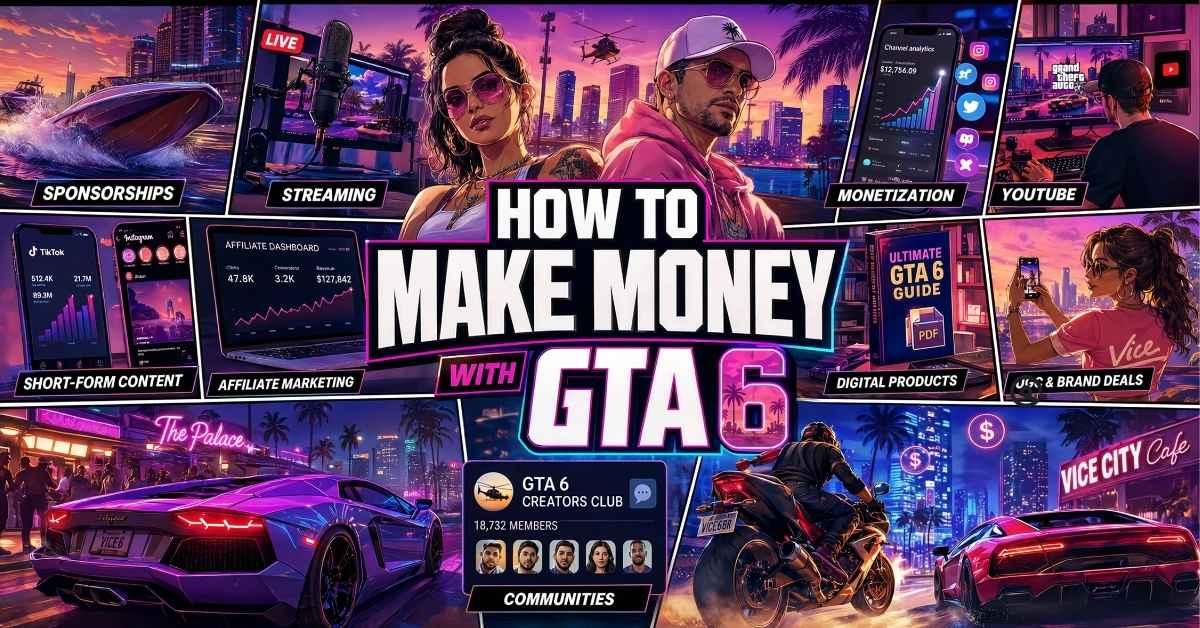
If you’re wondering how to make money with GTA 6, the biggest opportunity may not be in the game itself, but in the audience and demand you build around it. The release is expected to attract enormous attention, so now is the time to figure out how to turn that attention into income.
Grand Theft Auto VI is scheduled to release on November 19, 2026, for PS5 and Xbox Series X/S. Take-Two chairman Strauss Zelnick reaffirmed this date in early August 2026. The game takes players back to a new version of Vice City in the fictional state of Leonida. It follows two main characters, Jason Duval and Lucia Caminos, inspired by the infamous American outlaw couple Bonnie and Clyde.
A major game release like this brings a massive wave of attention, search demand, and audience pull. Knowing the GTA 6 release date is crucial for planning your content around the topic. This gives you a great chance to turn your interest in GTA 6 into a real business opportunity instead of playing it just as a hobby.
Many people advise starting a YouTube channel to make money from GTA 6, but that is just one option.
Top gaming creators often combine three main strategies at the same time.
- Attention: Focus on earning ad revenue, getting more views, and attracting new followers.
- Recommendation: Try using affiliate links, referral codes, coupons, brand deals, and sponsorships.
- Ownership: Sell products, offer memberships, or build independent communities that rely less on platform algorithms.
This guide explains each method, shows how to combine them without losing audience interest, and covers two key policies: Rockstar’s copyright rules and YouTube’s 2025 update on violent content, both of which affect how you can make money from GTA 6 content.
One mindset shift makes everything below easier to apply: you are not monetizing the game itself, but the attention, search traffic, and purchases it drives.
People who watch gameplay just for fun usually do not bring in much income. Viewers looking for tips on controller settings, the best capture cards, or GTA 6 streaming setups are more likely to buy something. The main ways to earn money focus on meeting these specific needs.
The Three-Tier Monetization Framework
All methods for making money as a gaming creator fall into three main tiers. Each tier has its own risks and depends on platforms in different ways. The most successful creators build all three tiers during one game cycle, rather than betting everything on the first.
| Sr. No. | Tiers | What It Is | Primary Income Sources | Platform Dependency | Time to First Dollar |
| 1. | Attention | Getting eyeballs on content you don’t own | Ad revenue (YouTube, TikTok, Twitch), platform bonus pools, Super Chats/Bits | Very high | Days to weeks |
| 2. | Recommendation | Turning an audience’s trust into referral income | Affiliate commissions, brand sponsorships, paid shoutouts | Medium | Weeks to months |
| 3. | Ownership | Building assets you control outright | Digital products, memberships, merch, owned email/community lists | Low | Months, but compounding |
The attention tier is the fastest way to make money with GTA 6, but it doesn’t last long because ad rates, content rules, and platform algorithms can change without warning.
The recommendation tier is more stable since it relies on your audience’s trust, but it still depends on external platforms.
The ownership tier takes the longest to build. However, it is the only one that can survive changes in platform rules or algorithms, or if the game becomes less popular.
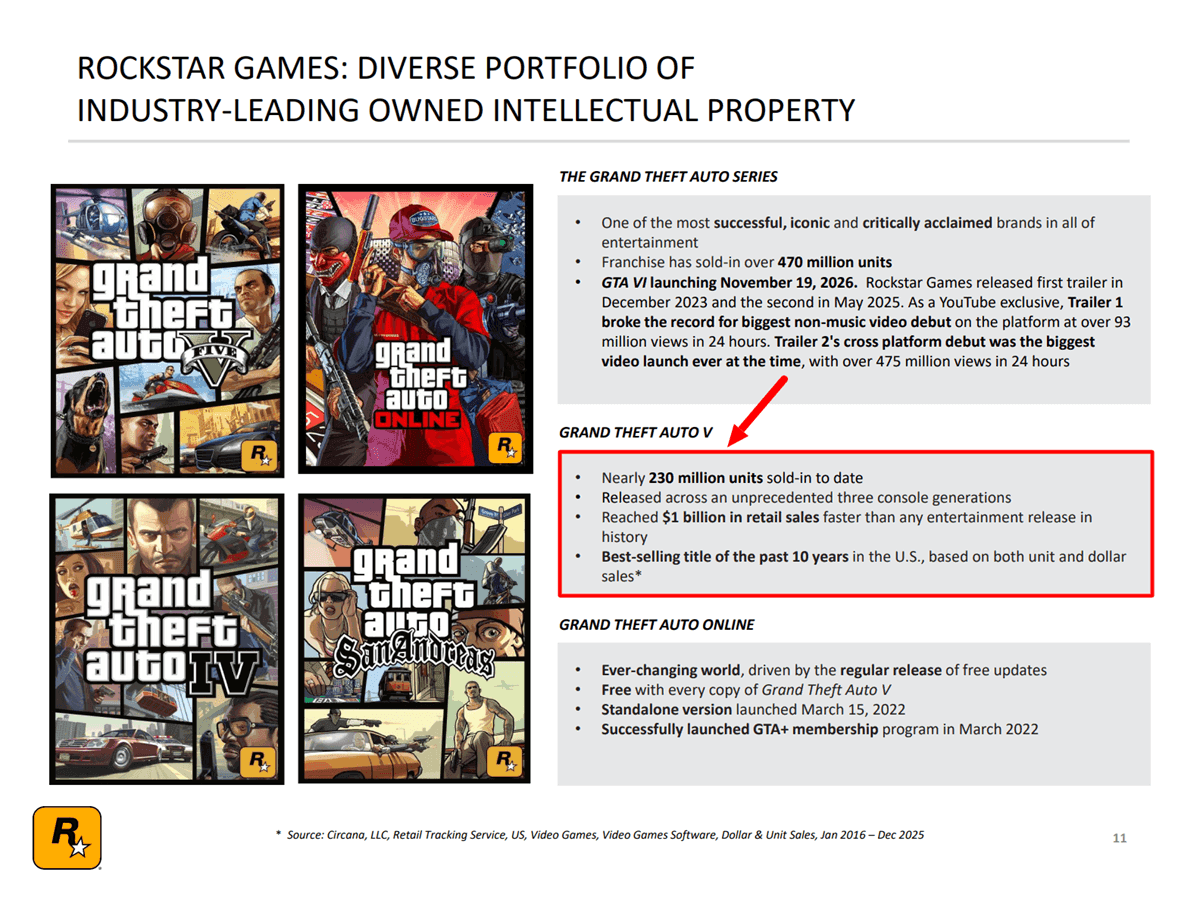
For example, Grand Theft Auto V stayed popular for over ten years after its release. It sold more than 230 million copies by May 2026 and reached $1 billion in retail sales faster than any entertainment release in the games category, according to Take-Two Interactive.
Most creators who still earn money from that game mainly use the ownership tier.
For each tier, this guide gives examples of possible income at different traffic and audience levels. These examples use published industry numbers and are meant to help you plan, not promise results. No creator, including me, can guarantee how much you will earn from a game that has not launched yet. The best approach is to show both the lowest and highest possible earnings.
The next sections look at each tier in the order you should build them. First, grow a wide audience using attention-based strategies. Once you have enough followers, move to recommendation-based methods. Finally, turn your audience into owned assets before new trends pull their attention away.
Strategic Timing Advantages for Content Creators
There is more to consider than just playing the game. According to a 2026 report from Research and Markets, the global creator economy is expected to grow from about $323.48 billion in 2026 to around $820.83 billion in 2030.
Grand View Research estimates the 2026 figure slightly lower at about $310.4 billion. Still, both sources agree the industry is growing by more than 20% each year. Most of this growth comes from sponsorships and affiliate deals, not just ads.
This growth matters for GTA 6 creators because brands are investing more in gaming sponsorships and affiliate programs. The launch of a big game like GTA 6 is expected to create one of the biggest jumps in gaming searches and social media activity. New creators entering the space now find more sponsorship opportunities than ever before, since they are joining a growing market at a key moment.
Layer 1: Attention (YouTube, Streaming, and Social Video)
YouTube: The Core Ad Revenue Engine
YouTube remains the largest monetization pool for gaming creators, and its 2026 rules are more specific than most guides suggest.
Ad revenue requires 1,000 subscribers plus either 4,000 valid public watch hours in the past 12 months or 10 million valid Shorts views in the past 90 days, according to YouTube’s Partner Program eligibility page.
A lower entry tier at 500 subscribers and 3,000 watch hours or 3 million Shorts views grants access to fan-funding tools like Super Chat and channel memberships, but not ad revenue.
Once monetized, YouTube pays creators 55% of net ad revenue on long-form videos, a split confirmed in YouTube’s creator help documentation and unchanged since the Partner Program launched. Shorts work differently. Revenue is pooled across all monetized Shorts, music licensing costs are deducted first, and the remainder is split among creators by share of views. Payouts are generally far lower per view than long-form ad revenue.
One more thing worth planning around: YouTube announced on August 10, 2026, that new creators applying to the Partner Program will need 8,000 watch hours or 20 million Shorts views starting February 1, 2027, double the current thresholds.
Creators accepted before that date keep the lower bar. This makes the months before GTA 6’s launch a better time to apply for monetization than the months after, since a channel that qualifies under today’s thresholds locks in the easier entry point.
A few things separate creators who earn well from GTA 6 content and those who don’t. E.g., niche and format still beat raw view count.
Gaming content usually pays advertisers less per view than finance or business content, often a few dollars per thousand views vs. $20 or more in other categories, based on 2026 ad-rate analysis from creator-economics trackers.
A GTA 6 channel that adds analysis, comparison, or tutorial framing on top of raw gameplay tends to out-earn a pure “let’s play” channel with the same view count because analytical and how-to formats attract a higher-value advertiser pool.
Long-form beats Shorts for actual dollars, even though Shorts drive discovery. Use Shorts to funnel new viewers toward long-form videos where the real ad revenue is, instead of treating Shorts as a standalone income source.
Putting Real Numbers on Attention-Layer Income
The math here is simple. Monthly ad revenue is roughly your monthly views divided by 1,000, multiplied by your RPM (what you receive per 1,000 views after YouTube’s cut). YouTube doesn’t publish official RPM figures by niche, so the ranges below come from aggregated 2026 industry trackers rather than official YouTube data and should be read as a planning range, not a promise.
Multiple independent creator-economics trackers put general gaming long-form content around $1 to $3 RPM. Gaming content that leans toward hardware reviews, tech comparisons, or buying advice reaches roughly $4 to $10 RPM, since that content attracts higher-paying advertisers than pure entertainment gameplay.
Applying that range across three realistic audience sizes:
- A newer channel pulling 150,000 monthly views at a $2 RPM earns around $300 a month from ads alone, which is a realistic starting point but not a business yet.
- A growing channel with 500,000 monthly views at a $3 RPM makes roughly $1,500 a month.
- A channel with real scale, say 2 million monthly views, leaning into higher-RPM formats like hardware comparisons and settings guides at a $5 RPM earns around $10,000 a month from ad revenue alone.
The honest takeaway is that attention-layer income scales with both traffic and format. The jump from $300 to $10,000 a month mostly comes from audience size and virality, not better ad placement.
Live Streaming: Twitch, Kick, and YouTube Live
Twitch’s standard revenue split for Affiliates and Partners is 50/50 on subscriptions. Streamers with a strong recurring subscriber base over consecutive months can qualify for Twitch’s Plus Program, which raises the split to 70/30. The exact viewer and subscriber thresholds have changed since the program launched. Check Twitch’s current creator dashboard before planning around a specific number.
Kick has positioned itself as the aggressive alternative, publicly advertising splits as high as 95/5 for streamers. However, its total advertiser demand and audience size remain smaller than Twitch’s, which affects how much total revenue that higher percentage actually represents.
For GTA 6, live streaming carries a scheduling advantage other formats lack. A same-day launch stream, played live as the embargo lifts on November 19, 2026, is one of the highest-value moments in this entire content cycle because search and social interest peak in the hours immediately around a AAA launch.
Short-Form Video: TikTok, Instagram Reels, and YouTube Shorts
Short-form clips are the discovery engine for everything else on this list, even though they rarely pay well on their own. TikTok’s Creator Rewards Program and Instagram’s Reels bonuses exist, but per-view payouts on both platforms are well below YouTube’s long-form ad rates. Neither publishes a fixed, guaranteed revenue split as YouTube does.
Think of short-form video for a GTA 6 channel as a funnel, not a destination. A 20-second clip of a chaotic heist or driving stunt can reach viewers who have never heard of a creator’s main channel. The clip’s caption and pinned comment do the actual monetization work by pointing to the long-form video, live stream schedule, or a specific product.
Treating Shorts and Reels as a standalone income stream usually leaves money on the table compared to using them as free advertising for the layers that actually pay.
Rockstar Copyright Policy Risks for GTA 6 Creators
This is the part most “how to make money with GTA 6” articles skip entirely, and it is the most important compliance fact in this guide.
Rockstar’s copyright policy, last updated January 10, 2025, states that non-commercial use “means that you don’t make money through the game footage you post or use the material as part of a promotion for a product or service.”
Taken literally, this would rule out ad-monetized GTA gameplay entirely. In practice, Take-Two has not enforced the policy this strictly for years, and ad-monetized GTA content is common on YouTube and Twitch. But the written policy has never been formally updated to explicitly allow monetization, so creators operate on established practice and platform norms rather than an explicit written license.
Here are the big red lines you shouldn’t cross if you want to stay on Rockstar’s good side:
- Don’t post any leaked or pre-release footage before the official launch. date
- Avoid uploading spoilers or story cutscenes stripped of surrounding context
- Don’t promote cheats, hacks, mod menus, or any kind of account or currency trading.
- Skip sharing any unauthorized ports or mods.
Staying within these boundaries is the safest way to keep a channel’s monetization intact.
YouTube’s Content Policy: Key Risks for GTA 6 Channels
YouTube tightened its content policy on November 17, 2025, expanding age restrictions to cover gaming videos showing “realistic human characters” in scenes of prolonged or zoomed-in violence against non-combatants. The announcement named factors like scene length, camera framing, and how lifelike characters appear as evaluation criteria.
Creator-focused coverage flagged GTA 6 as a likely test case given Rockstar’s push toward photorealistic models. Age-restricted videos lose ad eligibility and discoverability for logged-out and under-18 viewers, cutting into Layer 1 income.
Creators planning heavy GTA 6 content should assume clips centered on prolonged violence toward civilian NPCs carry real age-restriction risk, and should plan content focusing on driving, heists, comedy, exploration, and mission walkthroughs rather than framing violence as the main event.
One more rule worth knowing before launch day: YouTube’s monetization policy also requires content to be original, not just non-infringing. Raw gameplay uploaded with no commentary, structure, or editing can be treated as low-effort or repetitive under YouTube’s guidelines, risking the channel’s monetization even when the footage is totally allowed.
This means a wall of unedited GTA 6 clips is a weaker business bet than the same footage cut into a real video with commentary, structure, or a clear point.
Layer 2: Recommendation (Affiliate Marketing and Sponsorships)
Affiliate Marketing for a Gaming Audience
A GTA 6 audience buys things beyond the game itself: capture cards, controllers, headsets, chairs, and PC upgrades for the eventual PC port.
Established affiliate programs in this space include Amazon Associates for general hardware and dedicated brand programs from companies like Razer, SteelSeries, Corsair, Logitech G, and HyperX. Most run commission rates from low single digits to low double digits depending on the product category, according to current affiliate-network listings.
The mistake most gaming creators make with affiliate content is running it as a side note in a gameplay video description. It performs much better as its own content category: “best controller for GTA 6,” “capture card setup for console streaming,” or “PC specs to run GTA 6 at launch” (once official specs are published). These are commercial-intent searches with buyers already close to a purchase decision, converting at a significantly higher rate than a gameplay video’s audience clicking a description link almost as an afterthought.
Any affiliate link used in GTA 6 content needs a clear, upfront disclosure that it’s an affiliate link, which is a legal requirement under FTC guidelines, not just a best practice.
On a website, that link should also be marked as a paid or affiliate link in the page’s code (the rel=”sponsored” attribute), which is Google’s recommendation to stay in good standing with search.
Putting Real Numbers on Recommendation-Layer Income
Affiliate income depends on two numbers multiplied together: how many people click an affiliate link and how much each click is worth on average (called “earnings per click,” or EPC).
A 2026 benchmark analysis from several major affiliate networks puts typical EPC between $0.45 and $1.50 across programs. This already accounts for both conversion rate and commission size, making it a more reliable planning number than guessing conversion percentage and commission rate separately.
Click-through rate is the other variable, and it depends heavily on format. General affiliate links buried in unrelated content convert poorly, often under 1%. A page built specifically as a buying guide, where the reader arrived already looking to compare products, performs meaningfully better; one widely cited network comparison found dedicated affiliate landing pages converting at roughly 3.2% vs. 1.7% for regular content pages.
Working through three traffic tiers on dedicated GTA 6 buying-guide content:
- 15,000 monthly visitors at a 2% click-through rate produce 300 clicks. At a $0.60 EPC, that is about $180 a month, a realistic floor for a new site.
- 60,000 monthly visitors at a 3% click-through rate produce 1,800 clicks. At a $0.75 EPC, that’s roughly $1,350 a month.
- 400,000 monthly visitors at a 3.5% click-through rate produce 14,000 clicks. At a $0.90 EPC (achievable once a site has proven, high-converting comparison pages), that is around $12,600 a month.
The variable that moves the needle most here isn’t the commission rate, but how much of your traffic is genuinely shopping vs. just watching.
Sponsorships and Brand Deals
Sponsorship value scales with audience specificity, not just size. A mid-size GTA 6 channel with a clearly defined audience (heist-focused, roleplay-focused, comedy-focused) is worth more to a relevant sponsor per thousand viewers than a large general gaming channel with a scattered audience, because the sponsor can predict exactly who they’re reaching.
The GTA 6 launch window creates a specific, time-limited sponsorship opportunity. Gaming peripheral brands, energy drink and snack brands, and VPN or cloud-gaming services all run heavier ad budgets around major AAA launches than at any other time of the year. Creators who want sponsorship income from this cycle should reach out to brand partnership teams months before launch, not after, since most sponsorship budgets are allocated and locked weeks before a confirmed release date.
Brand deals remain one of the largest income sources for creators overall. Reporting from major creator-platform surveys consistently puts sponsorships and platform ad revenue as the two most common primary income sources, well ahead of affiliate or product income for most creators. This is a reason to invest real effort in outreach and media kits rather than waiting for brands to find a channel organically. Most do not.
Defining an Audience Sponsors Actually Want
Brands do not buy views. They buy a predictable audience they can describe in one sentence. A creator pitching sponsors should be able to answer specifically who watches their GTA 6 content, what those viewers already buy, and what platform they watch on most.
A channel built around technical driving mechanics attracts a different buyer than one built around comedic roleplay. A sponsor selling capture cards cares which one they are actually reaching. It helps to think in rough viewer types rather than one generic “GTA 6 audience”: people who watch mainly for entertainment and funny moments, people hunting for specific guides and walkthroughs, people chasing better settings and competitive performance, and people actively comparing gear before a purchase.
That last group is the smallest by view count and the most valuable to a sponsor or affiliate program because they are already close to buying something.
Creators who track this deliberately through YouTube Analytics, Twitch’s viewer data, or simple audience polls can build a media kit with real numbers instead of vague claims. This is where niche size matters less than niche clarity.
A 40,000-subscriber channel with a clearly defined, well-documented audience routinely out-earns a 200,000-subscriber channel with a vague one because the smaller channel is easier for a brand to say yes to.
Platform-by-Platform Revenue Comparison
No single platform wins on every metric, which is exactly why the ladder framework matters more than picking one channel.
YouTube long-form pays 55% of net ad revenue to the creator and reaches viewers primarily through search and recommendations. This rewards content with lasting search value (guides, comparisons, walkthroughs) long after upload day.
Twitch pays a 50/50 split by default on subscriptions, with a path to a better rate for consistent, high-viewership Partners. It rewards real-time community building over polished editing.
TikTok and Instagram pay the least per view of the major platforms. Instead, they offer the fastest possible reach for a single viral clip, making them the strongest discovery layer even when they are the weakest income layer.
Kick advertises the highest headline split of any major platform but currently has less total advertiser demand and a smaller built-in audience than Twitch or YouTube. This affects how much that higher percentage is actually worth in practice.
The practical takeaway is that a creator who picks only one platform optimizes for one variable (split percentage, reach, or format fit) at the expense of the other two. Cross-posting the same core content across two or three platforms, adapted to each one’s format rather than copy-pasted, maximizes the attention layer’s total output.
Layer 3: Ownership (Digital Products, Merch, and Memberships)
This layer determines whether a creator still earns from GTA 6 content in 2027 and 2028, long after the initial hype cycle cools.
Digital Products
Guides, coaching, and Discord communities built around specific in-game systems (heist strategies, business management if GTA Online-style modes return, editing presets, overlay packs) let a creator sell directly to their existing audience without relying on ad rates or a brand’s budget.
Platforms like Gumroad, Payhip, and Skool are common distribution points for such products in the gaming creator space, letting creators keep most of each sale after payment processing fees. This compares favorably to the 45% YouTube keeps on ad revenue or the 50% Twitch keeps on subscriptions by default.
The products that sell best in a gaming niche solve a specific, repeatable problem rather than offering generic “tips.”
A pack of editing presets tuned to GTA 6’s lighting and color grading, a written breakdown of an efficient heist route, or a Discord community organized around finding co-op groups all give buyers a clear reason to pay instead of watching free content elsewhere.
Vague “master GTA 6” courses tend to underperform compared to narrowly scoped products because the narrow product signals real expertise while the broad one signals a rushed cash grab.
Channel Memberships and Fan Funding
YouTube channel memberships and Super Chats/Super Thanks pay out at a 70/30 split favoring the creator, a better rate than the platform’s 55/45 ad-revenue split, according to YouTube’s official partner earnings documentation.
Twitch’s baseline subscription split is 50/50 for both Affiliates and Partners, with higher Plus Program tiers available only after creators meet sustained subscriber thresholds.
Fan-funding income is smaller than ad revenue for most creators but has two advantages: it isn’t subject to advertiser-friendly content restrictions like ad revenue, and it builds a direct financial relationship with the highest-value segment of an audience, the people who choose to pay a creator directly rather than just watching for free.
Putting Real Numbers on Ownership-Layer Income
Digital product revenue is straightforward multiplication: units sold times price. The harder number to pin down honestly is how many buyers a given list produces, so this is worth grounding in real data rather than optimism.
MailerLite’s analysis of over 300,000 email campaigns found an average email-to-purchase conversion rate of 0.32%, or about 3 purchases per 1,000 subscribers who received an offer. Highly engaged, narrow-niche lists can do noticeably better than that average, with several industry benchmarks putting a well-segmented list’s conversion near 1%, but 0.32% is the honest baseline.
Applying that range to a $29 digital product:
- An email list of 3,000 subscribers converting at the 0.32% baseline produces about 9 to 10 sales, or roughly $270. This is below $1,000, showing list size matters enormously.
- A more engaged list of 15,000 subscribers converting at 1% produces about 150 sales, or roughly $4,350.
- A list of 40,000 engaged subscribers at a similar rate and a slightly higher $35 price point produces around 320 sales, or roughly $11,200.
Membership income is easier to calculate since it just needs member count and price, using the splits above. Five hundred members paying $4.99 a month on YouTube’s 70/30 split generates about $1,750 a month for the creator; 1,500 members at the same price generates roughly $5,240 a month. The same 500 members on Twitch’s 50/50 baseline split produces about $1,250 a month.
The pattern is the same across all three layers. The math is simple, but the real-world factors matter most: how many people visit your channel, how big your email list is, and what ad rates your niche brings in. A game that hasn’t launched yet has no earnings history to point to, so it’s important to break down the numbers honestly instead of just making guesses.
Merchandise
Print-on-demand merchandise tied to a creator’s own branding, rather than Rockstar’s IP, avoids licensing questions that come with using copyrighted game assets commercially.
A creator’s own catchphrases, channel mascot, or original artwork inspired by (but not copied from) the game’s aesthetic is a safer, more durable merch strategy than using Rockstar’s actual characters, logos, or in-game assets, which the company has not licensed for third-party merchandise.
Audience Retention as the Real Asset
Every layer of this ladder depends on the same underlying resource: how many people keep coming back.
Industry benchmarks on gaming-audience retention consistently show that channels built around a recognizable format or personality hold subscribers longer than those built purely around a single game’s news cycle. This matters for a launch-driven title like GTA 6.
A channel that only covers this one game risks losing most of its audience once the initial hype fades. A channel that uses GTA 6 as its biggest current topic, within a broader identity the audience trusts, keeps far more of that audience when the next big release draws attention away.
This is also the practical argument for building an email list or Discord server early rather than waiting until a product is ready to sell. A list built during the pre-release hype window gives a creator a direct channel to their most engaged fans that no platform algorithm can throttle or de-prioritize later.
The Console-Only Launch Changes the Content Math
One detail changes almost every projection in this guide: GTA 6 launches exclusively on PlayStation 5 and Xbox Series X/S on November 19, 2026, with no confirmed PC release date as of this writing. This matters for creator planning in a few concrete ways.
PC-focused affiliate content (graphics card guides, “best specs to run GTA 6” articles) has no launch-day audience since there is no PC version yet. That content angle should wait until Rockstar confirms a PC release window rather than publishing speculative hardware guides now.
Console-side content has a narrower but more predictable hardware story. A PS5 or PS5 Pro and an Xbox Series X/S cover the entire eligible audience, which simplifies capture card and setup guides far more than the sprawling hardware variation a PC audience would require.
Streaming setup content built for console creators (capture card selection, console-to-OBS pipelines, console-specific stream overlays) faces less competition at launch than it will once a PC version eventually arrives and floods the space with PC-specific guides. Publishing this content before the console launch, while the audience is still console-only, is a genuine first-mover window.
Sequencing the Launch: A Realistic Timeline
Trying to run every layer at full intensity from day one spreads effort too thin. A more realistic build-out tied to the confirmed November 19, 2026 release date looks like this:
Now Through GTA 6 Launch (Pre-release Phase):
Build the channel and audience on trailer reactions, pre-game content (GTA V, GTA Online), speculation content, and hardware/setup guides. This is where affiliate content around capture cards and controllers performs best, since there’s no gameplay to show yet, and it’s also the window for locking in sponsorship deals before brand budgets fill up.
Launch Week (November 19 Onward):
The attention layer goes into overdrive. Live streaming the first hours, fast-turnaround reaction and first-impressions videos, and Shorts/clips built for maximum reach all matter more in this window than in any other part of the content cycle.
First 90 Days Post-launch:
This is where recommendation-layer content compounds, as search volume shifts from “GTA 6 release date” toward “GTA 6 best [A]” and “GTA 6 how to [B]” queries, which are exactly the commercial and how-to formats that carry affiliate and sponsorship value.
Month 4 and Onward:
Wait to launch products like paid guides or communities until you have an audience and a clear content focus. Selling before sharing valuable free content may weaken your results because you haven’t shown that you can create genuine partnership opportunities beyond basic sponsorships.
How to Make Money with GTA 6: Secret Opportunities
A few GTA 6 income paths sit outside the three-layer ladder because they depend on relationships rather than content output alone.
Rockstar occasionally features standout fan content on the Rockstar Newswire and its own social channels, as it has in the past for machinima and creative gameplay clips. That kind of feature does not pay directly, but the traffic and credibility spike it produces can meaningfully accelerate a channel’s subscriber growth in a single day.
Organized competitive and roleplay communities are also worth watching once GTA 6 launches, especially if the game supports large-scale multiplayer roleplay servers like those that made GTA V’s online ecosystem durable years after release. Creators who built roleplay-adjacent content around GTA V held some of the most loyal, long-retention audiences in the entire gaming creator space. This pattern is worth studying for anyone planning content beyond the first few months.
How to Grow Your Channel During the GTA 6 Launch
The monetization layers above only work if people actually find the content. A few tactics matter more for a single-game launch cycle than they do for evergreen gaming content.
Title and thumbnail testing matters most in the first 90 days because search volume for GTA 6 terms will be at its highest and most competitive right after launch. A title that clearly states the specific value inside a video, such as a named heist, location, or mechanic, tends to out-click a vague, hype-driven title. This is because searchers arriving from Google or YouTube look for a specific answer, not general excitement.
A tool like vidIQ can provide a competitive advantage. Instead of guessing which GTA 6 topics, keywords, or titles will perform best, use vidIQ to analyze search demand, identify related keywords, and generate effective title ideas before publishing. This approach changes your first 90 days from trial and error to targeting topics and packaging with proven demand.
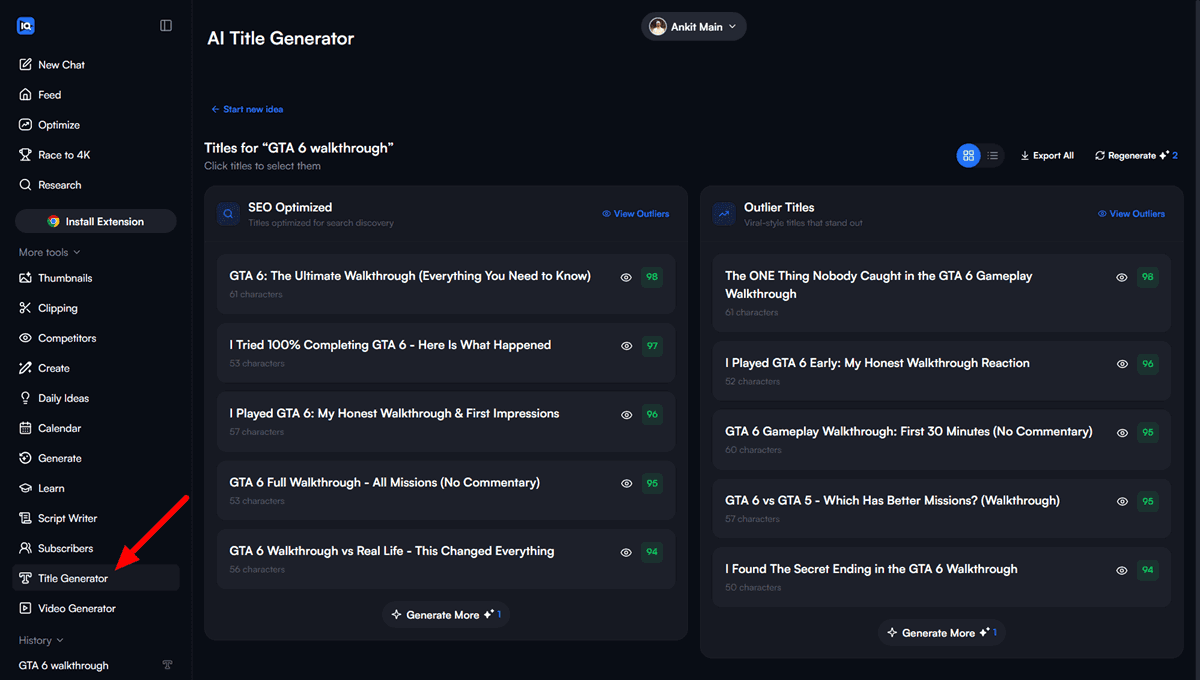
Upload cadence should focus on known news beats rather than a fixed daily schedule. Trailer drops, the official launch date, major patch releases, and confirmed PC port details cause sharp, short spikes in search interest. Channels with content ready within hours of these events capture a larger share of the spike than those publishing on a fixed weekly schedule.
The YouTube Community tab, Discord announcements, and pinned comments serve as free distribution for whichever layer needs a push. Community-tab posts pointing to a new product launch, affiliate guide, or live stream announcement cost nothing and reach an audience already opted in to hear from the creator.
Common Mistakes That Cap GTA 6 Creator Income
A few patterns show up repeatedly among gaming creators who plateau early in a game’s content cycle.
1. Chasing Every Trend Instead of Picking a Route
GTA 6 will generate a large volume of generic reaction and highlight content in the first weeks. Creators who pick a specific angle (heist strategy, roleplay, technical analysis, comedy) build a more addressable and monetizable audience than those competing only on upload speed.
2. Ignoring GTA 6 Monetization Layer 3 Entirely
Many gaming creators run only Layer 1 for years, tying their income entirely to a platform’s current ad rates and algorithm, with no safety net if either changes.
3. Treating Affiliate Links as an Afterthought
A single sentence and link in a video description converts much worse than a dedicated buyer’s-guide video or blog post built around commercial-intent search queries.
4. Skipping the Compliance Read
Losing monetization due to a spoiler strike or age-restriction wave is a common and avoidable way gaming creators lose months of income overnight.
Frequently Asked Questions
Q: Can I monetize GTA 6 gameplay videos on YouTube?
A: Yes, in practice, ad-monetized GTA gameplay is common and has been for years, but Rockstar’s written copyright policy technically defines “non-commercial” as not making money from the footage, and the company has never issued an explicit written update reversing that language. Creators operate on established platform norms rather than an explicit license, so staying inside Rockstar’s other stated rules (no spoilers, no leaks, no cheat promotion) is the safest approach.
Q: Will GTA 6 videos get age-restricted on YouTube?
A: Some could. YouTube’s policy update effective November 17, 2025, age-restricts gaming videos showing realistic human characters in prolonged or prominent scenes of violence against non-combatants. Content centered on driving, heists, missions, and comedy carries less risk than content built around prolonged violence toward civilian characters.
Q: What pays more for gaming content, YouTube or Twitch?
A: It depends on format. YouTube’s 55/45 ad-revenue split applies to long-form video and generally reaches a larger built-in audience through search and recommendations. Twitch’s 50/50 (or higher, for qualifying Plus Program partners) subscription split rewards real-time community building and works best for creators who stream consistently rather than uploading edited video.
Q: How many subscribers do I need to make money from GTA 6 content on YouTube?
A: YouTube’s Partner Program requires 1,000 subscribers plus 4,000 watch hours in 12 months (or 10 million Shorts views in 90 days) for ad revenue. A lower tier at 500 subscribers grants access to fan-funding tools like Super Chat and memberships without ad revenue.
Q: Is affiliate marketing realistic for a small GTA 6 channel?
A: Yes, more realistic than ad revenue in some ways, since affiliate commissions don’t require a subscriber threshold or platform approval the way YouTube ad revenue does. A small channel with a dedicated buyer’s-guide video (best controller, best capture card) can earn commission income well before it qualifies for the Partner Program.
Q: Should I build a Discord community or paid product before or after launch?
A: After, in most cases. Building an audience and proving a specific content angle during the pre-release and launch windows gives a paid community or guide a real reason to exist. Launching one before you have an audience to buy it usually underperforms.
Q: Do I need to pick one platform, or can I post the same content everywhere?
A: Cross-posting works, but copy-pasting the same video across platforms without adapting it rarely performs as well as tailoring the format to each one. A long-form YouTube video, a clipped highlight for TikTok and Reels, and a live stream on Twitch can all come from the same recording session without duplicating the work involved.
Q: What happens to GTA 6 content income after the launch hype fades?
A: It depends almost entirely on which layers a creator built during launch. Attention-layer income falls sharply once search volume normalizes. Recommendation-layer income declines more gradually as commercial searches continue. Ownership-layer income, built on products, memberships, and an owned audience list, resists the hype cycle ending. This is the core reason to build it early rather than treat it as a later-stage bonus.
How to Make Money with GTA 6: The Bottom Line
GTA 6’s November 19, 2026 launch is a single, dated event, but the income opportunity is not limited to that one day.
Creators who earn the most run all three layers of the monetization ladder at once: attention content capturing the initial wave of search and social interest; recommendation content converting that audience’s trust into affiliate and sponsorship income; and ownership assets that keep paying long after the launch-week spike fades.
Start with attention because it is the fastest layer to earn from. Build toward ownership because it is the only layer still yours a year from now.