
Etsy Fees For Digital Products: The Real Cost of Selling on Etsy in 2026

What Etsy Actually Charges You Per Sale
A seller lists a $5 digital planner on Etsy. By the time the sale clears, roughly a dollar of that is gone to fees. The seller feels robbed. A different seller lists a $50 template bundle that took the same 20 minutes to build, pays the same percentage in Etsy fees, and barely notices the cost.
Same platform. Same fee structure. Completely different reaction. That gap is the entire story behind Etsy fees for digital products, and almost nobody explains it clearly.
This guide breaks down every fee Etsy charges digital sellers in 2026, shows the real math at different price points, and answers the question that actually matters. Not “are Etsy fees high,” but whether Etsy still sends you enough buyers to make those fees worth paying. For a beginner deciding where to launch a first digital product shop, that distinction changes everything.
Why Etsy Fees Feel Bigger Than They Are
Digital products carry almost no production cost once the sales-ready file is created.
No packaging, no shipping box, no damaged inventory sitting in a closet.
That low overhead is exactly why every platform fee stings more here than it would for a physical product seller. When your entire cost to fulfill an order is a few minutes of your time, a $1 fee on a $5 sale reads as 20% of your effort walking out the door.
Raise the price to $50 for a more complete product, and the same percentage fee shrinks against the value delivered. Experienced Etsy sellers rarely compete by racing prices down. They compete by building something worth charging more for.
Every Etsy Fee For Digital Products, Broken Down
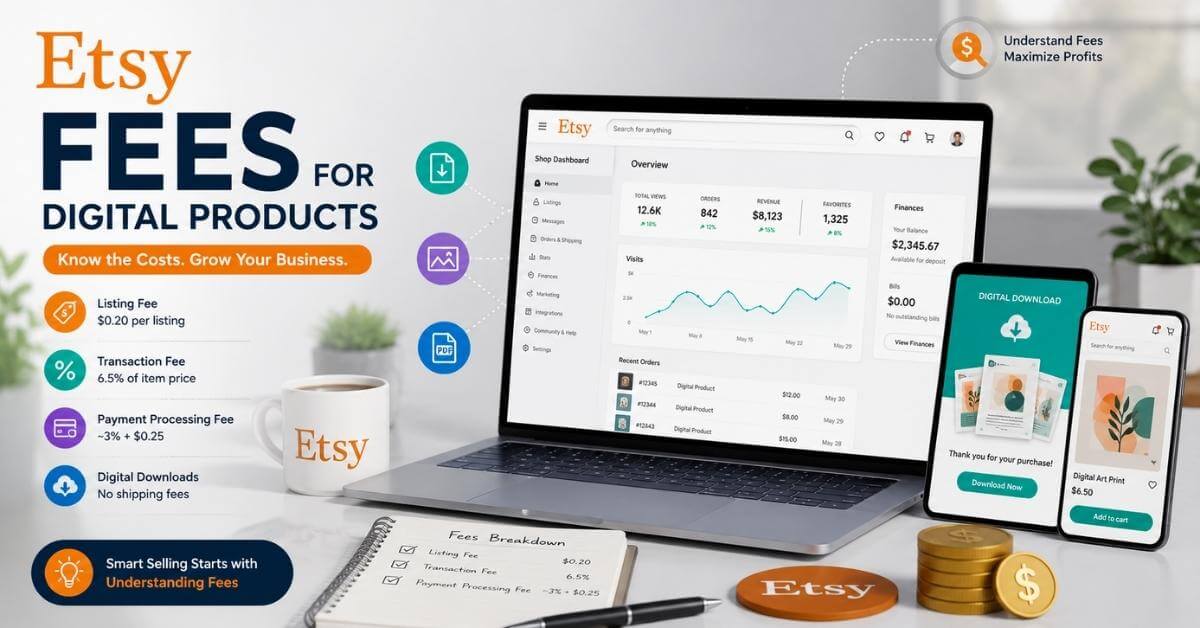
Etsy applies the same fee structure to digital and physical listings. There is no separate, cheaper tier for downloads.
| Fee Type | Cost | When It’s Charged |
| Listing fee | $0.20 per item | Charged when you publish a listing and again every 4 months if it has not sold |
| Transaction fee | 6.5% of the sale price | Charged on every completed sale |
| Payment processing | 3% + $0.25 (US rate) | Charged on every completed sale, rate varies by country |
| Offsite Ads | 12% to 15% of the sale | Mandatory once your shop passes $10,000 in trailing 12 month sales, if a buyer clicked an Etsy-placed ad first |
| Etsy Plus (optional) | $10 per month | Includes 15 listing credits plus extra shop customization tools |
| Currency conversion | 2.5% | Only applies if you list in a currency different from your payment account |
Etsy confirms this fee structure directly in its own Fees and Payments Policy, and the $10,000 threshold for mandatory Offsite Ads is calculated from item price times quantity sold over the trailing 12 months.
The listing fee catches new sellers off guard the most. It is not a one-time cost. An unsold listing renews automatically every 4 months, which means a shop full of slow-moving inventory quietly bleeds $0.20 charges in the background.
The Real Math At Different Price Points
Numbers land differently than percentages. Here is what Etsy actually keeps at 3 common digital product price points, using the standard US fee structure.
A $5 Printable
- Listing fee: $0.20
- Transaction fee: $0.33
- Payment processing: $0.40
- Total fees: Approx. $0.93.
You keep about $4.07, an effective cost of just under 19%.
A $20 Canva Template Pack
- Listing fee: $0.20
- Transaction fee: $1.30
- Payment processing: $0.85
- Total fees: Roughly $2.35.
You keep about $17.65, an effective cost of just under 12%.
A $75 Notion Workspace Bundle
- Listing fee: $0.20
- Transaction fee: $4.88
- Payment processing: $2.50
- Total fees: Roughly $7.58.
You keep about $67.42, an effective cost of just over 10%.
A $150 Complete Business Template System
- Listing fee: $0.20
- Transaction fee: $9.75
- Payment processing: $4.75
- Total fees: roughly $14.70.
You keep about $135.30, an effective cost of just under 10%.
The pattern is consistent across every price-tier analysis using Etsy’s published rates: the fixed costs, the $0.20 listing fee, and the $0.25 processing flat fee hit cheap products disproportionately hard, while percentage fees stay roughly proportional regardless of price. This is the actual mechanism behind why low-priced digital products feel like a losing game on Etsy, even before you factor in the time spent designing them.
Run these numbers against your own shop before assuming Etsy is either too expensive or perfectly fine. A shop full of $5 printables experiences Etsy fees completely differently than a shop selling $75 bundles, even though both are paying the exact same percentages.
The Hidden Etsy Cost Most Beginners Never Calculate
New sellers obsess over the 6.5% transaction fee. Almost none of them calculate what it actually costs to get a stranger to find their shop in the first place.
Selling on Etsy, combined mandatory fees typically land between 10% and 15% of each sale before any optional advertising. Selling through your own website instead, platform fees drop, but now you need real traffic. Google SEO, Pinterest, Instagram, email marketing, or paid ads all cost either money or months of unpaid effort before they produce a single sale.
Driving qualified traffic from scratch routinely costs more than Etsy’s commission ever would. The biggest expense in this business was never the fee. It is getting a stranger to discover your product exists at all.
Think of Etsy as a shopping mall and your own website as a boutique on an empty street. A cheaper storefront with zero foot traffic still produces zero sales. Etsy already has buyers actively searching for printable planners, SVG files, and Notion templates, and that built-in demand is the actual reason sellers keep paying its commission.
Etsy Fees for Digital Products Compared To The Alternatives
Etsy is not the only place to sell a digital download, and the fee math looks different depending on where you land.
| Platform | Monthly Cost | Fees |
| Etsy | $0 (or $10 for Plus) | 6.5% + 3% + $0.25 |
| Gumroad | $0 | 10% + $0.50 |
| Payhip Free | $0 | 5% |
| Payhip Plus | $29 | 2% |
| Payhip Pro | $99 | 0% |
| Shopify Basic | $39 ($29 billed annually) | 2.9% + $0.30 (Shopify Payments) |
Payhip is worth naming specifically here because it flips Etsy’s model. There is Payhip Marketplace for built-in buyer search, the fee drops as low as 0% on the Pro plan, and every plan includes a built-in affiliate program, which matters once you have your own following to sell to.
Shopify makes more sense once a shop has outgrown a single marketplace and wants a fully owned storefront, particularly for sellers planning to mix digital products with physical merchandise or a broader brand presence.
None of these alternatives replace what Etsy actually sells you: buyers who are already searching. They just cost less once you no longer need that Etsy search traffic.
When Etsy Actually Makes Sense
Etsy is a strong choice if you are just starting out, do not have an audience yet, do not know SEO, and want buyers now instead of after months of building traffic. It is also the right call if you would rather spend your time creating products than learning marketing from zero.
The marketplace effectively runs your customer discovery for you. That is worth real money to a beginner, even before you factor in the fee percentage.
When Etsy Stops Making Sense
Every seller who sticks around long enough hits the same realization. They are building Etsy’s traffic engine alongside their own shop, and every sale still depends on an algorithm they do not control.
Once a shop has consistent revenue, adding a second channel, such as your own website, an email list, Pinterest traffic, or a listing on Payhip or Gumroad, reduces how much any single platform’s policy change can hurt you. The strongest digital product businesses treat Etsy as one sales channel, not the entire business.
📌Also read: 12 Best Platforms to Sell Digital Products in 2026
A useful gut check: if losing Etsy access tomorrow would end your income entirely, that is the signal to start diversifying now, before it becomes an emergency instead of a planned decision. Sellers who wait until a policy change or a suspended shop forces the issue lose far more time than sellers who build a second channel gradually while Etsy is still working well.
The Pricing Mistake That Kills Margins Before Fees Even Apply
Many new sellers price like this: “Everyone else charges $3, so I will charge $2.50.” That strategy rarely works, and Etsy fees are usually not even the reason why.
After listing fees, transaction fees, payment processing, and the occasional advertising cost, a product priced to undercut the entire category leaves almost nothing behind. Racing to the bottom on price is one of the most reliable ways to kill a digital shop’s margins, faster than any fee ever could.
Sellers who consistently earn more solve a bigger problem instead of competing on price.
A complete business template bundle, a premium Notion workspace, a full wedding planning kit, or a branding package built for one specific type of buyer all justify a higher price because they save the buyer real time. Buyers pay more for a finished outcome than they will ever pay for a slightly cheaper single file.
The math backs this up directly. Two sellers each spend an hour building a product. One prices it at $5 and needs 20 sales to clear $100 before fees. The other builds a slightly more complete version, prices it at $35, and needs 3 sales to clear the same amount. The second seller spent roughly the same design time and needs far fewer buyers to hit the same revenue, which also means far fewer strangers who need to discover the listing in the first place.
How To Lower Your Effective Etsy Fee Rate
You cannot negotiate Etsy’s percentages, but you can control how much of your revenue they actually consume.
Bundle related products instead of listing everything individually. A $35 bundle of 5 templates pays the same $0.20 listing fee as a single $7 template, which immediately cuts your fixed-cost drag per dollar earned.
Offer free shipping-style pricing by building your full price into the listing rather than charging separately, since Etsy’s search algorithm favors listings without a separate shipping charge, and this applies to how digital listings compete for visibility, too.
An Etsy Plus subscription at $10 a month includes 15 listing credits, worth $3 in listing fees on its own, plus extra customization tools. For a shop publishing several new listings a month, that math can work in your favor.
Retiring genuinely dead listings matters too. A listing that has not sold or generated meaningful views across 2 renewal cycles is quietly costing you $0.20 every 4 months for essentially no return, and that money adds up across a shop with dozens of stale, forgotten listings sitting untouched in the background.
Etsy SEO Basics That Decide Whether The Fees Pay Off
None of the fee math above matters if nobody finds your listing. Etsy’s search algorithm is the actual mechanism that determines whether your fees turn into sales or just sit there.
Etsy search ranks listings primarily on relevance to the buyer’s exact search term, plus signals like how recently a listing was published, its review count, and how well it has converted for past shoppers. A title stuffed with vague, broad words like “digital planner” competes against tens of thousands of nearly identical listings. A title built around a specific buyer phrase, “postpartum recovery tracker printable” or “freelance invoice template Notion,” competes against far fewer.
Every listing gets 13 tag slots, and each one should hold a phrase a real buyer would actually type into Etsy’s search bar, not a repeat of words already in your title. Duplicating your title across your tags wastes slots that could be capturing a different phrase entirely.
Your first sales matter more than they seem to. New listings get a temporary visibility boost while Etsy tests them against shoppers, and how those first buyers respond, whether they click, favorite, or purchase, shapes how much ongoing reach that listing earns afterward. That is the practical reason a genuinely well-differentiated product outperforms a rushed one launched purely to fill out a shop.
Reviews compound this further. A listing with strong reviews and a healthy click-through rate keeps earning visibility long after the initial boost fades, which is part of why a smaller catalog of well-optimized, well-reviewed listings often outearns a large catalog of rushed ones. None of this SEO work costs an extra dollar in Etsy fees. It just determines whether the fees you already pay turn into an actual sale.
Tools Worth Running Alongside Your Etsy Shop
Etsy handles discovery. It does not help you keep a customer once they have bought from you once, and it does not protect you if your shop gets flagged or your category gets more competitive.
Capturing an email address at the point of sale is the single fastest way to reduce how dependent your income stays on Etsy’s algorithm. beehiiv and Kit both let you build that list starting from a free plan, then email buyers directly the next time you launch a product, independent of whether Etsy decides to show your new listing to anyone.
If your product line naturally supports ongoing access rather than one-time downloads, a template library, a resource vault, a growing course, a Skool community turns repeat Etsy buyers into a recurring subscription, with plans starting around $9 a month for the host.
For sellers who eventually want to sell higher-ticket digital products, such as a course, a coaching offer, a bundle, directly from their own site instead of a marketplace, ThriveCart Pro Plus charges a one-time $495 for lifetime checkout access with 0% transaction fees beyond standard card processing, which changes the math considerably at higher price points compared to a percentage-based marketplace fee.
None of these tools replace Etsy, and that is the point. Etsy remains the discovery engine for most beginners. These tools exist to make sure that once Etsy sends you a buyer, that relationship does not disappear the moment the download finishes.
Is It Still Worth Selling On Etsy In 2026
Yes, but not because the fees are cheap. They are not.
Etsy is worth the cost because it sells something difficult and expensive to build on your own: buyer intent. A marketplace full of people who arrived already planning to purchase justifies a higher fee than an empty storefront ever could, as long as your product actually converts once someone finds it.
The sellers who struggle tend to sell generic, underpriced products in the most crowded categories. The sellers who thrive differentiate their product, optimize their listing for Etsy’s search algorithm, earn real reviews, and gradually add traffic sources outside the platform. Etsy should not be a permanent home. It works best as a launchpad.
Final Take
Stop framing Etsy fees as money lost. They are the cost of acquiring a customer who was already looking for what you sell.
If Etsy sends you profitable sales without forcing you to spend months mastering SEO or paid ads first, those fees are a normal business expense, not a burden. The smartest long-term move is not choosing between Etsy and your own website. It is using Etsy to validate a product and build early cash flow while you gradually add channels you fully control.
For most digital product creators starting from zero, Etsy remains one of the fastest, lowest-risk ways to get a first sale. The platform is not perfect, and the fees are not small, but paired with a well-priced, well-differentiated product, it still returns more than it costs.
FAQ
Q: How much does Etsy charge for digital downloads specifically?
A: Etsy applies the same fee structure to digital and physical listings: a $0.20 listing fee, a 6.5% transaction fee, and a 3% plus $0.25 payment processing fee for US sellers. There is no separate, discounted fee tier for digital products.
Q: What is Etsy’s total effective fee rate for digital sellers?
A: Combined mandatory fees typically land between 10% and 15% of each sale before any optional advertising, though the exact rate shifts based on price point since fixed fees hit cheaper items harder than expensive ones. A $75 bundle often runs closer to 10%, while a $5 printable can run closer to 19%.
Q: Do I have to pay Offsite Ads fees on Etsy?
A: Offsite Ads become mandatory once your shop passes $10,000 in trailing 12-month sales, and the fee runs 12% to 15% on any sale where a buyer clicked an Etsy-placed ad before purchasing. Shops under that threshold can opt in voluntarily or skip Offsite Ads entirely.
Q: Is Etsy cheaper than Shopify or Payhip for selling digital products?
A: Etsy’s percentage fees usually run higher than Payhip’s lower tiers or Shopify’s processing rate, but neither of those platforms includes Etsy’s built-in buyer search. The real comparison is fee percentage against traffic cost, not fee percentage alone.
Q: How can I reduce the fees I pay on Etsy?
A: Bundling related products into one listing spreads the fixed $0.20 listing fee across more revenue per sale, and pricing for value instead of racing to the lowest price in your category protects your margin more than any fee workaround. An Etsy Plus subscription can also offset listing fee costs for shops publishing regularly.
Q: Should a beginner start on Etsy or build their own website first?
A: Etsy makes the most sense for a beginner with no existing audience and no SEO experience, since the marketplace supplies buyer traffic that would otherwise take months to build independently. Adding your own website and email list becomes the smarter move once your Etsy shop already has consistent, proven sales.
Q: Does Etsy charge extra fees for international sellers?
A: Payment processing rates vary by country, and a 2.5% currency conversion fee applies only if you list a product in a currency different from your connected payment account. Checking your specific rate inside Shop Manager is the most reliable way to confirm your exact cost, since Etsy updates these figures periodically.
Q: What is the biggest pricing mistake digital sellers make on Etsy?
A: Underpricing to compete on cost rather than solving a bigger problem for a specific buyer consistently produces thinner margins than the fees themselves. Complete bundles and niche-specific products built for one clear buyer type justify higher prices and absorb Etsy’s fee structure far more comfortably than a generic, cheap single file.
Q: How does Etsy’s search algorithm affect digital product sellers specifically?
A: Etsy ranks listings primarily on relevance to the buyer’s exact search phrase, plus how well a listing has converted for past shoppers and how recently it was published. A specific, niche title consistently earns more visibility than a broad, generic one, since it competes against a smaller pool of nearly identical listings.
Q: Can you make a full-time income selling digital products on Etsy?
A: Yes, though it typically requires a catalog built around a clear niche, consistent new listings, and pricing based on value rather than being the cheapest option in a category. Sellers who treat Etsy as one channel within a broader business, rather than the entire business, tend to build the most durable income over time.
What To Do Next?
Etsy fees for digital products are not the real obstacle most beginners think they are. The real question is whether your product and pricing are strong enough to make the traffic Etsy supplies worth what it costs.
Price your next listing for the value it delivers, not the cheapest number in your category, and track your actual effective fee rate for a month before deciding Etsy is too expensive. If the math works, keep building. If it does not, that usually points to pricing or differentiation, not the platform.
Once your Etsy shop has consistent sales, the next step is building an email list so every buyer can find you again without depending on Etsy’s search algorithm alone. Do this before you need it, not after a slow month forces the issue. Payhip is worth setting up as that second channel once you have proven what actually sells.
