Can You Sell AI-Generated Ebooks Legally in 2026

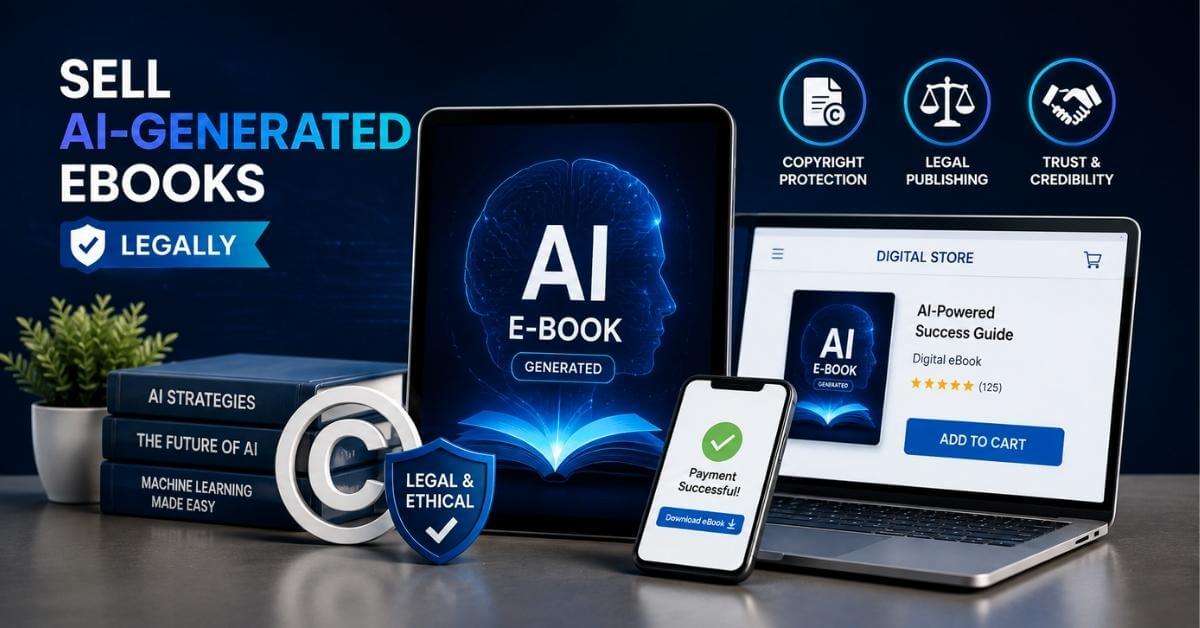
Can You Sell AI-Generated Ebooks Legally
In March 2025, the US Supreme Court declined to hear Thaler v. Perlmutter, leaving one rule firmly in place: content created entirely by AI, with no meaningful human input, cannot be copyrighted under US law. You can read the full court judgment here for additional details and legal context.
On February 13, 2026, the Munich Local Court (Amtsgericht München) ruled on the copyright status of AI-generated logos (Case No. 142 C 9786/25). The court found that three AI-generated logo designs did not qualify for copyright protection under German law because the prompts alone did not provide enough original human creativity for the logos to be considered protected works. The full German judgment is available here.
That single decision answers the biggest fear most beginners have about whether you can sell AI-generated ebooks legally. The short answer is yes, you can sell them. What you often cannot do is copyright them, and that distinction changes almost every decision that follows, from which platform you publish on to how much editing your draft actually needs.
This guide walks through what the US Copyright Office actually requires, what Amazon KDP, Etsy, and Google Play Books each demand for disclosure, and the specific editing threshold that turns a raw AI draft into something you can legally protect and confidently sell. Every rule here is checked against the platform’s own current policy, not a recycled blog post from 2023.
Why Purely AI-Generated Text Has No Copyright Owner
The US Copyright Office has held the same position since 2023: copyright protection requires a human author. A prompt, no matter how detailed or clever, does not count as authorship on its own. (Source: Copyright Registration Guidance:
Works Containing Material Generated by Artificial Intelligence)
This was tested directly in the Zarya of the Dawn case, where the Copyright Office ruled that AI-generated illustrations inside a graphic novel could not be copyrighted, while the human-written text and the overall arrangement of the images and text could. The distinction the Office draws is specific. Using AI as a tool to assist human expression is fine. Using AI to replace human expressive choices is not protectable. (Source: Congress.gov, Generative Artificial Intelligence and Copyright Law)
The mechanism behind this rule is simpler than it sounds. Copyright exists to protect the creative choices a person makes: word selection, structure, argument, voice. When an AI model generates a full chapter from a one-line prompt, the model made those choices, not you. Nothing prevents you from selling that chapter. Nothing stops someone else from copying it either, since uncopyrighted text has no legal owner to object.
That second part is the risk most sellers overlook. An AI-generated ebook with no meaningful human editing is not just weak intellectual property. It is content anyone else can legally republish or rebrand as their own, and you would have no legal ground to stop them.
AI Generated vs AI Assisted: The Distinction That Decides Everything
This single distinction governs both your copyright status and every major platform’s disclosure requirement, so it is worth defining precisely before anything else.
🤖 AI-generated content is text, images, or translations that an AI tool produced as the first version, even if you edited it afterward. Amazon’s own KDP policy states this directly: if AI created the initial draft, the content is classified as AI-generated regardless of how much you edited it later.
🤖 AI-assisted content is work you created yourself, where AI only helped refine, edit, brainstorm, or check grammar on writing that was already substantially yours.
The difference is not about effort. It is about who made the first creative decision. Writing your own rough draft and asking AI to tighten the prose is AI-assisted. Asking AI to write the chapter from a one-sentence prompt and then fixing typos is AI-generated, no matter how many hours you spent polishing it afterward.
Every rule in this guide, including copyright eligibility, Amazon’s disclosure checkbox, Etsy’s Creativity Standards, traces back to this same line. Knowing which side of it your ebook falls on before you publish saves you from guessing later.
Does Your AI Tool’s Commercial License Even Matter
Most AI writing tools grant broad commercial rights to what you generate. OpenAI’s Terms of Use assign users all right, title, and interest in ChatGPT output, and that assignment applies even on the free tier.
Here is the part that trips people up. That commercial license is a contract between you and the AI company. It gives you permission to use and sell the output. It does not create copyright where none exists. If the underlying text lacks human authorship, OpenAI’s terms cannot grant you a copyright that US law does not recognize in the first place, since a company can only assign rights that actually exist.
This is true across every major AI writing tool, not just one provider. The commercial license answers whether you are allowed to sell the output. The Copyright Office’s human authorship rule answers whether you can stop someone else from selling the same thing. Both questions matter, and they have different answers.
Amazon KDP Rules For AI Generated Ebooks
Amazon does not ban AI-generated books. It requires disclosure, and the rule is more specific than most sellers realize.
During the KDP publishing workflow, you must check a box declaring whether your book contains AI-generated text, images, or translations. The official checkbox language reads: “This title contains AI-generated content. This includes text (e.g., chapters, sections), images (e.g., illustrations, diagrams, cover art), or translations that were produced using AI tools.”
Three things about this disclosure surprise most first-time publishers. It is internal to Amazon and never shown on your public product page. Amazon has stated it does not affect your royalties, search ranking, or category eligibility. And it is required regardless of how heavily you edited the AI output afterward, since Amazon classifies by origin, not by effort.
The real risk sits entirely on the enforcement side. Undisclosed AI-generated content violates KDP’s terms, and Amazon has ramped up both automated detection and human review through 2025 and 2026, using writing pattern analysis, metadata, and submission velocity to catch undisclosed AI books. Consequences range from a blocked title to full account suspension for repeat violations.
Given the disclosure carries no downside and skipping it carries real account risk, there is no rational reason to leave that checkbox unchecked.
Etsy Rules For AI-Generated Digital Products
Etsy’s stance evolved significantly since 2023. As of 2026, AI-generated digital products are fully permitted under Etsy’s Creativity Standards, but they require specific, visible disclosure inside the listing itself, not a hidden internal checkbox like Amazon’s.
The seller must be the human directing the creative work, and the listing needs a disclosure line stating how AI was used, placed inside the description where a buyer will actually see it. Etsy also requires sellers to select “I did” rather than “another company” as the maker attribution for any AI listing they personally directed.
Etsy actively enforces its intellectual property and creativity policies through both rights holder reports and its own automated detection systems. According to Etsy’s 2025 Transparency Report, the platform processed approximately 111,000 intellectual property infringement reports, a 30% increase over the previous year. During the same period, Etsy removed around 846,000 listings for alleged intellectual property violations. About 18% of infringement reports were rejected because the reporter could not be verified, the claim lacked sufficient information, or it failed to meet Etsy’s reporting requirements.
Etsy has also expanded its proactive enforcement using LLM-based detection and other automated technologies. In 2025 alone, the company removed approximately 180,000 listings suspected of counterfeit violations and permanently closed around 28,000 shops for repeat infringement or counterfeiting offenses. Sellers whose listings are removed for copyright claims may submit a DMCA counter notice when eligible, and about 10% of copyright takedowns resulted in counter notices during 2025.
For digital product sellers, including ebook, printable, and template creators, these figures highlight how seriously Etsy treats policy compliance. Accurate AI disclosure, respect for intellectual property rights, and publishing original content can help reduce the risk of listing removals, account reviews, or shop suspension while building long-term trust with buyers.
Google Play Books And Apple Books
Google Play Books and Apple Books take a noticeably different approach than Amazon or Etsy, and most guides on this topic skip the distinction entirely.
Neither platform runs a dedicated AI-generated content checkbox during upload the way KDP does. Google’s content policies for Play Books focus on prohibiting spammy, misleading, or duplicate content rather than requiring a formal AI disclosure field, and Google Play separately supports AI-narrated audiobooks outright, alongside Spotify and Kobo Writing Life.
That does not mean anything goes. Both platforms still enforce originality and quality standards, and a book that reads as templated, unedited AI output risks rejection under general content quality rules even without a specific AI checkbox to trigger it. The practical takeaway: fewer formal disclosure hoops, but the same underlying expectation that a human shaped the final product.
For a beginner deciding where to launch first, this makes Google Play Books a reasonable secondary platform rather than a loophole. The lighter disclosure process reduces friction, but it does not lower the bar on originality, so the editing work described later in this guide still applies regardless of which storefront you choose.
Choosing Where To Sell Your AI-Assisted Ebook
Each platform trades reach for control differently, and the right choice depends on how much of the process you want to own.
| Platform | AI Disclosure Requirement | Built-In Buyer Traffic | Best Use Case |
| Amazon KDP | Yes, internal checkbox | Yes, largest ebook marketplace | Reaching readers actively searching for books |
| Etsy | Yes, visible in listing | Yes, marketplace search | Niche, visually packaged ebooks and bundles |
| Google Play Books | No formal checkbox | Yes, moderate | Reaching Android and international readers |
| Direct (Payhip, Gumroad) | Self-determined, disclose anyway | No, you supply traffic | Full pricing control, no marketplace cut |
Payhip is worth naming specifically for direct sales. On the free plan, you pay $0 a month and a 5% transaction fee, or upgrade to Plus at $29 a month to drop that fee to 2%, and every plan includes a built-in affiliate program that Amazon and Etsy do not offer.
Shopify fits sellers building a full personal brand around their books rather than a single title, particularly once an author has more than one product to sell. It starts around $39 a month, or $29 billed annually, with Shopify Payments covering processing at 2.9% plus $0.30 per transaction.
The smartest approach for most beginners: publish on Amazon KDP or Etsy first to reach existing buyer search traffic, then add a direct storefront once you have proof a title sells and want to keep a larger share of each sale.
How To Make Your AI-Assisted Ebook Actually Copyrightable
Selling legally and owning enforceable copyright are two different goals, and most creators only solve for the first one.
1. Write Your Own Outline Before Generating Anything
The structure and chapter flow you create yourself count as human authorship, even in sections where AI drafted individual sentences.
2. Substantially Rewrite the Draft, Not Just Proofread It
The Copyright Office looks at whether you made real creative choices in the final text, not whether you technically typed every word. Restructuring paragraphs and adding your own analysis count as meaningful human input. Cutting generic filler the AI defaulted to counts too.
3. Add Material Only You Could Add
A personal case study, an original framework, your own data, or a specific opinion cannot be replicated by prompting the same AI model again, which is exactly the kind of contribution the Copyright Office recognizes as protectable.
4. Document Your Process As You Go
Save your outline drafts and note which sections you wrote from scratch versus edited from AI output. Keep a running record of your revision history too. If you ever need to register a copyright or defend your work, this documentation is what separates a defensible claim from a guess.
5. Disclose the AI-Generated Portions Honestly if You Register a Copyright
The Copyright Office explicitly requires applicants to disclose and disclaim AI-generated material during registration and can only grant protection for the human-authored parts.
Building The Ebook Without Killing Its Originality
Speed and originality are not opposites here, but the tools you use for each step matter.
For an initial structured draft, Gamma turns a prompt or outline into a formatted document in minutes, which gives you a skeleton to substantially rewrite rather than a blank page to stare at. Treat its output the same way you would treat any AI-generated first draft: a starting point that needs your own restructuring and original material layered in before it resembles a finished, ownable book.
For supporting content like your sales page, blog posts, or chapter summaries used in marketing, SEOwriting.ai generates SEO-structured drafts starting on a free plan, with premium tiers starting around $19 a month for 50 articles and Unlimited MCP Generation.
For cover design and interior formatting, Canva remains the fastest route to a professional-looking book without hiring a designer, and its free tier already covers most single-title needs.
For topic and keyword research before you write a single chapter, Mangools validates whether your planned topic has real search demand. Starting around $18.85 a month on annual billing, it is also one of the few keyword tools with an official MCP server, which means you can connect it directly to Claude and ask it to pull keyword ideas, search volume, and difficulty scores without leaving your writing workflow.
Checking Your Work Before You Publish
Running your draft through an AI detector before publishing is not about gaming a score. It is a practical check on whether your editing pass actually changed the text enough to matter.
Originality.ai scans text for both AI-generated content and plagiarism in one pass, with a Pro plan around $14.95 a month covering 2,000 scan credits. Independent testing shows it performs well on raw, unedited AI text but scores noticeably softer once that same content has been genuinely rewritten, which is actually a useful signal, not a flaw. A high AI score after your editing pass tells you the rewrite was not substantial enough yet.
One honest limitation worth stating plainly: AI detectors of every kind carry real false-positive and false-negative rates, and no detector should be the sole basis for any legal or platform decision. Use it as a checkpoint that confirms your edits went deep enough, not as proof of copyright eligibility, which only the Copyright Office can actually determine.
Common Risks Beyond The Disclosure Rules
A few risks show up repeatedly in this space and rarely get covered honestly.
Training Data Infringement is an Unsettled Question
Whether AI companies had the right to train their models on copyrighted material is still being litigated, including the ongoing New York Times v. OpenAI case proceeding toward trial. This does not directly affect your right to sell your own output, but it is part of why AI copyright law keeps shifting under everyone’s feet.
AI Output May Resemble Copyrighted Works
AI models can reproduce content that resembles existing copyrighted work, even without you intending it. Running your final draft through a plagiarism checker before publishing protects you from unknowingly republishing something too close to an existing source.
Trademark Issues are Separate from Copyright Issues
An AI-generated cover or title referencing a real brand, franchise, or recognizable character can trigger a takedown regardless of your copyright status, since trademark law protects names and branding differently than copyright protects creative expression.
Policy Volatility is the Most Underrated Risk
Every platform rule in this guide can change with little notice. Etsy’s enforcement wave started with almost no warning in January 2026, and Amazon has tightened its review standards multiple times since the disclosure requirement launched. Building a business entirely dependent on one platform’s current AI tolerance is a real structural risk.
That last point is worth sitting with. A seller who published 40 AI-assisted titles under one platform’s older, looser rules can wake up to a retroactive policy sweep flagging their entire back catalog at once, exactly what happened to some KDP publishers when Amazon began reviewing previously published titles rather than only new submissions. Diversifying across at least two platforms is not just a growth tactic here. It is protection against a single policy update wiping out your entire catalog’s visibility overnight.
Turning One Ebook Into A Real Income Stream
An ebook sale is a single transaction. The sellers who build lasting income add layers around it.
Capturing a buyer’s email at the point of sale protects you from depending entirely on any one marketplace’s algorithm. beehiiv and Kit both let you start that list on a free plan, then email readers directly when your next title launches, independent of what Amazon or Etsy decide to show anyone that week.
For authors building a body of work around one topic, a Skool community turns individual book buyers into an ongoing paid membership, with plans starting around $9 a month for the host, giving readers continued access to your growing catalog instead of a single closed transaction.
📌 Also Read: 20 Best AI Digital Products to Sell Online
FAQ
Q: Can I copyright a book I wrote entirely with ChatGPT?
A: No, not if AI generated the actual text with no substantial human creative input, since the US Copyright Office requires human authorship for protection. You can copyright the parts you meaningfully wrote, restructured, or added original material to, but purely AI-generated passages remain unprotected regardless of how much you edited typos or formatting.
Q: Do I have to disclose AI use on every platform I sell on?
A: Amazon KDP and Etsy both require disclosure, though the format differs. Amazon uses an internal checkbox during upload that buyers never see, while Etsy requires a visible disclosure line inside the listing description itself, since Etsy’s Creativity Standards treat transparency to buyers as the actual requirement.
Q: Does disclosing AI use hurt my sales on Amazon or Etsy?
A: Amazon has stated the disclosure does not affect royalties, search ranking, or category eligibility, and it is never shown on your public book page. On Etsy, the disclosure line is visible to buyers, but the actual risk to sales comes from skipping it and later getting flagged, which triggers search de-prioritization far more damaging than an honest disclosure line ever would.
Q: How much do I need to edit an AI draft before it counts as my own work?
A: There is no fixed percentage, since the Copyright Office evaluates creative contribution, not word count changed. Restructuring the argument, replacing generic examples with your own, adding original analysis, and writing your own outline before generating anything all count as meaningful human authorship in a way that light proofreading does not.
Q: What happens if I sell an AI-generated ebook without disclosing it?
A: On Amazon, undisclosed AI content violates KDP’s terms and can lead to a blocked title or account suspension for repeat violations. Etsy’s 2025 Transparency Report shows strict enforcement: the platform removed approximately 180,000 listings and permanently closed around 28,000 shops for repeat infringement or counterfeiting violations.
Q: Can someone else legally copy and resell my AI-generated ebook?
A: If the text has no human authorship and therefore no copyright, yes, legally nothing stops another seller from copying and reselling it under their own name. This is the strongest practical reason to substantially rewrite AI output rather than publish it raw, beyond any platform disclosure requirement.
Q: Are AI-narrated audiobooks treated differently than AI-generated text?
A: Yes, several major platforms including Google Play Books, Spotify, and Kobo Writing Life officially support AI-narrated audiobooks without the same disclosure friction applied to AI-generated text content. The distinction reflects narration being treated as a production method rather than authorship of the underlying creative work.
Q: Is it legal to use ChatGPT output commercially if I don’t own the copyright?
A: Yes, OpenAI’s Terms of Use grant you commercial usage rights to ChatGPT output regardless of copyright status, since a commercial license and copyright ownership are separate legal questions. You are permitted to sell the output, but you cannot stop someone else from independently generating and selling similar content, since uncopyrighted material has no legal owner.
What To Do Next?
You can sell AI-generated ebooks legally in 2026, provided you disclose AI use where platforms require it and understand that raw AI output carries no copyright protection on its own.
Write your own outline before generating a single word, and edit deeply enough that the final book reflects real creative choices you made. Then disclose AI involvement honestly on every platform that asks. That combination protects your account standing and gives you an actual claim to the work you are selling.
Once your first title is live, the next move is building an email list so readers can find your next book without depending on a single marketplace’s algorithm. Payhip is worth setting up as a direct sales channel once your first ebook proves it sells.
