
Digital Product Income Report: What Creators Really Make

What A Digital Product Income Report Actually Is
A digital product income report breaks down how much a creator earns and spends from selling digital products over a specific time, often a month. A trustworthy report is more than a revenue screenshot. It separates gross revenue from net profit, lists expenses, and explains where the income came from, such as ebooks, templates, online courses, memberships, or other digital products.
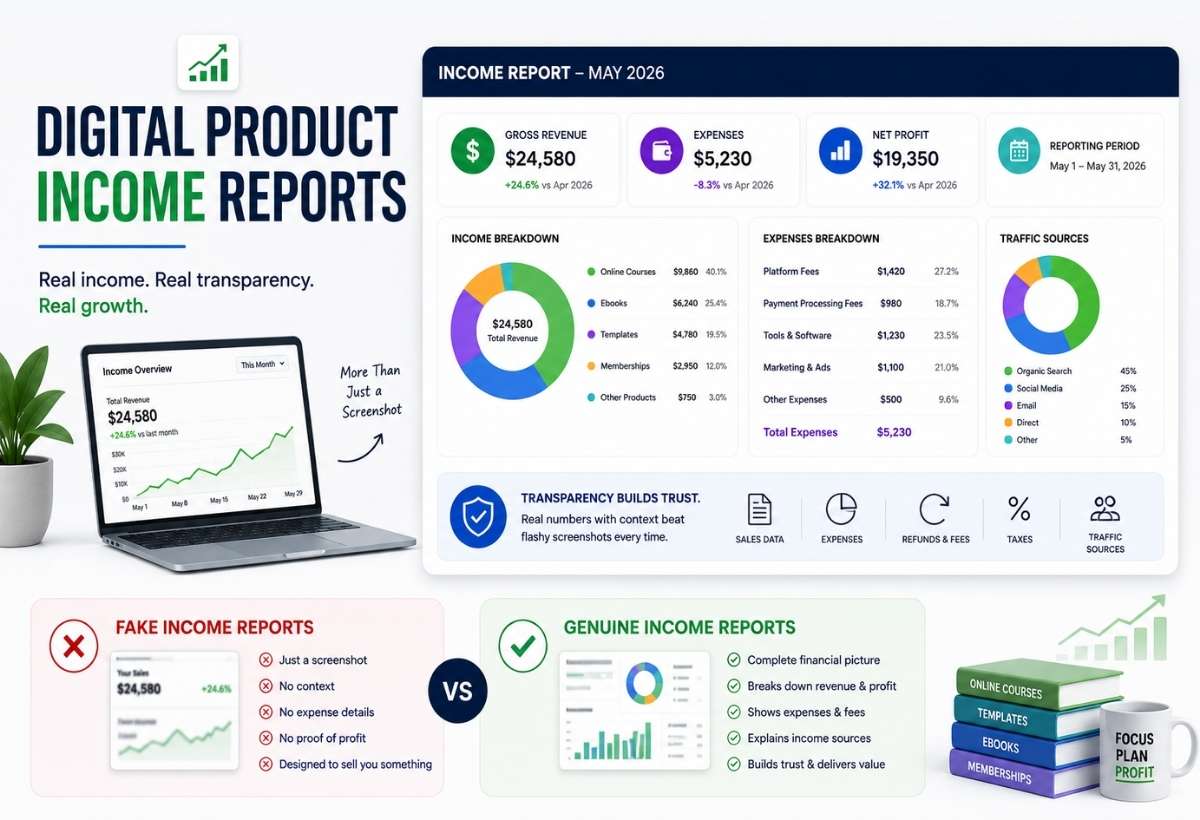
Unfortunately, many income reports online are screenshots with little or no real information. Without details like sales data, expenses, refunds, transaction fees, taxes, or traffic sources, a screenshot proves almost nothing. This is why social media is full of fake earnings claims meant to quickly gain trust and convince people to buy expensive ‘make money online’ courses or other get-rich-quick schemes.
A genuine digital product income report focuses on transparency, not hype. It provides the complete financial picture so readers can see what was earned, what was spent, and what profit was actually kept. Real numbers with context are much more valuable than flashy screenshots that reveal only a small part of the story.
This guide covers what real 2026 industry data says creators actually earn, how to spot a faked income report before it costs you money on a course or a template pack, and the honest step-by-step system behind a genuine $5,000 month. Every figure here is checked against platform data or independent research, not a Discord group’s word of mouth.
Why Income Reports Build Trust, When They Are Real
A real income report works because it replaces a vague promise with a specific, checkable claim. Readers trust numbers they can trace, not adjectives.
A trustworthy income report includes gross revenue, net profit after real expenses, and traffic sources and conversion rate alongside it. It should include at least one honest mistake from that period too. Reports that show only a revenue number and skip everything else are not lying outright, but they are showing you the least useful half of the picture on purpose.
Digital Product Industry Statistics For 2026
Real numbers first, then the context behind them.
| Metric | 2026 Data/Figure | Source |
| Global digital products market size (2025-2031) | $9.8 billion, projected to $18.3 billion by 2033 | HTF Market Insights |
| Global digital goods spending | $157.39 billion | Mordor Intelligence |
| Digital goods share of average online wallet | 2.7% | Deloitte |
| Etsy active buyers (Q1 2026) | 86.5 million | Etsy SEC Filing |
| Notion users worldwide | Over 100 million | Notion company Blog |
| Online education market size (2026) | Roughly $199.03 billion | Statista |
| Median monthly income, active Gumroad creator | $72 | InsightRaider |
| Share of Gumroad revenue earned by top 1% of creators | 99.5% | InsightRaider |
| Median annual income, committed self-published authors | $13,500 | Alliance of Independent Authors (ALLi’s 2025 Indie Author Income Survey) |
That last row matters more than any of the others. Every platform in this list follows the same shape: a small number of creators earn most of the money, and the typical creator earns far less than the number that gets screenshotted and shared.
Can You Really Make $5,000+ A Month Selling Digital Products?
Yes, but the honest answer requires 4 separate numbers, not one.
1. Beginners in their first 3 to 6 months typically earn between $0 and $500 a month, and a meaningful share earn nothing at all in their first quarter. This is not failure. It is the normal validation and audience-building phase every real business goes through.
2. Intermediate creators with a proven product and small audience typically land between $500 and $2,500 a month. This tier usually has 3 or more products live and at least one working traffic source, whether that is SEO, Pinterest, or a small email list.
3. Full-time creators treating this as a real business commonly reach $5,000 to $15,000 a month. Multi-product sellers with 3 or more listings earn an average of $5,201 a month, 5.7 times more than single-product sellers.
4. Six-figure creators exist and are real, but they are the platform’s top 1%, the same 1% capturing 99.5% of all Gumroad revenue according to 2026 platform data. Treat any income claim above $20,000 a month as an outlier story worth studying for tactics, not a typical outcome worth expecting on your own timeline.
The Truth About Income Screenshots
A screenshot shows one number. A real business has at least 6 numbers that matter, and most of them never make it into the post.
1. Revenue is Not Profit
Imagine someone posts a Stripe screenshot showing $10,000 in sales. On the surface, that looks like a huge win. But when you take away the money that went to software fees, advertising, and taxes, the amount they actually get to keep drops to $4,000 or maybe even less. The headline number is never the whole story.
2. Refunds Quietly Eat the Total
Digital products with generous refund policies commonly see 3% to 10% of gross revenue returned. That means for every $1,000 they make, $30 to $100 might go right back to customers who changed their minds. This refund money gets quietly subtracted from what they actually earn, but you rarely see that number mentioned in those big sales screenshots.
3. Ad spend is Almost Never Disclosed
Let’s say a creator spends $2,000 on ads and brings in $6,000 in sales. When you look at that screenshot, you see the full $6,000, but that’s not what actually lands in their pocket. The $2,000 spent on advertising comes straight out of the total, so their real earnings before any other costs are only $4,000. The screenshot tells just one part of the story.
4. Affiliate Income Gets Blended into the Total Sales
If someone says, “Here’s how much I made,” but mixes in commissions from selling other people’s products, their numbers look bigger than what their own digital products actually made. It can make their business seem more successful than it really is, even if most of that money came from promoting someone else.
There’s another way the numbers get distorted: sometimes creators let other people (affiliates) sell their products and pay those affiliates a huge cut, sometimes up to 85% of the sale. So, if a product sells for $100, the creator might only keep $15 after paying out commissions, but the income report still shows the full $100 as revenue. To anyone reading, it looks like the creator made a lot more than they actually took home. The real profit can be a tiny fraction of what the screenshots suggest.
5. Taxes are the Silent 20 to 30%
If you’re selling digital products in the U.S., taxes are a bigger deal than most people expect. Self-employment tax/income tax can eat up 20% to 30% of your net profit, and sometimes even more depending on where you live and how much you make. That means for every $1,000 you think you’ve earned, you might only keep $700 or $800 after taxes take their share. Almost nobody shows this in their income screenshots, so it’s easy to overlook until tax season comes around and the numbers suddenly look a lot smaller.
6. Hidden Business Expenses Add up Fast
Most people never think about the steady drip of business expenses that eat away at a creator’s earnings. Things like email software, website hosting, design tools, paying freelancers for help, and monthly subscriptions can easily add up to a few hundred dollars every single month. These aren’t flashy or fun to talk about, but they’re real. By the time all these quiet costs are paid, the money actually showing up in your bank account can be much less than the headline sales number. It’s one of those invisible details that separates what looks like a big win from what’s actually left over at the end of the month.
Screenshot Generators And Fake Income Reports
This is the part of the digital product world nobody wants to admit exists, but it shapes buyer trust more than anything else in this guide.
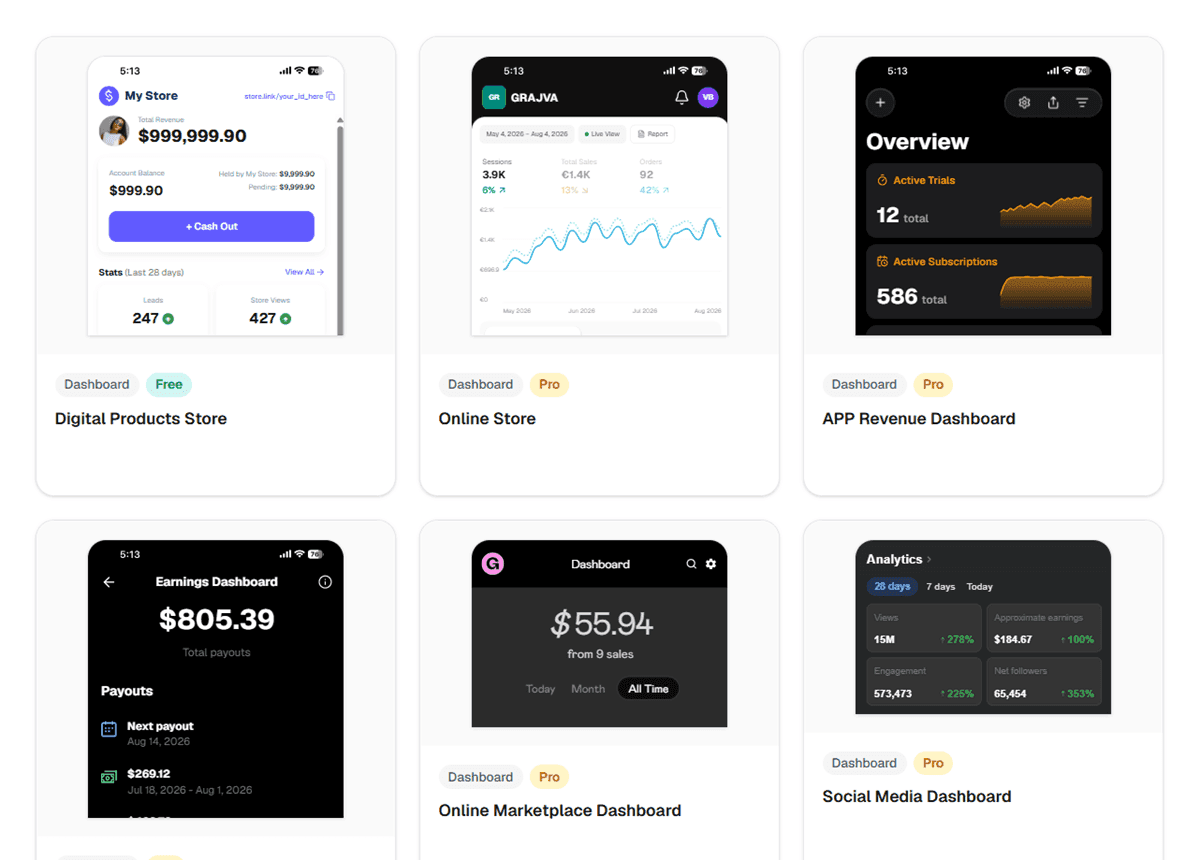
Fake Stripe dashboards, fake PayPal receipts, and fake Gumroad or Shopify screenshots are all generated using free web tools built specifically to produce a convincing but entirely fictional image. Fake bank balances follow the same pattern. AI image generation has made this even easier, producing screenshots with realistic fonts and layouts that are functionally impossible to fact-check by eye alone.
People fake these screenshots for one obvious reason: a fabricated $20,000 month sells a $497 course far better than an honest $2,000 one does. The fake screenshot is not the product. It is the advertisement for the product.
The damage lands on the buyer, not the scammer. Someone convinced by a fabricated income report buys a course expecting a repeatable system, follows it exactly, and earns nothing close to what they were shown, then blames themselves instead of the doctored proof that sold them.
A few red flags consistently show up in faked reports. Suspiciously round numbers, a $50,000 month with no visible refunds, chargebacks, or fee deductions anywhere in the breakdown, and a total revenue figure with zero supporting context like traffic numbers, conversion rate, or product breakdown. Genuine income reports are messy. Real months have a slow week, a refund, an ad campaign that flopped.
Verifying a claim before trusting it takes 3 checks.
- Search whether the same creator has published consistent numbers over multiple months, not just one highlight.
- Look for a visible product catalog and real reviews that would plausibly generate the claimed revenue.
- And treat any income proof attached directly to a course sales page with more skepticism than one shared with no ask attached, since the incentive to exaggerate is highest exactly where the stakes for you are highest too.
How A Genuine Digital Product Business Actually Works
Real income does not come from one great product. It comes from a repeatable system that turns strangers into buyers, then buyers into repeat customers.
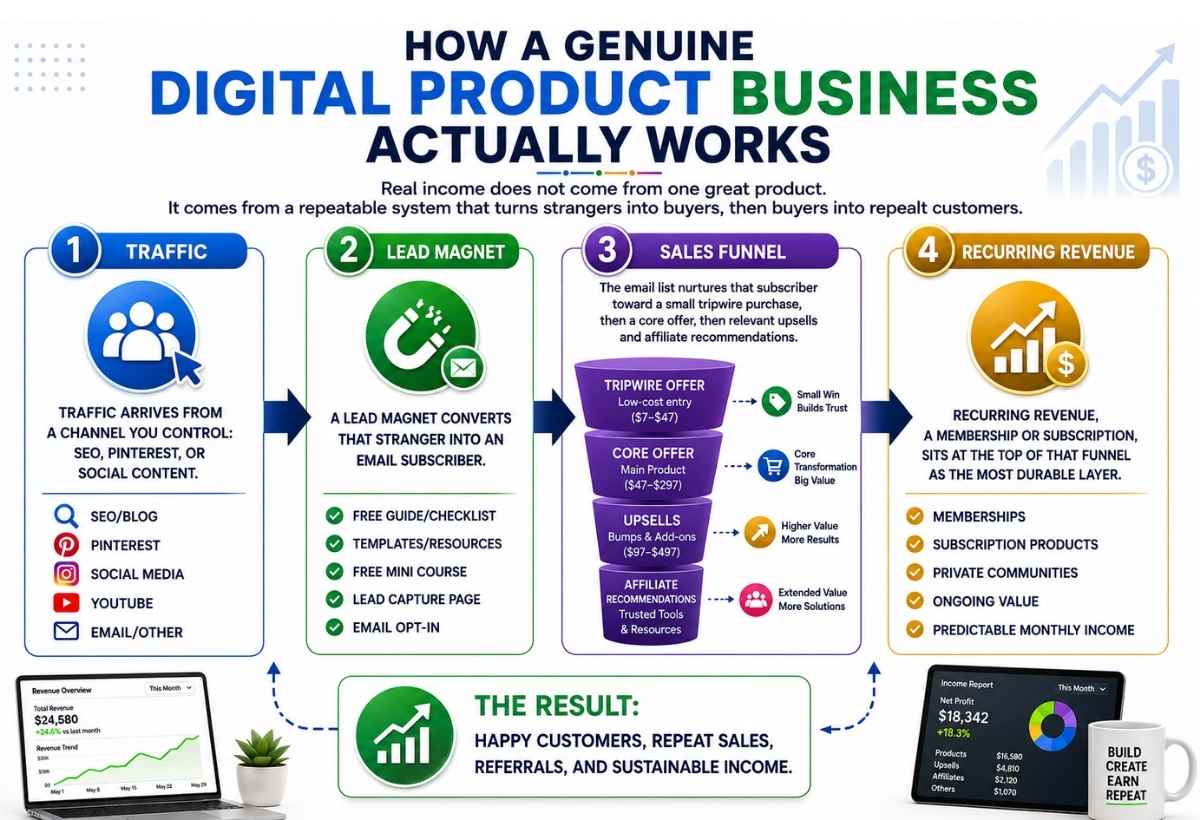
The mechanism runs in a specific order.
Step 1: Traffic arrives from a channel you control: SEO, Pinterest, or social content.
Step 2: A lead magnet converts that stranger into an email subscriber.
Step 3: The email list nurtures that subscriber toward a small tripwire purchase, then a core offer, then relevant upsells and affiliate recommendations.
Step 4: Recurring revenue, a membership or subscription, sits at the top of that funnel as the most durable layer.
Skipping the lead magnet and email steps is the single most common reason a good product never turns into consistent income. Without an owned list, every sale depends entirely on a platform’s algorithm deciding to show your listing that week.
Also Read: How to Make Passive Income with Digital Products
A Realistic $5,000 Month Income Breakdown
Illustrative, not a specific real creator, but built from realistic proportions seen across active multi-product sellers.
| Revenue Source | Income |
| Templates | $1,600 |
| Courses | $1,200 |
| Affiliate commissions | $900 |
| Membership | $700 |
| Consulting | $400 |
| Upsells | $300 |
| Sponsored content | $250 |
| Ad revenue | $150 |
| Gross total | $5,500 |
Notice that no single line item drives the whole month. That diversification is deliberate, and it is the actual reason this creator’s income is more stable than a seller relying on one product category alone.
Monthly Expense Breakdown
Gross revenue may be the big number you see in screenshots, but it is not the number you actually live on. That’s just the total money coming in, before you pay for anything that keeps your business running. What really matters is what’s left after all your bills and business costs are paid.
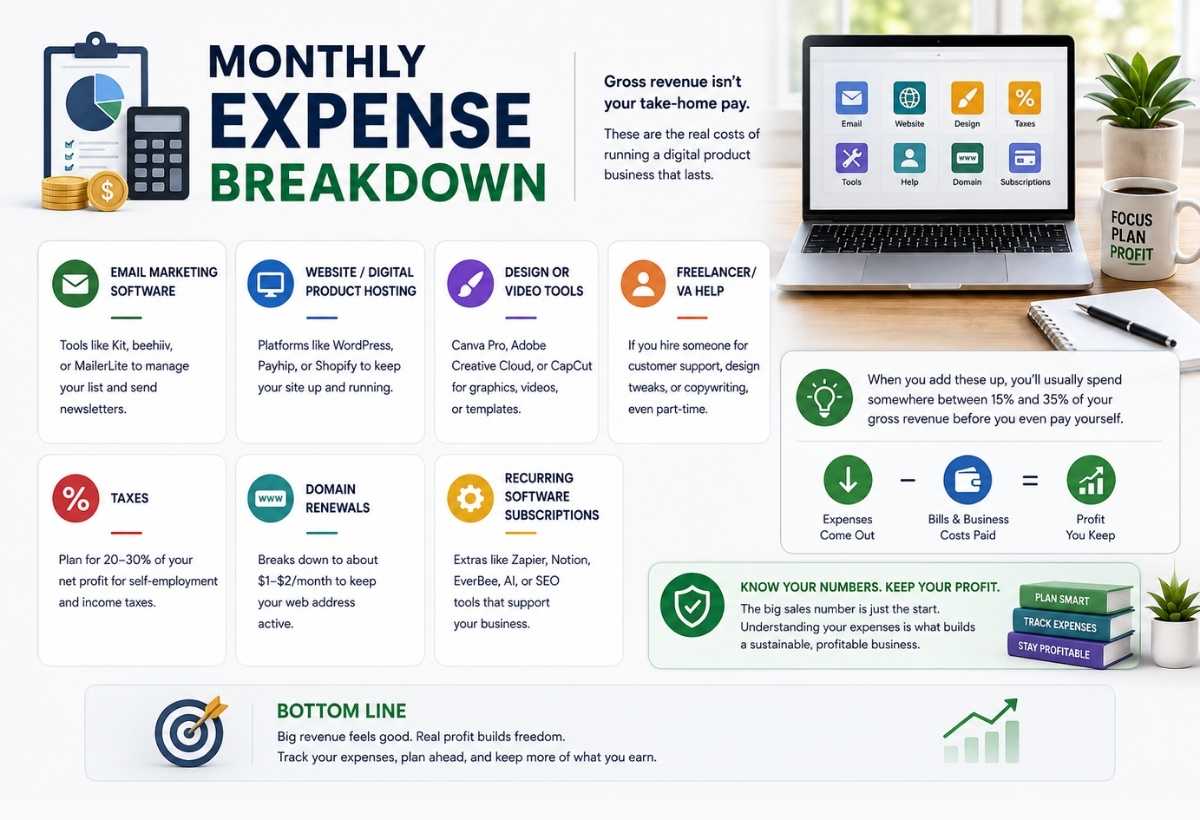
If you earn $5,000 in sales for the month, here’s what real expenses can look like:
- Email Marketing Software: $35–$100/month for tools like Kit, beehiiv, or MailerLite (to manage your list and send newsletters).
- Website/Digital Product Hosting: $9–$99/month for platforms like WordPress, Payhip, or Shopify (to keep your site up and running).
- Design or Video Tools: $13–$50/month for Canva Pro, Adobe Creative Cloud, or CapCut (for graphics, videos, or templates).
- Freelancer/VA Help: $100–$400/month (if you hire someone for customer support, design tweaks, or copywriting, even part-time).
- Taxes: 20–30% of your net profit (plan for at least $500–$1,000/month set aside for self-employment and income taxes).
- Domain Renewals: $10–$20/year (breaks down to about $1–$2/month, just to keep your web address active).
- Recurring Software Subscriptions: $20–$200/month for extras like Zapier, Notion, EverBee, AI, or SEO tools.
When you add these up, you’ll usually spend somewhere between $750 and $1,750 every month if you’re earning $5,000. That’s about 15% to 35% of your gross revenue gone before you even pay yourself. It’s totally normal, and it’s the real cost of running a digital product business that lasts. Knowing these numbers ahead of time means you won’t be surprised when your actual take-home profit is lower than the big headline sales figure.
The Step-by-Step System to Reach $5,000/Month
Step 1: Choose a Niche
Pick a specific audience you understand, not a broad category. Focus on a group you already know inside and out, maybe moms who homeschool, new freelancers, or small business owners. Don’t try to make something for “everyone.” The more precise you are, the easier it is to make something people actually want and will buy.
Step 2: Research the Market
Before you start making your product, check if people are actually looking for it. This means using tools like Google Trends or just searching on marketplaces to see if your idea is something people really want, not just something you think is cool. If you see lots of people searching for it, that’s a good sign you’re on the right track. If nobody is asking for it, you might want to pick a different idea. It’s way easier to sell something people already want than to convince them they need something new.
Step 3: Find Real Pain Points
Go straight to places where your audience hangs out like Amazon reviews, Facebook groups, Reddit threads, or even YouTube comments. Pay attention to what people complain about, what confuses them, or what they wish existed. These honest reactions and frustrations are pure gold. When you spot the same problem coming up over and over, you’ve found a real pain point something your product can actually fix. Solving this is what gets people excited to buy, because you’re giving them exactly what they’ve been looking for.
Step 4: Validate Demand
Before you get too excited about your idea, check whether someone else is already selling it and whether their product has a lot of happy customers. Search for similar products in your niche on places like Etsy, Amazon, or even Google. If you find products with lots of five-star reviews and real feedback, that means people already like and buy these kinds of things.
Don’t just assume you’ve found a brand-new gap in the market; sometimes the demand is already being met. But if you spot a way to do it better, or you notice a missing feature everyone wants, that’s where you can stand out. The goal isn’t to copy, but to learn what’s working and see if you can make something even better or more helpful. Don’t just reinvent the wheel.
Step 5: Create Your First Product
Focus on making one product and finish it all the way, even if it’s small. Don’t get distracted by trying to start a bunch of different things at once. When you actually launch and deliver a complete product, you’ll learn much more, feel proud that you finished something, and give real customers a chance to buy. Ten half-done projects on your computer won’t help anyone or make you money. Put all your effort into getting one thing out in the world, then improve from there.
Step 6: Launch It
Don’t wait until everything looks flawless. Get your product out there as soon as it’s ready, even if it still feels a little rough around the edges. Real feedback from buyers will show you exactly what needs fixing or improving much faster than spending weeks tweaking things on your own. The sooner you launch, the sooner you’ll know what people actually want, and you can make changes that matter to your real customers, not just to you.
Step 7: Collect Testimonials
Once you make your first few sales, don’t be shy; reach out to those customers and ask what they honestly thought. A simple yet personalized email or message like, “Was anything confusing, or is there something you wish was better?” works great.
People usually appreciate being asked, and their answers will show you what’s working, what needs fixing, and even what you could add next time. This real feedback is way more useful than guessing, and it helps you make your product even better for the next buyers.
Step 8: Build Your Email List
Right from the start, add an email signup form to every product page you make. It doesn’t have to be fancy; a simple box asking for a first name and email is enough. You can add a freebie (lead magnet) before your main offer to increase the opt-in rate. This way, anyone interested in your product can join your list, even if they’re not ready to buy yet. Over time, this list becomes a group of people who actually want to hear from you when you have something new. The sooner you start collecting emails, the easier it gets to make future sales, launch updates, and build a real connection with your audience.
Step 9: Add Affiliates
Once your product starts making sales and you know people want it, invite others to help spread the word. These people are called affiliates, and they get a small commission whenever someone buys your product through their link. It’s a win-win: you reach more buyers, and your affiliates earn a reward for helping you grow. Everyone gets rewarded for their effort.
Platforms like Gumroad and Payhip have built-in affiliate programs, so you don’t need to set up anything complicated. Just make sure your product really sells before you invite affiliates. It’s much easier for them to promote something that already has proof it works.
Step 10: Scale Your Digital Product Business
Once your first product is making sales and your basic system is working, it’s time to take things up a notch. Start by creating more products. These can be related to your first one or fill in gaps you’ve noticed from customer feedback. Next, put your product in front of new audiences by trying out different channels.
For example, you might add Pinterest, X.com, Threads, or TikTok if you started on Instagram, or open a small email newsletter if you’ve only used social media so far. Finally, consider adding something people pay for every month, like a Skool membership or subscription. This gives you steady income and helps turn one-time buyers into loyal fans. By growing step by step, you build a business that’s stronger and more stable, not one that relies on luck or just a single hit product.
Best Selling Digital Products Right Now
Product category matters less than most guides suggest, but it still shapes your price ceiling and production time.
| Category | Examples | Typical Price Range |
| Templates | Canva, Notion, printables, planners | $5 to $79 |
| Written products | Ebooks, checklists, digital journals | $7 to $27 |
| Structured learning | Online courses, prompt libraries | $19 to $500+ |
| Creative assets | Presets, fonts, icons, stock photos, LUTs, music | $5 to $49 |
| Software and systems | Plugins, calculators, automation workflows | $9 to $199 |
| Recurring access | Memberships, subscription communities | $9 to $97 a month |
Top Digital Product Ideas By Niche
Rather than a flat list of 100 near-identical ideas, here is where real demand clusters by audience type. Pick the niche you already understand, then choose the product format from the table above that fits it.
| Niche Cluster | What Tends To Sell Best |
| Business and marketing | Templates, swipe files, consulting-adjacent products |
| AI and productivity | Prompt libraries, automation workflows |
| Education and coaching | Courses, guided workbooks |
| Health, fitness, and finance | Trackers, structured programs, planners |
| Parenting, wedding, and travel | Printable planning kits |
| Photography, design, and music | Presets, asset packs, templates |
| Kids, religion, and hobby niches | Activity packs, guided journals |
The pattern across every niche is the same. A specific product for a named audience outperforms a generic version of the same idea, often by a wide margin.
Most Profitable Digital Products
High-ticket courses and consulting-style offers produce the most revenue per sale but require the smallest audience to hit a meaningful number.
Recurring memberships produce the most stable income over time, since they do not require a new sale to generate next month’s revenue.
Passive, evergreen products like templates and printables produce the most volume with the least ongoing work once built.
The most resilient businesses in this space combine all 3: one high-ticket offer, one recurring layer, and a catalog of evergreen low-ticket products feeding the funnel.
Digital Products Beginners Can Create For Free
You do not need a paid tool stack to publish a first product. Here’s a quick rundown of free tools you can use, along with what each one is best for:
- Google Docs: Write and format ebooks, guides, or any text-based product.
- Canva (Free): Design templates, planners, presentation slides, and simple graphics.
- ChatGPT, Gemini, or Claude: Brainstorm ideas, draft copy, or outline product content with the help of AI.
- Google Sheets: Build spreadsheets, trackers, or budget planners you can sell or share.
- PowerPoint or Gamma: Create professional presentations or slide decks.
- Notion: Organize digital planners, databases, or resource hubs.
- Figma: Design more advanced templates, UI kits, or digital assets.
- Photopea: Edit images and graphics (it’s like Photoshop, but free in your browser).
- CapCut: Edit videos for product demos, tutorials, or social media content.
- Audacity: Record and edit audio for podcasts, courses, or music.
All of these tools are free to start with and let you create real digital products without spending a dime. You don’t have to buy expensive software; just pick the ones that fit your project and get started.
The process is the same regardless of budget. Pick an idea, research real demand, outline it, create the content, design the final files, export them properly, upload to a platform, publish the listing, then promote and refine based on what actually converts.
Best Platforms To Sell Digital Products
Where you list a product changes your traffic source, your fee structure, and how fast you see your first sale.
| Platform | Fee Structure | Built-In Traffic | Best For |
| Etsy | 6.5% + $0.20 listing + processing | Yes, marketplace search | Beginners with no audience |
| Payhip | 0% to 5% depending on plan | No | Lower fees once you have traffic |
| Gumroad | Flat 10% + $0.50 | No | Simple single-product setup |
| Shopify | 2.9% + $0.30 processing | No | Full brand control, digital plus physical |
| Amazon KDP | Up to 70% royalty on ebooks | Yes, largest book marketplace | Ebook and course-adjacent authors |
| Skool | Flat monthly fee from $9 | No | Recurring paid communities |
| SuperProfile | Commission-based per sale | Some, link-in-bio traffic | Bundling storefront and social in one link |
Starting on Etsy or Amazon KDP for the built-in search traffic, then adding Payhip once you have a proven product, gives beginners the fastest realistic path to a first sale.
Digital Product Pricing Guide
- Low-ticket products, generally under $20, work best as fast, low-friction first purchases that build trust quickly.
- Mid-ticket products, roughly $20 to $97, work well for complete template systems or short courses.
- Premium products above $97 require stronger proof and positioning, since buyers need real confidence before that size of purchase.
- Bundles raise revenue per sale without adding creation time once individual pieces already exist. Subscriptions and licensing, including PLR and MRR products, add recurring or resale-based income on top of one-time sales.
For beginners wanting a fast-start catalog instead of building everything from scratch, a pack like the Mega PLR Video Course Bundle gives you resellable content to list immediately. Treat it the way any experienced reseller treats bulk inventory: sort through it, keep what is genuinely high quality, and build real product pages around whatever earns its place in your catalog.
Marketing Strategies That Actually Drive Sales
Traffic without a system behind it rarely converts, regardless of the channel.
Here’s a simple list of tools you can use, and exactly what each one does:
- KWFinder (Mangools SEO + AI Suite): Helps you see what people are actually searching for online, so you know if your product idea has real demand before you build anything. Mangools MCP server paired with Claude AI lets you pull up keyword data right inside your writing app, so you don’t have to switch between tools or tabs.
- SEOwriting.ai: Speeds up the writing process by making rough drafts of product descriptions or blog posts for you—great for saving time when you’re not sure how to start.
- Outfame: Helps you find and connect with real Instagram users who care about your niche, so you can grow an audience that might actually buy from you.
- ManyChat: Sends automatic messages to people on Instagram who comment on your posts, turning likes and comments into actual conversations and possible sales.
- EverBee: Shows you which Etsy products are selling well by putting sales numbers right on Etsy’s search results, so you can spot trends and avoid wasting time on products with low demand.
- beehiiv and Kit: Both let you build an email list for free, so you can stay in touch with people who are interested in your products and let them know when you launch something new. You don’t need to worry about platform changes or algorithms because your email list is always yours.
Every tool here is beginner-friendly and makes a real difference. You don’t need to be a tech expert; just pick the tool that matches what you need, and try it out for your project.
Building Trust Without Fake Income Reports
Here’s how you can build real trust with your audience, instead of relying on flashy screenshots:
- Share real stories from customers. When people hear how your product helped someone with a name and a face, it feels honest and easy to believe.
- Show testimonials with real names and photos. These carry way more weight than a random number or a faceless review.
- Share case studies. Walk people through how your product solved a specific problem for someone. Real details matter.
- Give a behind-the-scenes look. Show your process, your workspace, or even your mistakes. This makes you relatable and shows you’re not hiding anything.
- Show product walkthroughs. Let buyers see exactly what they’re getting before they buy. This helps them trust the quality and reduces refund requests.
- Share real numbers, but add context. Don’t just drop a big sales number—explain where it came from and what it means.
- Talk openly about failures or slow months. Saying, “I struggled with sales in March,” or “This launch didn’t go as planned,” makes your story believable. Nobody fakes a bad month.
When you do these things, people see you as a real person, not just another internet seller. Trust built this way lasts much longer than any screenshot ever could.
Common Mistakes That Sink A Digital Product Business
- Launching too many products before any single one is proven spreads marketing effort too thin to build real traction anywhere.
- Picking a niche based on personal interest instead of validated demand wastes real creation time on something nobody is searching for.
- Skipping an email list from day one leaves every future sale dependent on a platform’s algorithm.
- Poor pricing, especially underpricing to compete on cost, produces thinner margins than the fees ever would.
- Ignoring SEO and relying entirely on social discovery limits reach to whoever happens to see one post.
- Skipping validation and building a full catalog before a single sale confirms demand risks months of wasted effort.
- And giving up before month 3, when most beginners are still in the validation phase covered earlier in this guide, ends businesses that were never actually given a fair test.
Building Your Own Digital Product Income Report
A useful income report template covers gross revenue, net profit, a full expense breakdown, traffic numbers, new email subscribers, conversion rate, best-selling products by revenue, refunds issued, affiliate income kept separate from product income, ad spend, new products launched that period, lessons learned, and a specific goal for the following month.
Here is what that looks like applied to one realistic month.
- Traffic: 16,927 visitors.
- Email subscribers: 620 new.
- Orders: 182.
- Average order value: $42.
- Gross revenue: $7,644.
- Total expenses: $1,935.
- Net profit: $5,709.
The report is more useful than the number alone because it shows the mechanism. A 1.07% conversion rate from visitor to order tells you exactly where to focus next month, either raising traffic or improving the offer, in a way a single revenue screenshot never could.
FAQ
Q: How much can beginners realistically make selling digital products in the first few months?
A: Most beginners earn between $0 and $500 a month in their first 3 to 6 months, and a meaningful share earn nothing in their first quarter while validating a niche and building initial traffic. This is a normal part of the process, not a sign the business model does not work.
Q: Can digital products actually become a passive income source?
A: Fulfillment is genuinely passive since files deliver automatically after purchase, but the traffic and marketing that drive those sales require ongoing work, especially in the first year. Sellers who build an email list and diversify across several products see the most stable, closest-to-passive results over time.
Q: Do I need my own website to sell digital products?
A: No, marketplaces like Etsy, Gumroad, and Amazon KDP let you publish and sell without building a website first, which is the fastest path for most beginners. A website becomes more valuable once you want full pricing control and a lower long-term fee structure through a platform like Payhip or Shopify.
Q: What sells the fastest for a brand new digital product seller?
A: Printables and simple templates typically sell fastest since they can be built and listed within days using free tools, and marketplace search traffic on platforms like Etsy can produce a first sale within weeks. Courses and higher-ticket products take longer to build trust and sell.
Q: Can ChatGPT or other AI tools actually create sellable digital products?
A: Yes, AI tools can draft ebooks, generate templates, and speed up production significantly, but raw AI output rarely converts as well as content with real personal expertise and editing layered in. Treat AI as a speed tool for the first draft, not a replacement for the specific knowledge that makes a product worth paying for.
Q: Is Etsy still worth it for digital products in 2026?
A: Yes, for most beginners, since Etsy’s 86.6 million active buyers as of Q1 2026 supply search traffic that a brand new seller cannot replicate on their own. The tradeoff is a combined fee structure running roughly 10% to 15% per sale, which becomes less attractive once a seller has built their own traffic and wants to keep more margin.
Q: How many digital products should you launch before expecting real income?
A: Data from Gumroad’s 2026 platform statistics shows multi-product sellers with 3 or more listings earn an average of $5,201 a month, 5.7 times more than single-product sellers. A small, focused catalog of 3 to 5 proven products consistently outperforms either a single item or a large, unfocused catalog.
Q: How do you spot a fake digital product income report before trusting it?
A: Look for suspiciously round numbers with no visible refunds or fees, a total with zero supporting context like traffic or conversion data, and income proof that appears only on a sales page trying to sell you something. Genuine income reports include messy, specific detail that would be pointless to fabricate.
Q: Do you need an LLC to start selling digital products?
A: Not to start; most beginners operate as a sole proprietor while validating their first products, and forming an LLC becomes more relevant once income and liability exposure grow. Consult a tax professional once you are earning consistently, since requirements vary significantly by state and country.
Tools Mentioned In This Guide
| Tool | What It Is For | Link |
| Payhip | Low-fee digital product storefront with built-in affiliates | Try Payhip |
| Shopify | Full-control storefront for digital and physical products | Try Shopify |
| Skool | Paid recurring community platform | Try Skool |
| Canva | Free and Pro design tool for templates and covers | Try Canva |
| KWFinder (Mangools SEO + AI Suite) | Keyword research with an MCP server for Claude | Try KWFinder |
| SEOwriting.ai | AI-assisted SEO content drafting | Try SEOwriting.ai |
| Gamma | Prompt-to-document drafting for ebook skeletons | Try Gamma |
| Originality.ai | AI detection and plagiarism checking before publishing | Try Originality.ai |
| Outfame | Real, niche-targeted Instagram growth | Try Outfame |
| ManyChat | Instagram DM automation that turns comments into sales | Try ManyChat |
| EverBee | Etsy sales and revenue research | Try EverBee |
| beehiiv | Free-start email list with 0% subscription revenue cut | Try beehiiv |
| Kit | Free-start email list with built-in product sales | Try Kit |
| ThriveCart Pro Plus | One-time checkout tool with 0% transaction fees | Try ThriveCart |
| SuperProfile | Bundled storefront and link-in-bio platform | Try SuperProfile |
Final Thoughts
Digital product income reports are valuable exactly when they are transparent and include real context, not just a screenshot with no math behind it.
The industry data in this guide points in the same direction from every angle: a small share of creators earn the outlier numbers, and the typical creator earns far less. Not because the model is broken, but because most people quit before month 3 or never add the email list and diversification that separates a $72 median month from a $5,000 one.
Sustainable digital product businesses get built on solving a real, specific problem, marketing consistently, and improving based on actual conversion data instead of guesses. Document your own numbers honestly from day one. That habit alone builds more credibility and more useful self-knowledge than any income screenshot ever could.
Ready to stop guessing and start making real money online?
Digital Wealth Academy 3.0 isn’t just another MMO course; it’s your blueprint for building a profitable digital product business from scratch. We’ll show you exactly how to pick a winning niche, create products people actually want, and turn your ideas into real income, step by step.
No filler, no fluff, only proven strategies with 137.1K people who get real results.
Plus, it offers a generous 85% affiliate commission. So why wait? Buy now.