
What Is PLR Digital Products and How to Make Money With Them in 2026

![What Is PLR Digital Products and How to Make Money With Them [Beginner's Guide]](https://successpixel.com/wp-content/uploads/2026/06/What-Is-PLR-Digital-Products-and-How-to-Make-Money-With-Them-Beginners-Guide.jpg)
PLR Digital Products: What They Are and How to Actually Profit in 2026
A solopreneur buys a 30-page ebook on productivity for $27. She rewrites the introduction, swaps out the cover in Canva, renames it, and lists it on Gumroad and Etsy under her own brand. Within 6 weeks, she has made $480 from a product that took her 3 hours to customize. That is PLR at work.
What is PLR digital products?
Short for Private Label Rights digital products, this is a licensing model where you purchase pre-made digital content with the legal right to modify it, rebrand it, and resell it as your own. You do not have to create anything from scratch. You buy an existing product, make it yours, and sell it repeatedly. This is one of the lowest-barrier entry points into the faceless digital product business — and one of the most misunderstood.
This guide covers exactly how PLR works, how it compares to MRR and other license types, which PLR niches and formats sell best in 2026, where to buy high-quality PLR products, where to sell them, and the specific mistakes that separate sellers who build real income from those who give up after their first listing flops.
What Is PLR? The Clear Definition
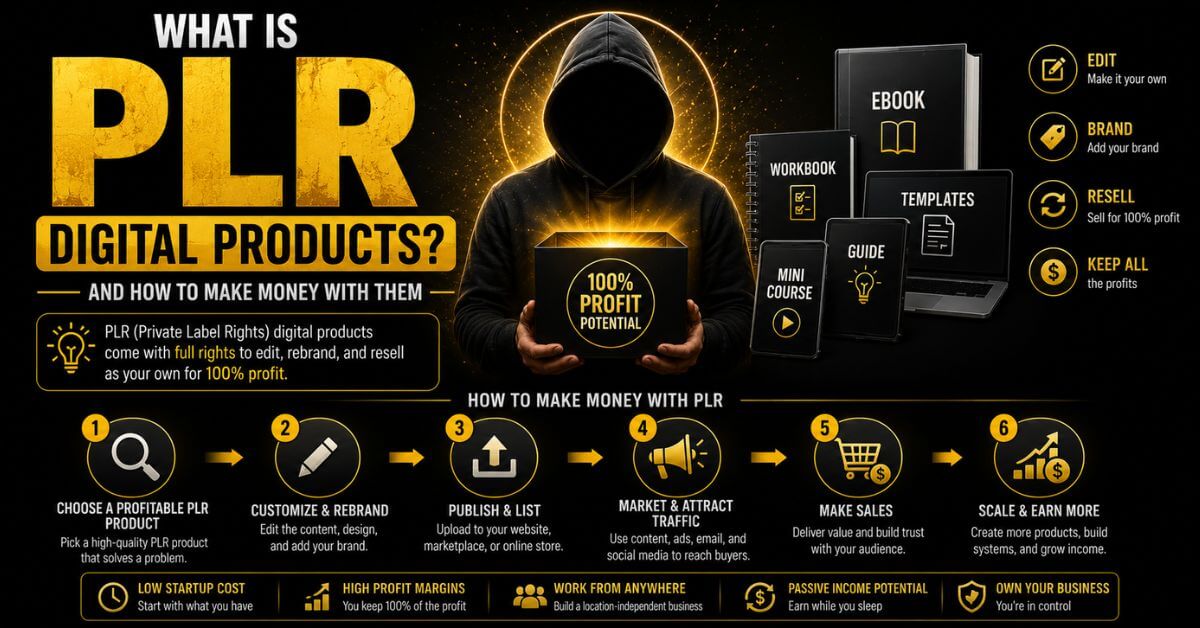
PLR stands for Private Label Rights. It is a licensing agreement between the original content creator and the buyer that transfers broad creative and commercial control to the buyer.
When you purchase a PLR product, you receive:
- The right to edit, rewrite, or restructure the content
- The right to rebrand it under your own name or business
- The right to resell the modified product and keep 100% of the revenue
- Sometimes, the right to give it away as a lead magnet
What you do not receive is the ability to claim you personally wrote the original content — and you do not receive exclusive rights unless the license specifically says so. Most PLR licenses are non-exclusive, which means many buyers purchase the same source file.
The mechanism that makes PLR valuable is straightforward. Content creation is the most time-consuming part of a digital product business. PLR removes that bottleneck entirely. Instead of spending weeks writing a 40-page guide from scratch, you buy a professional foundation and spend a few hours making it genuinely yours. The product you sell is your branded version — not the raw PLR file.
PLR has roots in the physical manufacturing world, where one factory might produce goods that 10 different brands then sell under their own labels. The digital version works the same way: one creator writes the content, licenses it to multiple buyers, and each buyer builds their own product from it.
PLR vs MRR vs Resell Rights: What Actually Differs
Most beginner guides lump these together. They are meaningfully different, and confusing them will cost you either money or legal exposure.
PLR (Private Label Rights): You can edit the content, rebrand it, change the title, rewrite sections, and sell it as your own creation. Full creative control. You keep 100% of your sale price.
MRR (Master Resell Rights): You can sell the product as-is, at your own price, and pass on the right to resell to your buyers. You cannot edit or rebrand the original content. The product stays unchanged. Your buyers can also resell it.
RR (Resell Rights): You can sell the product as-is and keep the revenue. You cannot modify the content, and your buyers cannot resell it — they can only use it personally.
White Label: Similar to PLR but often at a higher quality threshold and price point. White-label content is typically produced by professional agencies for corporate use, with stronger quality control and more exclusive licensing terms.
The practical difference for a beginner: PLR gives you the most flexibility to build a unique product. MRR gets you to market faster but limits differentiation. RR is the most restricted and least useful for building a real brand.
The best approach for most beginners is to start with PLR because the creative control it offers is the only route to standing out in a market where many sellers are working from the same source files.
Why PLR Beats Starting From Scratch (and When It Does Not)
PLR wins on speed and cost. Creating an original 40-page ebook from research to final layout takes 30 to 80 hours for most non-expert writers. A comparable PLR ebook costs $17 to $97 and can be customized and listed within a weekend.
The digital content creation market was valued at $31.8 billion in 2025 and is projected to reach $66 billion by 2030, according to The Business Research Company. That growth reflects the expanding demand for digital products across every niche — and PLR is one of the most practical ways for solo creators to participate without building a content team.
PLR also solves the blank-page problem. Many beginner creators know their niche but struggle to structure a full product. A PLR foundation gives you a complete structure to work from, even if you end up rewriting 80% of it.
Where PLR does not win: brand differentiation. If you are trying to build a recognizable store with a distinctive voice and original value, PLR is a starting point, not a destination. The sellers who build long-term income from PLR treat the source file as raw material, not a finished product. They add original examples, update statistics, rewrite in their own voice, and package the result in a way that reflects their brand aesthetic.
PLR sold unchanged is almost always a bad business decision. The file circulates widely among other buyers. Identical products on the same platform compete purely on price, which drives margins toward zero.
The 8 Most Profitable PLR Product Types in 2026
Not all PLR categories perform equally. These are the formats that actually sell, ranked by versatility and market demand.
Ebooks and Guides
PLR ebooks remain the most purchased and most versatile format. Top-performing niches include personal finance, health and wellness, productivity, business, and mindset. A 30 to 50-page PLR ebook in a specific sub-niche — “Social Media Marketing for Therapists,” for example — sells far better than a generic “marketing guide” ebook because the buyer audience is precise and underserved.
Sellers who customize PLR ebooks meaningfully and list them on Gumroad with a compelling product page commonly report $200 to $800/month from a single well-positioned title. The key variable is how much genuine customization was applied.
Canva Templates
PLR Canva template packs are among the fastest-growing formats in 2026. You purchase a set of editable Canva templates with PLR rights, customize the color palette and typography to match your brand, and sell the pack on Etsy or Creative Market.
Instagram content templates, social media post templates for coaches, media kit templates, and lead magnet templates all sell consistently. Faceless Instagram accounts regularly promote these template packs by posting before-and-after examples and mockup images, with a Gumroad or Stan Store link in the bio.
Workbooks and Printables
Workbook templates and printables with PLR rights sell well on Etsy because buyers can find them through organic search without you building an audience. Habit trackers, goal-setting worksheets, budget planners, and journaling templates in specific niches outperform generic designs. A PLR budget planner customized for freelancers will outsell a generic budget planner every time.
Online Courses and Video Scripts
PLR course content — written modules, lesson scripts, slide deck frameworks — allows you to launch a digital course without recording a single word from scratch. You purchase the content framework, record yourself presenting it (or use Canva presentations and screen recordings for a faceless format), and sell the course on your own site or via Gumroad.
Course PLR tends to cost more ($47 to $297 for a full course bundle) but commands much higher resale prices ($97 to $497+ per student). The margin math works in your favor even with a significant upfront investment.
Social Media Template Packs
Pre-designed social media content packs with PLR rights — caption templates, story designs, Carousel layouts — sell to small business owners and service providers who need consistent content but lack design skills. These pair naturally with a Threads or Instagram content strategy where you post niche marketing tips and direct followers to your template store.
Email Sequences and Newsletters
PLR email sequences — a 7 or 10-email welcome series, a product launch sequence, a nurture series — are purchased by marketers and coaches who need functional email content without writing it from scratch. This is a higher-trust niche that requires more customization, but the buyer audience pays premium prices for ready-to-deploy sequences.
Notion Templates
PLR Notion templates have grown quickly alongside the Notion platform itself. Dashboard templates for business management, content planning, client tracking, and personal finance sell on Gumroad and direct storefronts. Faceless Threads accounts in the productivity niche regularly promote these with short workflow tip posts and a bio link to their store.
Prompt Libraries and AI Tools
A newer PLR format is prompt libraries — curated collections of tested ChatGPT, Claude, or Midjourney prompts for specific professional uses. These require significant testing and curation to be genuinely valuable, but they carry high perceived value and low competition in most niches.
Where to Buy Quality PLR Products
The PLR sourcing decision is where most beginners make their first costly mistake. Low-quality PLR — poorly written, factually outdated, or licensed from an unclear source — creates a product that damages your brand and generates refund requests.
PLR.me is one of the largest and most established PLR platforms. It focuses primarily on health, wellness, and personal development content. Memberships start at a monthly fee and provide access to a large content library with clear licensing terms on every product.
Content Sparks specializes in high-quality business and marketing PLR, including full online course frameworks. Their content is written at a professional standard and targets coaches, consultants, and educators. Pricing is higher ($47 to $197 per product), but the quality gap is significant.
IDPLR is one of the largest PLR libraries by volume, offering thousands of products across dozens of niches under a lifetime membership model. The quality varies widely. Always preview sample content before purchasing from bulk-library sources.
Buy Quality PLR (buyqualityplr.com) produces niche-focused PLR packs written by subject matter experts, with a strong reputation for accuracy and usability. A reliable source for health, wellness, and business content.
Creative Market and Envato carry design-focused PLR and extended commercial license templates — Canva template packs, graphic assets, and social media designs. These are not traditional PLR platforms, but the commercial licenses function similarly for template-based products.
Gumroad itself hosts many individual creators who sell their own PLR content directly. Searching “PLR” or “private label rights” on Gumroad surfaces individual sellers in specific niches, sometimes at lower prices than dedicated PLR platforms with equally high quality.
The rule for every purchase: read the license document before buying. Every legitimate PLR source provides a clear license file that specifies what you can and cannot do with the content. If the license is vague or absent, skip it.
Where to Sell PLR Digital Products
The right platform depends on your product type, your traffic strategy, and how much control you want over the buyer relationship.
Gumroad
Gumroad is the strongest starting platform for most PLR sellers. Setup takes under an hour. Gumroad handles payment processing, automatic file delivery, and basic customer communications without any technical knowledge required. The platform’s built-in Discover feed provides a second traffic channel on top of whatever external promotion you run.
Gumroad also supports a “pay what you want” pricing model, which works well for introductory PLR products or free lead magnets designed to build your email list. Every buyer who purchases from your Gumroad store can be added to your email list — building an asset you own that no platform can take from you.
Etsy
Etsy is the highest-traffic option for PLR products that have a visual, downloadable component — Canva templates, printables, planners, and workbook PDFs. The platform’s organic search traffic means buyers can find your products without you running paid ads or building a social following.
The caveat for PLR on Etsy: Etsy’s terms of service require that the products you sell are genuinely your own work. Heavily customized PLR — products you have meaningfully rewritten, redesigned, and rebranded — satisfies this. Unmodified or lightly edited PLR files do not. This is not just a terms-of-service issue; it is also a practical sales issue. Identical products from multiple sellers flood Etsy search results, and none of them rank or convert well.
Payhip
Payhip is a direct-sale storefront with a strong free plan and 0% transaction fees on paid tiers. Its built-in affiliate program is a meaningful advantage — you can recruit other creators and faceless Instagram or Threads accounts to promote your PLR products for a set commission, generating sales without building an audience yourself.
Stan Store and Beacons
For PLR sellers whose primary traffic comes from Instagram or Threads, Stan Store and Beacons function as link-in-bio storefronts that allow followers to browse and buy directly without leaving the mobile browsing flow. Both support multiple digital products and digital delivery. Stan Store is the more polished option for sellers focused on social-first traffic.
Your Own Website (Shopify or WooCommerce)
A dedicated storefront makes sense once you have 10 or more products and want to build long-term brand equity. You own the customer relationship entirely, pay no marketplace fees, and can implement your own email capture, upsell, and affiliate systems. The setup investment is higher than any of the above options, but the control is total.
Amazon KDP
PLR ebook content can be formatted and uploaded to Amazon’s Kindle Direct Publishing platform. This requires more formatting work and strict adherence to Amazon’s content originality standards — uploading lightly edited PLR across multiple accounts violates Amazon’s policies and risks account suspension. If you use PLR for KDP, the content must be substantially rewritten to be genuinely original.
How to Customize PLR So It Actually Gets Sold
This is the section most PLR guides skip entirely. It is also the most important one.
The difference between a PLR product that generates $0 and one that generates $400/month is almost always the quality of customization applied before listing. Here is a practical framework.
Step 1: Rewrite the introduction and conclusion completely
These are the sections buyers read first and last. They form the first impression and the final call to action. Write these in your own voice, with your own angle, targeting your specific audience.
Step 2: Update all data, statistics, and examples
PLR content is often 12 to 36 months old by the time you purchase it. Any figures, platform references, or tool recommendations need to be verified and updated. Outdated statistics damage your credibility.
Step 3: Add your own examples and case studies
Even brief, specific examples — “a freelance designer who used this approach found…” — add authenticity that no PLR writer can provide. Readers can sense when content is generic. One real example anchors the whole product.
Step 4: Redesign the visual presentation
If the PLR product includes a PDF, rebuild it in Canva using your own brand colors, fonts, and cover design. A product that looks professional and visually distinctive is perceived as more valuable than one with a generic design — even if the content is identical.
Step 5: Rename the product entirely
Do not sell a PLR product under its original title. Give it a new name that speaks directly to your target audience and reflects your brand positioning.
Step 6: Write your own product description
The sales copy you write for Gumroad, Etsy, or your storefront page is what converts browsers into buyers. Generic copy from the PLR seller will not work. Write specifically for the person you are selling to.
At a minimum, steps 1, 4, and 5 are non-negotiable before listing. Steps 2, 3, and 6 separate good PLR sellers from great ones.
The PLR Traffic Stack: How to Drive Sales Without a Big Audience
Creating and listing a PLR product is the easy part. Generating consistent traffic to it is where most beginners get stuck. The good news is that faceless traffic sources work exceptionally well for PLR products.
Instagram is the most active platform for digital products and PLR-adjacent content. Faceless Instagram accounts in the “digital products,” “side hustle,” and “solopreneur tips” niches consistently drive buyers to Gumroad and Etsy storefronts through text-based carousel posts, product mockup images, and screen-recording Reels. The account never shows a face. The content educates the niche audience, and every 4 to 5 posts include a soft product mention with a bio link.
Threads rewards short value posts and distributes content algorithmically, which means new accounts can reach thousands of readers within days. A Threads account posting daily productivity or digital business tips in your PLR niche — with your Gumroad link in the bio — is one of the fastest-growing free traffic sources available right now for text-heavy products like ebooks and email sequences.
Pinterest is the long-game traffic engine. Pins linking to your Etsy listings or Gumroad product pages are indexed by Pinterest’s search algorithm and can drive traffic for 12 to 24 months from a single image. PLR product mockups, tip graphics, and niche educational infographics all perform well. No face, no video, no posting schedule required.
Email marketing is the traffic source you own. A free PLR product offered as a lead magnet — listed on Gumroad for $0 in exchange for an email — builds a subscriber list you can monetize directly. Every new paid PLR product you launch gets announced to a warm audience that already knows and trusts your brand. Even 300 engaged subscribers consistently outperform 5,000 cold social media followers in terms of actual sales conversion.
Affiliate programs on Gumroad and Payhip let other creators promote your PLR products for a commission. In a faceless business, affiliates do the audience-building you have chosen not to do, and you only pay them when they generate a sale.
Profitable PLR Niches in 2026
Niche selection is the single most consequential decision you make as a PLR seller. The right niche has three characteristics: existing demand (people are actively searching for and spending money in this space), accessible PLR supply (quality source content exists at a reasonable price), and manageable competition (you can stand out with moderate customization effort).
The most consistently profitable PLR niches right now are:
Personal finance and money management: budgeting guides, debt payoff planners, investment basics. Evergreen demand, broad appeal, and strong Etsy search traffic for printable finance tools.
Health and wellness: meal planning, stress management, sleep improvement, fitness tracking. One of the largest PLR markets by volume. Competition is higher, so specificity matters more: “nutrition guides for women over 40” outperforms “healthy eating tips” in every metric.
Business and marketing for solopreneurs: content creation guides, Instagram growth frameworks, email marketing templates, and lead magnet creation. The buyer audience here is creators and small business owners, many of whom are actively purchasing digital tools and education products.
Productivity and organization: Notion templates, time blocking systems, task management guides, and goal-setting frameworks. Strong demand among students, freelancers, and remote workers.
Mindset and personal development: journaling prompts, confidence workbooks, habit trackers. High PLR supply and consistent demand across multiple platforms.
AI tools and prompts: curated prompt libraries for ChatGPT, Midjourney, and other tools. This is the fastest-growing PLR-adjacent niche and the least saturated. Original curation and testing are required to build genuinely useful prompt collections.
The niches to approach with caution: legal advice, medical diagnosis, and financial planning, which are specific professional services. PLR content in these areas often contains disclaimers that must remain in the final product, and buyer expectations for accuracy are higher than in lifestyle or business niches.
What Most PLR Sellers Get Wrong (and How to Fix It)
Most beginner PLR guides focus on the upside. Here is the honest picture of where sellers go wrong.
1. Buying cheap bulk PLR without reading the license
Bargain PLR bundles sold for $7 containing “1,000 articles” are almost always low quality, outdated, and frequently resold under licenses that have been misrepresented. The cost of listing a product based on inaccurate or restricted content is always higher than the $7 you saved.
2. Listing the PLR file unchanged
This is the most common mistake. An unmodified PLR ebook competes directly with every other buyer of the same file. On Etsy, multiple identical products cannibalize each other’s search ranking. On Gumroad, they compete purely on price. Neither outcome builds a sustainable business.
3. Ignoring platform rules
Etsy requires that products sold are genuinely your own work. Amazon KDP has strict content originality policies. Uploading lightly edited or duplicate PLR across these platforms risks account suspension. Always read the platform terms alongside the PLR license.
4. Pricing too low
A $3 PLR ebook needs to sell 100 copies to make $300. A $27 ebook needs to sell 12. At $47, you need 7. Beginners consistently underprice because they feel uncertain about the value of their product. A properly customized, professionally presented PLR product delivers real value and should be priced accordingly.
5. Building no email list
Every sale that goes through Etsy or a marketplace is a sale from a buyer you do not own. The platform owns the customer relationship. Selling the same product through Gumroad alongside Etsy, and offering a free lead magnet to capture emails, builds an asset that compounds over time regardless of any platform’s algorithm changes.
Building a PLR Business That Lasts
The sellers who build real, sustainable income from PLR treat it as a foundation for a brand, not a shortcut to skip building one. Here is what that looks like in practice.
You pick a niche your target audience cares about. You source 1 or 2 high-quality PLR products in that niche. You customize them substantively, design your own covers in Canva, write your own sales copy, and list them on Gumroad as your primary storefront and on Etsy for search traffic. You set up a faceless Instagram or Threads account that posts valuable content in your niche 3 to 5 times per week or even daily, with a bio link to your store.
You offer one PLR product as a free or low-cost lead magnet on Gumroad to build your email list from the first week. Within 60 days, you use early revenue to either purchase more PLR products or begin creating your first original product — something genuinely unique that no other PLR buyer has.
By month 6, you have a library of 8 to 15 products, a small but engaged email list, an Etsy store with early reviews, and a growing faceless social presence. That combination — product library, email list, search traffic, and social presence — is what the $0 sellers do not build. It takes 4 to 6 months of consistent effort to assemble. But once it exists, it generates income with significantly less ongoing work than it took to build.
The PLR model is not passive from day one. It becomes increasingly passive as your product catalog and email list grow. Every new subscriber is a future customer. Every new listing is a new traffic entry point. The compounding effect is real — but only for sellers who treat this as a business with a timeline, not a side project with no deadline.
FAQ
Q: Are PLR digital products legal to sell?
A: Yes, provided you operate within the terms of the specific license you purchased. PLR is a legal licensing model that transfers defined rights from the original creator to the buyer. The license document that comes with every legitimate PLR product specifies exactly what you can and cannot do. Always read it before listing anything for sale.
Q: What is the difference between PLR and white-label content?
A: Both allow modification and rebranding, but white-label content typically refers to professionally produced, higher-quality material sold by agencies or specialist producers, often at higher price points and with stronger quality guarantees. PLR is a broader consumer-facing term that covers a wide range of quality levels. White-label content is usually licensed with stricter controls and sometimes more exclusive terms than standard PLR.
Q: Can I sell PLR products on Etsy without getting banned?
A: You can sell PLR-based products on Etsy, provided the final product represents your own original work. Etsy’s policies require that sellers create or design the products they sell. A substantively customized, rebranded, and redesigned PLR product generally meets this standard. An unmodified PLR file uploaded directly does not. The practical rule is: if a buyer opened 3 different Etsy listings and could not tell they came from the same source file, your customization is sufficient.
Q: How much does it cost to start a PLR business?
A: You can start for as little as $27 to $97 for a single quality PLR product, plus $0 on Gumroad’s free plan for your storefront. Add a Canva free account for redesigning covers and layouts, and your total startup cost can be under $100. Scaling to more products, a Payhip paid plan, or a Shopify storefront adds cost over time, but is not required to make your first sales.
Q: Which PLR niches are most profitable in 2026?
A: The most consistently profitable niches are personal finance, health and wellness (with specific sub-niche focus), business and marketing for solopreneurs, productivity and Notion templates, and AI prompt libraries. Within any niche, specific sub-niches outperform generic topics. A budgeting guide for freelancers outperforms a general budgeting guide on every platform metric.
Q: How do I drive traffic to PLR products without showing my face?
A: Three channels work consistently without on-camera presence. Pinterest pins linking to your Etsy listings and Gumroad pages generate evergreen search traffic for 12 to 24 months per pin. Faceless Instagram accounts posting niche value content — carousels, mockup posts, screen-recording Reels — drive buyers to your bio link. Threads posts with daily niche tips reach new readers algorithmically without requiring a follower base. All three can be managed without revealing your identity.
Q: How many PLR products do I need to make a consistent income?
A: Most sellers report a more stable monthly income starting around 10 to 15 listed products. The reason is diversification: some products will underperform regardless of quality, and a larger catalog provides more entry points for buyers finding you through Etsy search, Pinterest, or Instagram. A catalog of 20 to 30 products in a focused niche, paired with an email list, is the combination that most commonly generates $500 to $2,000/month.
Q: Can I use PLR content as a lead magnet to build my email list?
A: Yes, and this is one of the best uses of PLR for beginners. A customized PLR ebook or guide offered as a free download in exchange for an email address builds your list quickly without requiring you to write the content from scratch. List it on Gumroad for $0, link it from your Instagram bio or Threads profile, and promote it through Pinterest pins. Every subscriber who downloads it is a warm lead for your paid products.
If you want to go deeper, explore how to set up your Gumroad storefront from scratch, and how PLR fits into a broader, faceless digital product business built for passive income.
