How to Make Passive Income with Digital Products
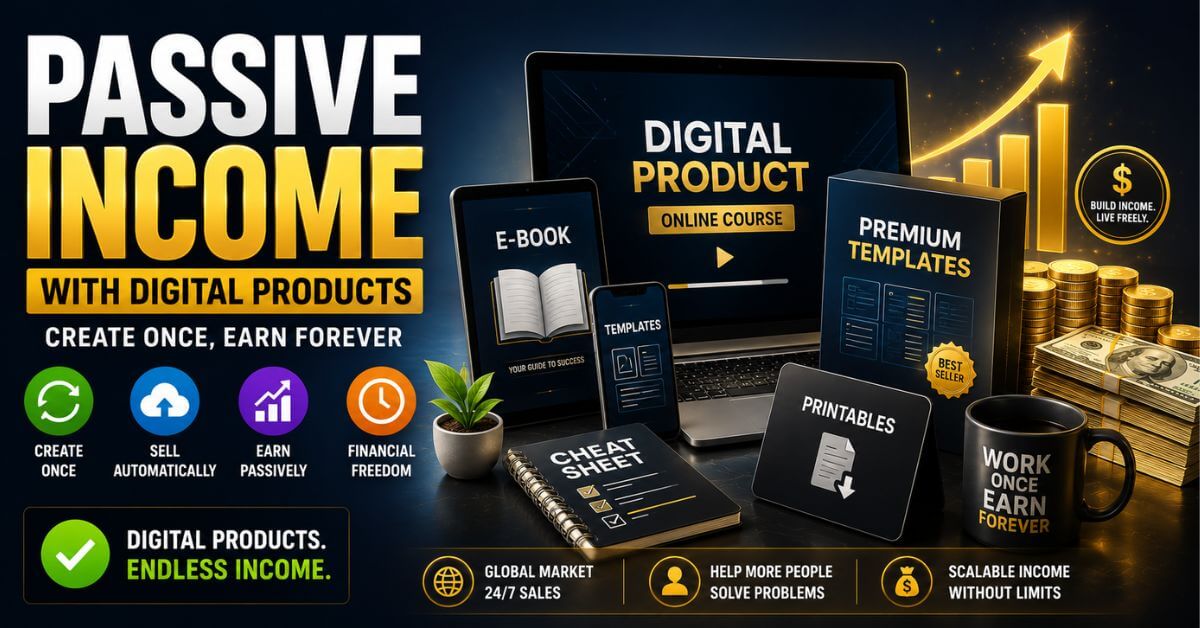
What Passive Income with Digital Products Really Means
Hazel Paradise sells ebooks and spreadsheets online. She sums up her business in four words: “Build once. Sell forever.”
That is the core idea behind passive-income digital products.
You build a file once and list it somewhere buyers already search. The platform delivers it automatically every time someone pays, whether that is at 2 pm on a Tuesday or at 3 am on a Sunday.
No shipping, no printing, no inventory sitting in a closet.
This guide covers what to build, where to sell it, and what a realistic month one, month three, and month six actually look like. It is written for beginner creators, freelancers, students, stay-at-home parents, and anyone who wants a second income stream without a boss or a storefront lease.
By the end, you will know which digital product to build first and what to do with it this week.
Why Digital Products are a Strong Passive Income Idea in 2026
Three numbers make this case better than any adjective could.
The global digital products market hit $9.8 billion in 2025. It is on track to reach $18.3 billion by 2033, a 9.6% annual growth rate (HTF Market Insights).
Consumer spending on digital media, including ebooks, courses, and templates, passed $560 billion in 2024. Transaction volume for digital products grew nearly 70% between 2022 and 2024 alone (Mastercard).
McKinsey separately projected global spending on digital goods to exceed $135 billion by 2024. Stripe’s own research shows that digital goods already account for an estimated 2.7% of the average global shopper’s wallet, with room to grow (Deloitte).
Three practical shifts made this accessible to regular people, not just software companies:
- AI tools cut product creation time from weeks to hours.
- Marketplaces like Etsy and Payhip now handle payment, delivery, and customer emails without a developer.
- Buyers on Pinterest, Instagram, and TikTok are already searching for the kind of specific, one-problem product a solo creator can build
That combination, not luck, is why passive-income digital products have become a mainstream online business idea.
It also sits inside something larger. Digital products are one branch of the creator economy, alongside paid newsletters, coaching, and affiliate marketing.
The skills that sell one printable well, understanding a specific audience, writing clear copy, pricing for value, carry directly into a course, a paid community, or a full catalog later. That progression is exactly what the rest of this guide walks through.
How passive income from digital products actually works
Here is the mechanism, not just the promise.
You create a file once. You list it on a platform connected to a payment processor. A buyer pays. The platform delivers the file automatically. You never touch that individual transaction.
The word “passive” describes what happens after the listing goes live. It does not describe getting there.
Sellfy, a marketplace used by creators across the photography, fitness, and food niches, reports that its average seller moves roughly 32,000 printable products per year on the platform. That volume comes from listings built once and left to run, not from daily manual work per order.
Income compounds as you add listings, because each new product is another chance to be found in search. Search traffic does not require a new post every day, the way social media does.
This is different from a service business, where income stops the moment you stop working. It is also different from most side hustles, where each dollar of income requires a matching hour of your time.
One file can sell to your first buyer and your 1000th buyer using the exact same upload.
The honest tradeoff: creation and marketing are not passive. Product validation, keyword research, cover design, and building traffic to a listing are active works, sometimes for weeks before the first sale.
What is passive is fulfillment. Know that distinction before you start, and you will not quit in month one wondering why nothing sold overnight.
The Best Digital Products for Passive Income
Not every digital product behaves the same way.
Some take thirty minutes to create and sell thousands of times. Others take weeks and sell for hundreds of dollars each. Here is what is performing well right now, with real, named examples behind each category.
Notion Templates
Notion templates are prebuilt workspaces, project trackers, and budget dashboards that buyers duplicate into their own account with one click.
Notion surpassed 100 million users in 2024, as confirmed on the company’s blog in the post titled “100 Million of You” (Notion HQ, 2024). Its template marketplace now lists more than 30,000 templates built by independent creators (Notion data, cited in ModernMeetingStandard, 2026).
A single-use business template typically sells for $15 to $29. A full business operating system can sell for $50 or more.
No coding is required. Only a clear structure and a genuine use case.
Canva Templates
Canva templates are editable design files sold as links that the buyer can duplicate and customize.
Social media carousel packs and pitch deck templates sell consistently on Etsy and Creative Market. A carousel pack priced between $9 and $15 often outsells a $40 template because the buying decision is faster and the value is obvious at a glance.
Also Read: How to Sell Canva Templates and Make Massive Profits
Printable Digital Products
Printables are PDF files buyers print at home: planners, trackers, worksheets, wedding checklists.
They remain some of the highest-volume digital downloads on Etsy, since delivery is instant. The catch is competition. A generic daily planner competes against thousands of near-identical listings.
A planner built for one specific audience converts better than a broad one. A postpartum recovery tracker or a freelance invoice log answers one exact search instead of a vague one.
Ebooks and Digital Guides
An ebook is the most accessible knowledge product format. If you can write 5,000 to 15,000 words on something you genuinely understand, you have a sellable file.
Ebooks perform well when priced between $7 and $27, either as standalones or bundled with a course.
The common mistake is writing for everyone. A guide titled “productivity systems for freelance video editors” outsells one titled “how to be more productive,” because it names a specific reader.
PLR and MRR Products
These two licensing models are often confused, and getting them right changes your entire strategy.
With PLR (Private Label Rights), you can buy a product and rewrite, rebrand, and sell it as your own original work. With MRR (Master Resell Rights), you buy a product and the right to resell it exactly as is, and your buyers get that same resale right.
Here is what that looks like in practice. A creator buys a $30 PLR pack of budgeting worksheets, rewrites the introduction, changes the design, adds two original worksheets of her own, and lists it under her own store name for $19.
A different creator buys the same worksheets under an MRR license, changes nothing, and resells them at the price the original creator set. Both can work. The PLR route takes an afternoon of extra effort and produces something that looks original. The MRR route takes an hour and produces something dozens of other resellers may be selling at the same time.
Online Courses
A course is a structured set of video or written lessons. It commands the highest price point of any digital product category, typically $97 to $500 or more.
Ashley Keller, a certified prenatal and postnatal exercise specialist, turned her own workout routines into a business called GlowBodyPT. Her 12-week post-pregnancy plan is priced at $130.
The online education market is projected to reach roughly $227.65 billion by 2031, and course profit margins often exceed 80% because the core content is built once and sold repeatedly (Statista).
The tradeoff is upfront effort. Building a course that students actually finish, not just purchase, takes real planning.
AI Digital Products
This is the newest category, and most competing guides barely mention it.
AI-generated art packs, prompt bundles for tools like ChatGPT or Midjourney, and AI-assisted ebook drafts are genuinely faceless products. The creator curates and directs rather than manually producing every element.
The skill here shifts from craft to prompt engineering and niche selection. One honest caveat: platforms are tightening disclosure rules around AI-generated listings, so check the specific marketplace policy before you list.
| Printables | $5 to $20 | Low | Fast first product |
| Canva templates | $9 to $40 | Low | Visual creators |
| Notion templates | $15 to $50 | Medium | Organized systems thinkers |
| Ebooks | $7 to $27 | Medium | Writers with a specific niche |
| PLR products | $10 to $60 | Medium (customization) | Building a brand fast |
| Online courses | $97 to $500+ | High | Subject matter experts |
| AI digital products | $5 to $30 | Low to medium | Curators and prompt builders |
Printables and templates take the least time to test. That makes them the most practical first product for most beginners, not because they earn the most, but because they are the fastest way to find out whether a niche has real demand.
Best Platforms to Sell Digital Products Online
Where you list a product changes your traffic source, your fee structure, and how much marketing you need to do yourself.
Etsy
Etsy brings built-in buyer search traffic from day one. That is the specific reason it works well with zero audience: buyers are already searching the marketplace itself. Etsy charges a small listing fee plus a 6.5 percent transaction fee.
The tradeoff is that you are renting attention on someone else’s marketplace. Algorithm or fee changes are outside your control.
Gumroad
Gumroad charges a flat 10% plus $0.50 per transaction, with no way to reduce that rate at any volume (Gumroad Pricing).
Gumroad is easy to use and popular among creators, but it won’t send you buyers on its own—unless you pay a whopping 30% fee for its Discover feed. To succeed here, you’ll need to bring your own audience.
Also Read: How to Set Up a Gumroad Store and Make Your First Sale
Payhip
Payhip flips the typical pricing model. On the free plan, you pay $0 per month and a 5% transaction fee. If you upgrade to the Plus plan for $29 a month, your transaction fee drops to just 2%. The Pro plan, at $99 a month, eliminates transaction fees altogether.
Here is what that means in real dollars. At $5,000 in monthly sales, Payhip Plus costs about $129 total. Gumroad costs about $685 for the exact same volume. That is a difference of $556 a month, or $6,672 a year.
Payhip reports that more than 130,000 sellers currently run their stores on the platform. It includes courses, memberships, coaching tools, and a built-in affiliate program on every plan, including the free one, and it automatically collects and remits EU and UK VAT (Payhip Pricing, 2026).
For anyone planning to sell more than one type of digital product, Payhip is the platform worth setting up first.
Shopify
Shopify starts at around $29 a month and suits sellers who eventually want to sell physical products alongside digital ones. It carries no separate platform transaction fee beyond standard payment processing, but the monthly cost applies whether you sell anything or not.
| Platform | Listing Fees | Processing Fees | Audience Potential | Recommended For |
| Etsy | Small listing fee | 6.5% | Built-in marketplace search | Beginners with no audience |
| Gumroad | $0 | 10% + $0.50 | Your own audience | Simple one-product setup |
| Payhip | $0 to $99 | 0% to 5% | Your own audience | Scaling past one product |
| Shopify | $29+ | 0% (processor fees apply) | Your own audience | Digital plus physical combo |
Start on Etsy to prove demand exists. Move higher-margin or repeat products to Payhip once you have some traffic and want to keep more of each sale.
Creating Digital Products Faster with AI Tools
The biggest barrier used to be time. Writing a full ebook could take a month of evenings.
That barrier has mostly disappeared. AI writing tools now produce a structured first draft in minutes instead of weeks. You still provide the expertise and the final edit, but the blank page problem is largely solved.
Writesonic is built for exactly this stage. Its Article Writer generates a researched first draft running into the thousands of words from a topic and outline, which is a realistic starting point for an ebook chapter or a course module script.
The output still needs a human pass. Independent reviewers consistently note that raw AI drafts read as generic without editing, and that limitation applies to every AI writing tool on the market, not just this one.
Here is the mechanism worth understanding: AI removes the friction of the blank page and the research phase, which is where most beginners stall out and never finish a product. Once a rough structure exists, adding your own real examples and formatting for your niche takes a fraction of the original time.
One honest limitation: a digital product built entirely from unedited AI output rarely sells well, and some marketplaces now require disclosure for AI-assisted listings. Use AI for speed on the first draft, then add the specific, personal detail that makes a product worth paying for.
Building an Email List that Turns into Recurring Passive Income
Marketplace traffic is borrowed. An email list is owned.
This is the single biggest strategic gap in most beginner digital product businesses, and also the fastest way to turn one-time buyers into a recurring income stream.
Here is how it works. Every buyer who purchases from your store can be added to an email list, with their permission. You email that list when you launch a new product or run a sale. Because that person already bought from you once, the conversion rate on a second offer is far higher than that of converting a stranger from cold search traffic.
My favorite email automation tool, beehiiv, is built for this specific job. It combines a newsletter builder, a simple website, and monetization tools such as paid subscriptions and digital product sales into a single dashboard. It takes 0% of your subscription revenue; only standard Stripe processing fees apply (beehiiv, 2026). The free plan supports building an audience of up to several thousand subscribers before any cost applies.
The structural advantage over marketplace traffic is straightforward. A launch email to your own list does not depend on an algorithm deciding to show your listing that week.
Building the list does not need to be complicated. Offer one small free download in exchange for an email address, deliver it automatically, and email that list every week or two with something genuinely useful, plus an occasional offer.
Selling Through Instagram DMs and Chat Automation
A newer distribution channel for digital product sellers is direct message automation. Instead of only sending buyers to a store link, creators use automated chat flows to answer questions and deliver products inside the conversation itself.
Here is the mechanism. Someone comments a keyword on your Instagram post or Reel. An automation immediately sends them a direct message with a link, a freebie, or a purchase option. That removes the extra step of leaving the platform, which cuts the number of people who drop off between seeing your content and actually buying.
ManyChat is the tool most creators use for this, and it connects to Instagram as an official Meta business partner (ManyChat, 2026). Reported open rates on these automated DMs run 70 to 90%, compared with 15 to 25% for typical email (Outfame).
That does not mean DM automation replaces email. It works best as a fast, high-intent channel layered on top of existing content, particularly for launches and time-limited offers.
One honest limitation: automation only works if you already have an audience engaging with your posts. It amplifies existing attention. It does not attract attention out of nothing, so content still has to come first.
Turning a Digital Product Business into a Paid Community
Individual product sales are useful, but recurring revenue is what actually compounds. This is where a growing number of digital product sellers move next: from one-time downloads into an ongoing paid community.
A skool community combines a discussion feed, a classroom area for courses and files, and event scheduling into one paid membership.
Pricing is entirely up to the creator, and monthly fees typically range from $9 to $97 depending on the depth of content and support offered.
Skool offers two simple pricing plans: $9/month for the Hobby tier and $99/month for the Pro tier. Each member payment is subject to a 2.9% fee plus 30 cents.
What stands out for creators is how Skool can turn your lineup of templates, ebooks, or course modules into a reliable monthly income, moving you away from chasing one-off sales.
Skool community monetization in practice usually layers together a few pieces: a lower-cost tier built around your existing digital products, a mid-tier with added coaching or live sessions, and occasional one-time launches sold to the full membership.
If a full community feels like more than you want to manage right now, Skool is still worth testing at a small scale, since its low-cost entry tier makes it realistic to try with an audience of a few dozen people before committing further.
One honest caveat: a paid community requires ongoing presence. Members expect you to show up, post, and respond. It is a stronger recurring income stream than a static listing, but it is meaningfully less passive and can be automated via AI or VA.
How to Price a Digital Product for Real Passive Income
Pricing is where most beginners quietly limit themselves. Underpricing feels safer, but it attracts the wrong buyer and caps income even when demand is strong.
Your cost to fulfill order number two and order number two thousand is nearly identical. That means the price should reflect the value the product delivers, not what feels comfortable to type as a beginner. A $39 ebook that saves someone ten hours of work is priced fairly. A $9 version of the same ebook signals low value before anyone opens it.
A $9 ebook and a $39 ebook usually require the same creation effort, but the higher price attracts a more serious buyer and can generate four times the revenue for the same work.
Research two or three comparable listings in your niche before setting a price. Buyers already have a reference point in their head for what similar products cost.
Bundling is the other lever worth understanding early. Once you have three or four related products, packaging them together at a discount to the sum of their individual prices raises average order value without any extra creation work. A buyer on the fence about a single $15 template often says yes to a $35 bundle of five because the perceived value increases faster than the price.
The Truth About “Passive Income with Digital Products” and Realistic Passive Income Timelines
This is the section most guides skip, and the one that actually protects your motivation.
Based on the platform and seller data cited throughout this guide, here is a realistic pattern for a beginner starting from zero:
- First sale: typically 30 to 60 days after listing, with real keyword research behind the listing
- $500 a month: typically 3 to 6 months in, once you have several listings live and some early reviews
- $1,000 or more a month: typically 6 to 12 months in, once you have multiple products and at least one owned traffic channel like email
These are estimates drawn from the patterns above, not a guarantee. Anyone promising overnight income or a fixed dollar figure in week one is selling a fantasy, not a business model.
Two limitations are worth naming, honestly.
Marketplace dependence is a real risk. Etsy has adjusted its fees and search algorithm before, and a seller whose entire income sits on one platform is exposed if rankings or policy shift. Spreading products across two or three platforms and building an email list you actually own reduces that risk.
Market saturation is also real. The same low barrier that makes this accessible to you makes it accessible to everyone else. A generic template competes against thousands of near-identical listings.
Specificity, not volume, is what separates a product that sells consistently from one that sits unseen. Choosing a narrow, underserved niche before you build anything is the single most valuable skill in this business model.
Your 30-day Plan to Start Selling Digital Products for Passive Income
Days 1 to 5: Pick a Niche and Validate It
Search for your product idea directly on Etsy or Google. Hundreds of reviews on something similar clearly indicate real demand exists. Zero results can mean an untapped niche, or it can mean nobody wants it. Read the reviews on close competitors to learn which one it is.
Days 6 to 12: Build One Product, Not Ten
Use Canva for templates, a simple document editor for an ebook, or Writesonic to draft the first version faster. Finish the first product completely before starting the second.
Days 13 to 16: List It Properly
Write a title and description using the exact phrases buyers search for, not clever branding language. Add a clean mockup image. List on Etsy first if you have no audience, or on Payhip if you already have some traffic to send.
Days 17 to 23: Set Up Your Email List and Your Product Delivery
Connect an email tool like beehiiv so every buyer can join your list with permission. Offer one small free download to start building that list even before your first paid sale.
Days 24 to 30: Add a Traffic Channel and Review
Post content on Pinterest or Instagram pointing to your product. Set up a simple ManyChat flow if you already post on Instagram regularly. Review what got attention, fix your weakest listing, and start product number two.
If you want a complete, structured system instead of piecing this together yourself, this is exactly the gap our own Digital Wealth Academy 3.0 was built to close: niche selection, product creation, and monetization, in order. And if branding your store is the part that feels hardest to figure out alone, the Ultimate Branding Course covers how to build a store identity people trust enough to buy from twice.
Recommended Tools Mentioned in This Guide
| Payhip | Selling digital products, courses, and memberships with low fees | Try Payhip |
| Writesonic | Drafting ebooks, course scripts, and product copy faster | Try Writesonic |
| beehiiv | Building an email list and monetizing it directly | Try beehiiv |
| ManyChat | Automating Instagram DMs to sell and deliver products | Try ManyChat |
| Skool | Turning a product catalog into a paid recurring community | Try Skool |
FAQ
Q: How much money can you realistically make selling digital products for passive income?
A: Based on the seller and platform data in this guide, most beginners see a first sale within 30 to 60 days and reach $500 a month within 3 to 6 months with a small, growing catalog. Consistent $ 1,000-or-more months typically take 6 to 12 months of active listing and traffic work. Income scales with the number of well-optimized products live, not with time alone.
Q: What is the difference between PLR products and MRR products for passive income?
A: PLR, or Private Label Rights, lets you modify, rebrand, and resell a product as your own original work, which takes more effort but produces a differentiated asset. MRR, or Master Resell Rights, lets you resell a product exactly as is and pass the same resale rights to your buyers, which launches faster but puts you in direct competition with everyone else reselling the same file.
Q: Which platform is best to sell digital products online with no existing audience?
A: Etsy sends buyer traffic to new listings automatically through its marketplace search, which makes it the practical starting point with zero audience. Payhip and Gumroad depend on the traffic you bring yourself, so they suit sellers who already have some social following or an email list.
Q: Can you actually build a scalable online business around digital downloads alone?
A: Yes, but scale comes from the catalog and the traffic system around it, not from any single file. Sellers who combine multiple products, an owned email list, and at least one recurring revenue layer, such as a paid community, are structurally positioned for more stable income than sellers relying on a single listing.
Q: Are AI digital products actually profitable, or is that just a trend?
A: AI-generated prompt packs, art bundles, and content drafts sell when the creator adds real curation, niche focus, and quality control, rather than listing raw, unedited AI output. Platforms are increasingly requiring disclosure for AI-assisted listings, so check the specific marketplace policy before publishing.
Q: How is a Skool paid community different from just selling a course once?
A: A one-time course sale ends the revenue relationship at checkout. A paid Skool community business charges an ongoing monthly fee, typically $9 to $97, for continuous access to content and interaction, generating recurring income rather than a single transaction.
Q: What is the fastest digital product to create as a complete beginner?
A: A printable, like a niche-specific planner, tracker, or checklist, is typically the fastest product to finish and list, often within a single week using free tools like Canva. It also tests whether real demand exists in your chosen niche before you invest the extra weeks a full course or ebook requires.
Q: Do you need a large social media following to make passive income from digital products?
A: No. Etsy’s built-in search traffic lets sellers make their first sales without an existing following, since buyers are actively searching the marketplace. A following becomes more valuable once you move to platforms like Payhip or Gumroad, which depend on the traffic you bring yourself.
Q: How do you validate a digital product idea before spending time creating it?
A: Search your exact product idea on Etsy or Google and study what already ranks. Strong review counts on a similar product confirm demand exists. Reading the negative reviews on that product often reveals the specific gap your version can fill, which is more useful than guessing from scratch.
Q: Should you price a digital product low to get your first sales faster?
A: A modest introductory price for your very first batch of buyers can help generate early reviews. Pricing that is permanently low signals lower value and caps revenue, even when demand is strong. Research two or three comparable listings in your niche and price close to that range once you have a few reviews.
Q: What makes recurring income from digital products different from a single product sale?
A: A single sale ends the revenue relationship at checkout. Recurring income comes from models such as a paid community, a subscription tier, or a bundle sold on a recurring basis. Sellers who add at least one recurring layer to their product catalog build a more stable revenue base than sellers relying on individual sales alone.
What to Do Next?
Passive income digital products are not a lottery ticket, nor are they an overnight get-rich-quick system.
They are a real, well-documented online business model. It rewards a narrow niche, a finished product, and consistent traffic more than any shortcut.
Pick one product type from this guide. Validate it against real Etsy or Google search demand this week. Build the first version before you build the second.
Once that first listing is live, your next step is learning how to write product descriptions that actually convert browsers into buyers, and how to turn that first sale into a repeat customer through your own email list.
If you want to follow a complete, tested system instead of building this alone, Digital Wealth Academy 3.0 walks you through the entire process from niche to first sale. The Ultimate Branding Course helps you build a store people remember and come back to.