Gemini Statistics 2026: Users, Revenue, and Market Growth
The Gemini app crossed 1 billion monthly active users on August 11, 2026. Google’s own announcement called it the fastest-growing product in the company’s history, just three weeks after Alphabet disclosed 950 million monthly active users on its Q2 2026 earnings call. Gemini’s models also process 22 billion API tokens per minute, up from 16 billion the prior quarter. Nearly 90% of the Fortune 100 now use Gemini Enterprise.
These numbers come directly from Alphabet’s disclosures and Google’s blog, not third-party estimates. They offer a clearer and more specific view than the general figures often shared in Gemini statistics roundups, which sometimes lack sources.
The following information about Gemini’s user base, revenue, pricing, enterprise adoption, and market position comes from Alphabet’s earnings reports, official Google announcements, and named analytics providers. Each figure includes its publication date. If a statistic is a third-party estimate and not confirmed by Google, it is clearly noted.
Key Gemini Statistics at a Glance
- The Gemini app surpassed 1 billion monthly active users as of August 11, 2026, the fastest-growing product in Google’s history (Source: Google, “More than 1 billion people are using the Gemini app every month,” August 11, 2026)
- 63% of Gemini users now talk to it directly via voice, including a growing share of “voice-only” users, and busy parents are 43% more likely than average to use voice for everyday tasks (Source: Google)
- Gemini generates more than 150 million images per day (Source: Google)
- Gemini for iOS has surpassed 100 million active users (Source: Google)
- Three weeks earlier, the app reached 950 million monthly active users as of Alphabet’s Q2 2026 earnings call on July 22, 2026, with daily active users tripling year over year (Source: Alphabet Q2 2026 earnings release, SEC filing)
- Gemini’s models process 22 billion API tokens per minute, up from 16 billion the prior quarter (Source: Alphabet Q2 2026 earnings release)
- Nearly 90% of the Fortune 100 now use Gemini Enterprise (Source: Sundar Pichai, Alphabet Q2 2026 earnings release)
- Alphabet’s Q2 2026 revenue reached $119.8 billion, up 24% year over year, with Google Cloud revenue up 82% to $24.8 billion (Source: CNBC, July 22, 2026)
- Google Cloud’s revenue backlog grew to $514 billion, more than half of which is expected to convert to recognized revenue over the next two years (Source: Yahoo Finance, citing Alphabet’s Q2 2026 results)
- Gemini’s share of worldwide generative AI web traffic rose from under 9% to roughly 27 to 28% between January 2025 and May 2026, the second-largest share behind ChatGPT (Source: Similarweb, 2026 Generative AI Landscape report)
- Google’s Antigravity AI coding tool, a separate product from the Gemini app, reported 2.4 million weekly active users in the same Q2 2026 earnings cycle (Source: CNBC, July 22, 2026)
- Alphabet raised its 2026 capital expenditure guidance to a range of $195 billion to $200 billion, up from the prior $180 billion to $190 billion forecast, reflecting continued AI infrastructure investment (Source: CNBC, July 22, 2026)
Gemini User and Growth Statistics
Monthly Active User Growth Timeline
Gemini’s user base has scaled quickly since early 2025, and every checkpoint below comes from an Alphabet earnings disclosure or an official Google announcement, not a third-party estimate.
| Date | Monthly Active Users | Source |
|---|---|---|
| Q1 2025 | ~350 million | Google Q1 2025 earnings |
| May 2025 (I/O) | ~400 million | TechCrunch, citing Google |
| Q3 2025 | ~650 million | TechCrunch, citing Google |
| Early 2026 (Q4 2025 earnings) | ~750 million | TechCrunch, citing Google |
| May 2026 (I/O) | ~900 million | |
| July 22, 2026 | 950 million | Alphabet Q2 2026 earnings release |
| August 11, 2026 | 1 billion+ | Google, official blog announcement |
That’s roughly a 2.9x increase in about sixteen months, and daily active users grew even faster than the monthly figure, tripling year over year, according to Pichai’s own remarks on the July earnings call (Source: Google, Alphabet Q2 2026 earnings call transcript).
For comparison, TechCrunch’s coverage of Google’s Q4 2025 results noted that ChatGPT was estimated at around 810 million weekly active users in the same late-2025 window, and Meta AI reported 1 billion monthly users at the time, putting Gemini’s growth in context against its two largest consumer competitors rather than in isolation (Source: TechCrunch).
How People Actually Use Gemini
Google’s August 11, 2026 announcement of the 1-billion-user milestone included behavioral data beyond the user count, covering voice, camera, and platform-specific usage patterns Google hasn’t previously disclosed in this level of detail.
| Behavior | Figure |
|---|---|
| Users who talk directly to Gemini via voice | 63% |
| Increased voice usage among busy parents vs. average users | +43% |
| Gemini Live interactions that go beyond voice (camera, screen share) | 1 in 5 |
| School-related requests that include a file attachment | 38% |
| Images generated per day | 150 million+ |
| Popular apps Gemini can trigger actions across on Android | 40+ |
| Active users on iOS | 100 million+ |
| macOS power-user prompting frequency vs. other surfaces | ~2x |
(Source: Google, “More than 1 billion people are using the Gemini app every month,” August 11, 2026)
Two patterns stand out in this data beyond the headline numbers. First, camera and screen-sharing use within Gemini Live, going beyond voice entirely into live visual problem-solving, is particularly popular with DIYers and students, according to Google, suggesting Gemini’s multimodal features are seeing genuine task-specific adoption rather than novelty use.
Second, the platform split shows meaningfully different behavior by device: iOS has crossed 100 million active users on its own, while macOS users specifically prompt roughly twice as often as users on other surfaces, a signal that desktop power users are the most intensive Gemini segment currently identified.
AI Overviews and AI Mode Usage
Gemini’s reach extends well beyond the standalone app, and this is where the scale gets genuinely large. AI Overviews, the Gemini-powered summaries that appear directly in Google Search results, reached more than 2.5 billion monthly users by Google I/O 2026 (Source: Alphabet Q2 2026 earnings release).
It’s worth stating clearly: the 950 million app figure and the 2.5 billion AI Overviews figure are not additive, and they measure different things. AI Overviews counts anyone who saw a Gemini-generated summary in Search, whereas the app figure counts people actively using the standalone Gemini product. Some users appear in both counts.
AI Mode, Google’s more conversational search experience, has its own separate growth story:
- Google’s AI Mode surpassed 1 billion monthly active users within its first year of availability
- AI Mode reached 75 million daily active users
- AI Mode queries run roughly three times longer than traditional search queries, and close to one in six AI Mode queries are non-text, meaning they involve voice or image input rather than typed text
Google’s broader ecosystem integration helps drive these numbers. All 15 Google products with more than 500 million users each now run on Gemini models in some capacity, and Circle to Search, Gemini’s on-screen search feature, is available on more than 580 million Android devices.
One newer integration worth flagging separately: Ask YouTube, a Gemini-powered feature that lets viewers ask questions about individual videos directly on the watch page, drew more than 140 million engaged users in June 2026 alone, according to Pichai’s Q2 2026 earnings remarks (Source: Google, Alphabet Q2 2026 earnings call transcript).
That’s a genuinely new distribution channel for Gemini that most existing statistics roundups haven’t captured yet.
➡️ Also Read: AI Statistics 2026: Adoption, Investment, and Industry Trends
Gemini Statistics by Country and Demographics
Google does not publish detailed demographic data for Gemini users. The following numbers are based on Similarweb analytics for gemini.google.com as of July 2026.
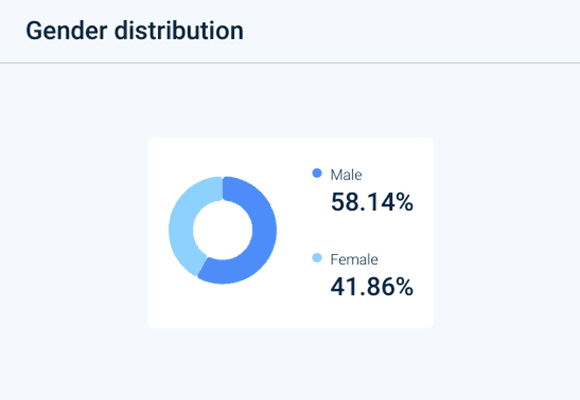
According to Similarweb’s most recent tracking, Gemini’s audience is 58.14% male and 41.86% female.
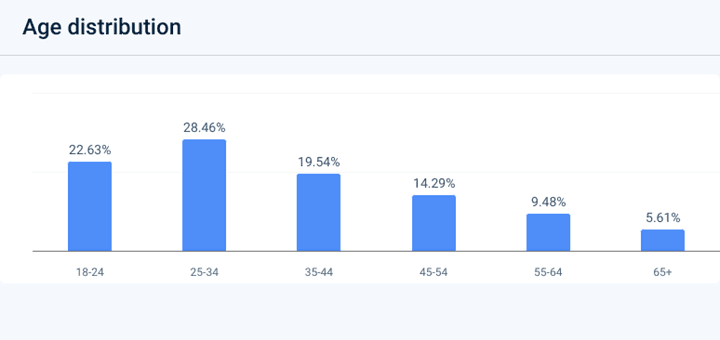
The largest age group is 25 to 34 years old (28.46%), followed by 18 to 24 years old (22.63%) and 35 to 44 years old (19.54%). This age distribution matches trends across other major AI chatbot platforms.
By country share, the United States accounts for approximately 11.30% of total Gemini web traffic, followed by Japan (7.74%), India (6.31%), Brazil (5.18%), and Indonesia (4.49%), measured in the May 2026 to July 2026 window. (Source: Similarweb).
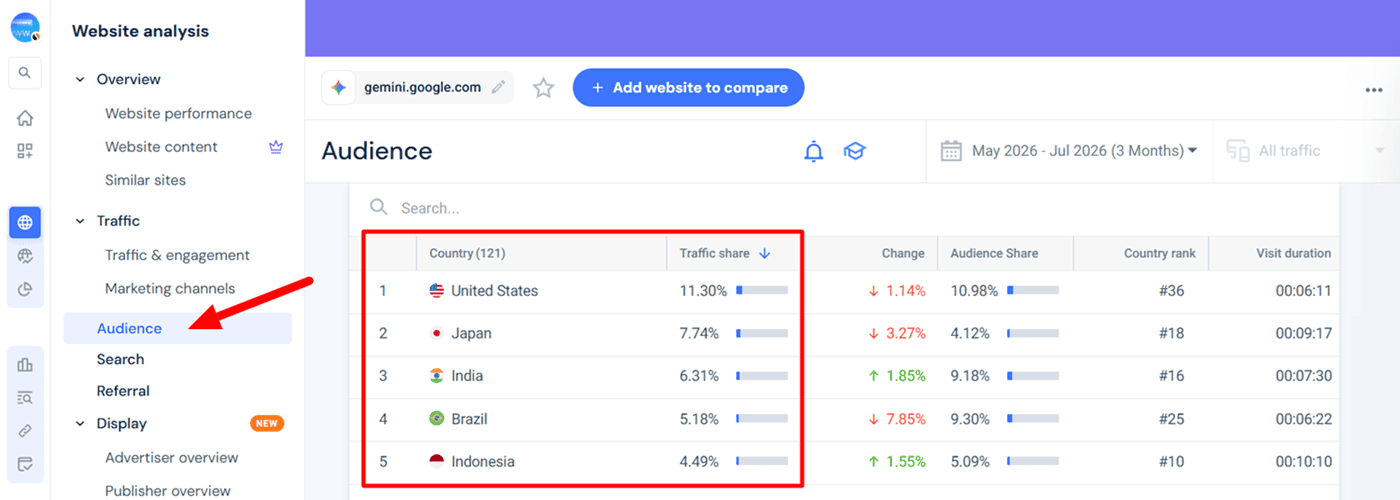
This distribution indicates a more global audience compared to US-centric products, reflecting Gemini’s availability in over 230 countries and territories and support for more than 70 languages.
These figures are website-visit estimates from a single analytics provider and do not represent a Google-confirmed census of Gemini’s actual user base.
Google does not disclose age, gender, or country data at this level of detail. Therefore, consider these statistics indicative rather than precise.
Google Gemini Revenue and Financial Statistics
Pricing and Monetization
Google restructured its entire consumer AI subscription lineup at I/O 2026 on May 19, 2026, moving from a single Premium tier to a four-tier structure and substantially cutting top-end prices.
As of Google’s subscription page on August 18, 2026, the current consumer plans are as follows. Google AI Plus costs $4.99 per month after a June 2026 price reduction from its original $7.99 launch price, and includes 200 GB of storage with double the usage limits of the free tier (Source: Gemini AI Pricing Page).
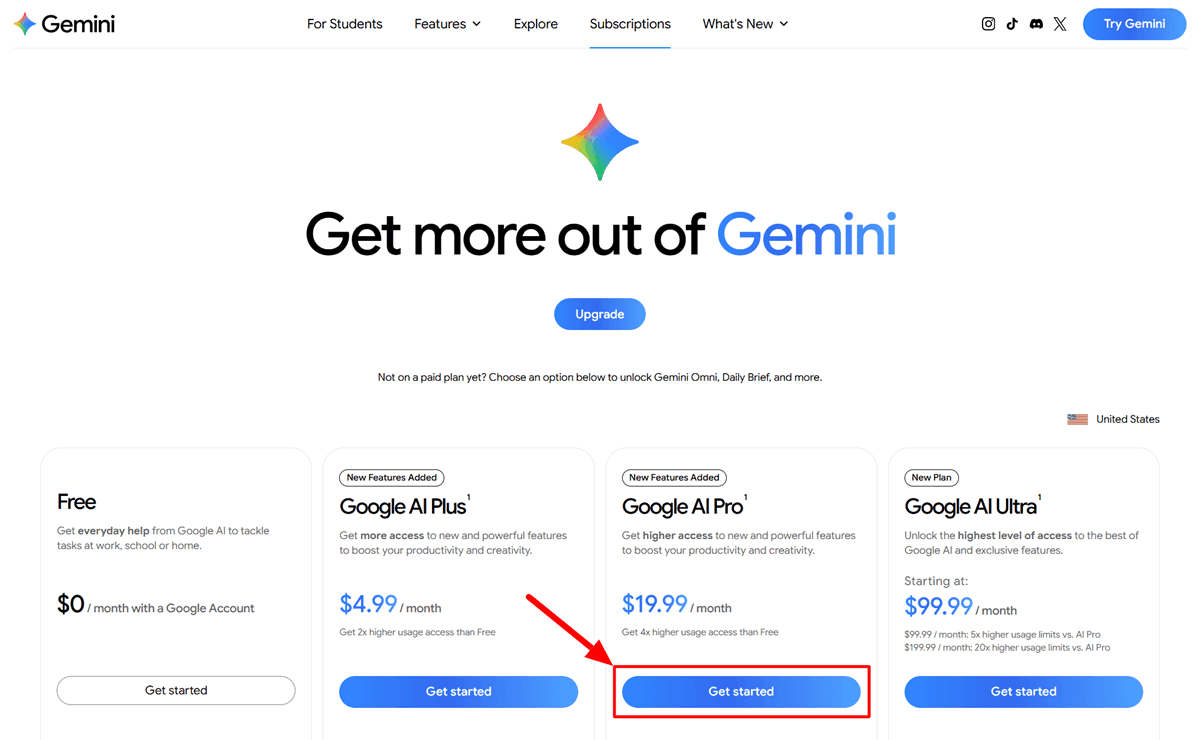
Google AI Pro costs $19.99 per month, includes 5 TB of storage, quadruple usage limits, and access to the Gemini 3 Pro model, along with a bundled YouTube Premium Lite subscription (Source: Google One, August 18, 2026).
Google AI Ultra now comes in two tiers following the I/O 2026 restructure. The lower Ultra tier costs $99.99 per month with five times AI Pro’s usage limits and 20 TB of storage. The higher Ultra tier costs $199.99 per month, a substantial cut from its previous $250 price point, and includes 20 times AI Pro’s usage limits, plus access to Gemini’s most capable reasoning model, Gemini Deep Think (Source: Google, official I/O 2026 announcement).
On the developer side, Gemini API pricing is billed per million tokens and varies by model tier. The latest model, Gemini 3.7 Flash, which launched August 13, 2026, is priced at $1.50 per million input tokens and $7.50 per million output tokens, undercutting the earlier Gemini 3.1 Pro model’s $2 input and $12 output pricing by roughly 25% on comparable coding tasks (Source: Gemini API Pricing Data).
Google doesn’t break out Gemini-specific revenue from Alphabet’s consolidated results, so any dollar figure attached specifically to “Gemini revenue” should be read as an estimate rather than a disclosed number.
What Google does disclose are adoption metrics tied to monetization: more than 8 million paid Gemini Enterprise seats, up from roughly 2 million in Q3 2025, and Gemini Enterprise seat growth of 40% quarter over quarter in Q1 2026 alone.
Google Cloud and Enterprise Revenue
Google Cloud is the clearest place where Gemini’s business impact shows up in Alphabet’s actual financial results. Cloud revenue reached $24.8 billion in Q2 2026, up 82% year over year, well above analyst expectations of roughly $22.4 billion (Source: Forbes, July 22, 2026).
A few more figures worth isolating from the same earnings cycle:
- Google Cloud’s operating margin expanded from 20.7% in Q2 2025 to 35.6% in Q2 2026 (Source: Yahoo Finance)
- Cloud operating income more than tripled year over year to $8.8 billion (Source: Forbes)
- Google’s revenue backlog, largely tied to AI infrastructure and Cloud contracts, grew by more than $50 billion quarter over quarter to $514 billion (Source: Yahoo Finance)
- Alphabet’s Q2 2026 net income reached $112.1 billion, compared with $28.2 billion in the same quarter a year earlier, though this figure includes one-time items beyond core operating performance (Source: 9to5Google, July 22, 2026)
Alphabet is funding this growth with a substantially larger capital budget. The company raised its 2026 capital expenditure guidance to a range of $195 billion to $205 billion, up from the $180 billion to $190 billion it forecast just one quarter earlier, and CFO Anat Ashkenazi told analysts the company remains in “a supply-constrained environment” for AI infrastructure (Source: CNBC, July 22, 2026).
Gemini Enterprise Adoption Statistics
Enterprise adoption is where Gemini’s growth looks most different from a typical consumer AI chatbot story. A few figures define the current picture:
- Nearly 90% of the Fortune 100 now use Gemini Enterprise, according to Pichai’s Q2 2026 earnings remarks (Source: Alphabet Q2 2026 earnings release)
- More than 8 million paid Gemini Enterprise seats are active, spread across a customer base that includes named enterprise accounts like PepsiCo, Intel, HSBC, Bell Canada, and Macy’s (Source: Futurum Group)
- Google’s Agent Development Kit, the framework enterprises use to build and deploy AI agents on top of Gemini, reached nearly 70 million total downloads by Q2 2026 (Source: Futurum Group)
- Marketplace transactions on Google Cloud grew more than sevenfold year over year, a signal that partner and reseller channels are becoming a meaningful path for enterprise AI adoption rather than direct sales alone (Source: Futurum Group)
- Google’s new customer acquisition velocity for Cloud more than doubled year over year, according to Pichai’s earnings call remarks (Source: Google, Alphabet Q2 2026 earnings call transcript)
That combination, a near-universal Fortune 100 footprint alongside accelerating new-customer growth, suggests Gemini Enterprise isn’t just retaining early adopters. It’s actively expanding into net-new accounts at a faster rate than it was a year earlier.
Gemini API and Developer Statistics
Developer adoption of Gemini has grown in step with consumer and enterprise usage.
As of 19 May 2026, over 8.5 million developers are building new apps and experiences with Gemini models each month.
Google’s Generative AI model APIs now handle about 19 billion tokens per minute.
In the last year, more than 375 Google Cloud customers each processed over one trillion tokens, showing strong demand for AI across different industries.
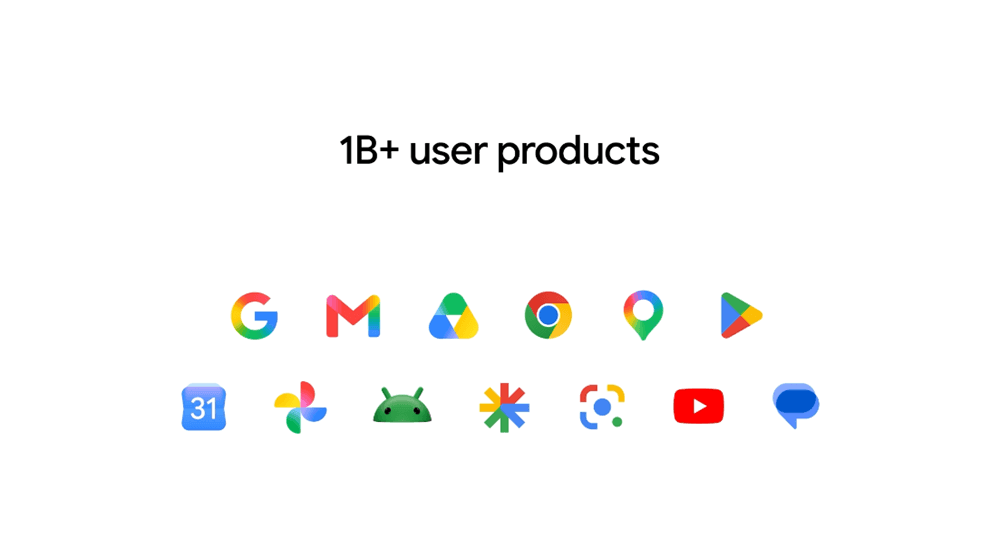
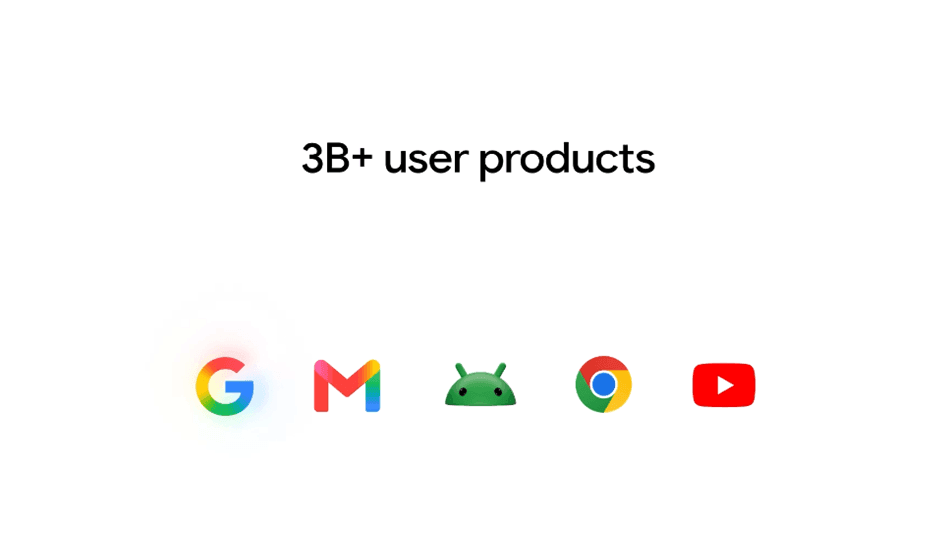
Today, 13 Google products have more than a billion users, and five have over 3 billion users. Gemini models are a major reason why more people are choosing Google products and using them more often. (Source: Google I/O 2026)
Token processing volume is the clearest real-time signal of API-level developer activity, and it has grown fast:
- Roughly 10 billion tokens per minute in early 2025
- 16 billion tokens per minute by Q1 2026
- 22 billion tokens per minute by Q2 2026, more than doubling in a single year (Source: Alphabet Q2 2026 earnings release, July 22, 2026)
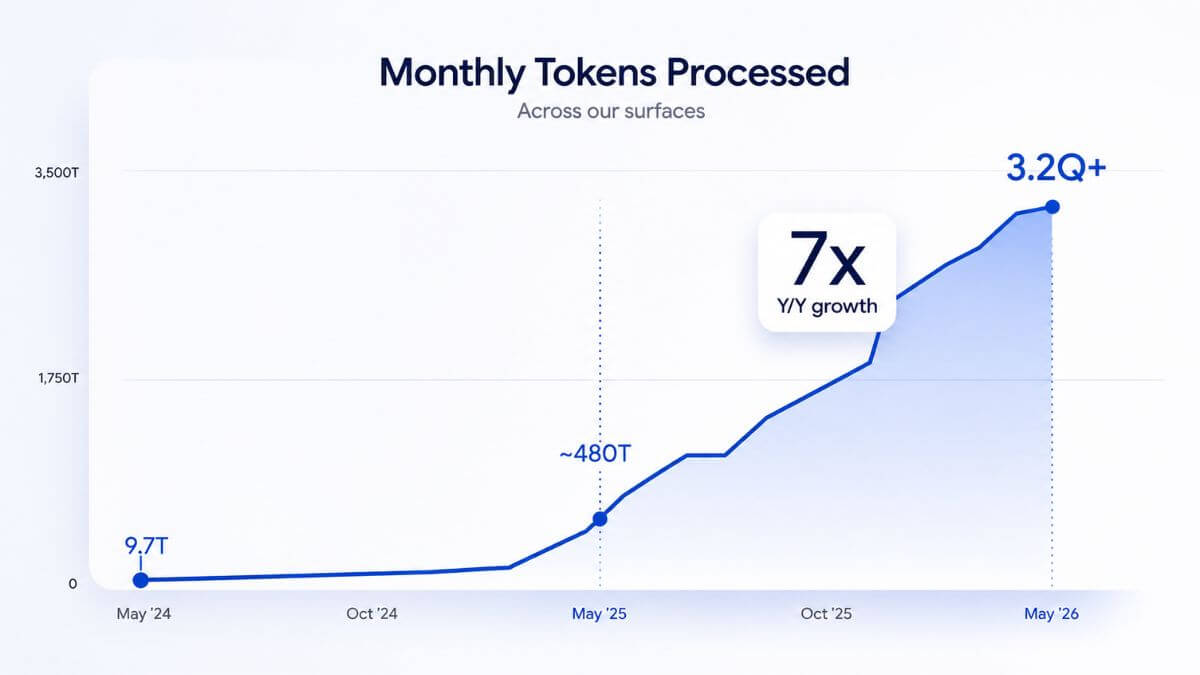
Two years ago, Google processed 9.7 trillion tokens each month across its platforms, which was already massive. By last year’s I/O, that number had grown to about 480 trillion tokens. Now, it has increased seven times to over 3.2 quadrillion tokens every month. (Source: Google I/O 2026)
Independent developer research adds useful context on how widely AI coding tools have spread generally. Stack Overflow’s 2025 Developer Survey found that 84% of respondents were using or planning to use AI tools in development, with 51% using them daily, and 28% of professional developers specifically reported using Gemini.
Google’s own coding-focused product, Gemini CLI, launched as an open-source, Apache 2.0-licensed terminal agent on June 25, 2025. Personal accounts get access to Gemini 2.5 Pro with a 1 million token context window, plus a free usage tier of 60 requests per minute and 1,000 requests per day.
The project’s GitHub repository has drawn more than 106.5k stars, 14.4k forks, and 6,369 commits since launch, a strong signal of active developer engagement with the open-source tooling around Gemini rather than just the hosted product.
Gemini Market Share: Gemini vs. ChatGPT vs. Other AI Platforms
Market share figures for AI chatbots vary significantly depending on which analytics provider and time window you cite, so it’s worth naming the source and date for every number in this section rather than presenting a single snapshot as definitive.
Similarweb’s own worldwide web traffic panel, published as part of its 2026 Generative AI Landscape report, shows the clearest trend line.
ChatGPT’s share of global generative AI website traffic fell from roughly 76% in June 2025 to approximately 53% by May 2026. Gemini captured most of that lost ground, rising from under 9% to roughly 27 to 28% of traffic over the same period, making it the second-largest AI platform by web traffic share (Source: Similarweb, 2026 Generative AI Landscape report).
Claude, the third major platform tracked, grew from roughly 2% to around 9% over the same window, still far smaller in absolute terms but the fastest proportional grower of the three.
Raw user counts tell a related but distinct story, since different companies report different metrics on different schedules. OpenAI reported more than 900 million weekly active users for ChatGPT as of February 2026, and the ChatGPT app separately crossed 1 billion global monthly active users by June 2026 (Source: SensorTower’s State of AI Report 2026).
Gemini’s 950 million monthly active users, disclosed the same month via Alphabet’s earnings, put it in a broadly comparable range to ChatGPT by raw scale, even though the two companies measure and report on different cadences (weekly versus monthly) that make an exact comparison imprecise.
Claude trails both platforms by a wide margin on raw user count, with estimates ranging from roughly 56 million app-only monthly active users to a broader combined web-and-app estimate closer to 245 million, depending on scope.
Meta AI is worth including in this picture too, even though it’s rarely covered alongside the other three. Meta AI reported 1 billion monthly users in late 2025, putting it ahead of both Gemini and Claude by that specific metric at the time, though Meta AI’s usage is heavily embedded inside WhatsApp, Instagram, and Facebook rather than driven by a standalone destination the way ChatGPT, Gemini, and Claude are (Source: TechCrunch).
The practical read: ChatGPT still leads on most raw scale metrics, but its share of the category has fallen by more than 20 percentage points in a year, as Gemini specifically has closed the gap fastest by absolute percentage points gained, while Claude has grown fastest in proportional terms off a much smaller base.
Gemini Product Ecosystem Statistics
Gemini’s footprint now extends well beyond the chatbot most people associate with the name, and several of these products have meaningful adoption numbers worth tracking separately.
Google Antigravity, Google’s dedicated AI coding assistant, reached 2.4 million weekly active users as of Q2 2026, disclosed in the same earnings cycle as the headline Gemini app figures (Source: CNBC, July 22, 2026).
That’s a separate product from Gemini CLI, and both compete directly with tools like Claude Code and GitHub Copilot in the AI coding assistant category.
Gemini Enterprise handled more than 5 billion customer interactions in Q4 2025 alone, up 65% year over year, a figure that captures the scale of automated customer-facing usage running on Gemini across Google’s enterprise customer base (Source: Google Q4 2025 Earnings Call, February 2026).
Gemini Enterprise continues to gain momentum. In the first quarter of 2026, Google reported a 40% increase in paid monthly active users compared to the previous quarter. (Source: Google Cloud Blog)
Google has seen strong adoption of Gemini Enterprise to date from companies including:
- KPMG achieved a 90% employee adoption rate for Gemini Enterprise, deploying more than 100 specialized agents in the first month to support global client services.
- Macquarie Bank saved over 100,000 employee hours by automating workflows and streamlining operations with Gemini Enterprise.
- WPP doubled its production speed by launching an AI-driven campaign every four days. It generated 2.5 times more value for clients through rapid real-time asset testing and creative iteration.
- Virgin Voyages deployed more than 1,000 specialized AI agents across the enterprise, including 50 dedicated agents that reduced marketing campaign creation times by 40%.
- Signal Iduna improved customer response efficiency by 37%, delivering insurance answers significantly faster using Gemini Enterprise.
- GE Appliances scaled decentralized AI by deploying over 800 AI agents across its manufacturing, supply chain, and logistics operations.
- Deloitte increased security analyst efficiency by over 60%, reducing threat hunting across billions of logs from hours to seconds using Gemini in Security Operations.
- Colgate-Palmolive reduced external security exposure issues by 44% while maintaining extended periods with zero critical security risks.
- University of California Riverside reduced incident response times by 90%, cutting detection-to-resolution duration from over 20 minutes to under two minutes.
- The American Society of Clinical Oncology scaled trusted cancer expertise to 50,000 oncology professionals worldwide through Gemini Enterprise.
Two newer agentic features, Gemini Spark and Daily Brief, launched around I/O 2026 as part of Google’s push toward AI agents that act on a user’s behalf rather than simply responding to prompts. Gemini Spark is available to Pro or Ultra subscribers as a personalized agent that can run tasks autonomously across Google products, while Daily Brief pulls together morning updates from Gmail, Calendar, and Gemini conversations into a single summary (Source: Gemini Spark Overview).
According to our live data tracking, the Gemini app has been downloaded over 1 billion times since its May 2024 launch. It has reached 100 million active iOS users and has consistently ranked among the five most downloaded apps worldwide during this period.
➡️ Also Read: Claude Statistics 2026: Users, Revenue, and Market Position
Frequently Asked Questions About Gemini Statistics
Q: How many users does Google Gemini have?
A: The Gemini app reported 950 million monthly active users as of Alphabet’s Q2 2026 earnings call on July 22, 2026. Including Gemini-powered features across Google’s ecosystem, such as AI Overviews in Search, total reach extends to more than 2.5 billion monthly users. However, that broader figure measures a different kind of usage than the standalone app count.
Q: How fast is Google Gemini growing?
A: Gemini grew from roughly 400 million monthly active users in May 2025 to 950 million by July 2026, more than doubling in about fourteen months. Daily active users grew even faster, tripling year over year according to Google’s own Q2 2026 disclosure.
Q: What is Google Gemini’s revenue?
A: Google doesn’t disclose standalone Gemini revenue as a separate line item within Alphabet’s results. The clearest financial signals are Google Cloud’s revenue, which reached $24.8 billion in Q2 2026 (up 82% year over year), and Gemini Enterprise’s paid seat count, which surpassed 8 million.
Q: How much does Gemini cost?
A: Google AI Plus costs $4.99 per month, Google AI Pro costs $19.99 per month, and Google AI Ultra runs $99.99 to $199.99 per month depending on tier, following Google’s I/O 2026 pricing restructure. A free tier remains available with lower usage limits and access to Gemini’s base models.
Q: How does Gemini compare with ChatGPT in market share?
A: Gemini held roughly 27 to 28% of worldwide generative AI web traffic as of May 2026, up from under 9% a year earlier, according to Similarweb. ChatGPT remained the largest platform at approximately 53% of traffic over the same period, down from around 76% a year prior, meaning Gemini has closed a meaningful share of the gap even though ChatGPT still leads.
Q: How many developers use Gemini?
A: Developer adoption grew from roughly 9 million builders in mid-2025 to approximately 13 million using Gemini and Google’s broader generative AI models by late 2025, alongside 22 billion API tokens processed per minute as of Q2 2026.
Q: What companies use Gemini Enterprise?
A: Gemini Enterprise counts named customers including PepsiCo, Intel, HSBC, Bell Canada, and Macy’s, and reaches nearly 90% of the Fortune 100. The platform has more than 8 million paid seats and handled over 5 billion customer interactions in the fourth quarter of 2025 alone.
Q: Is Gemini available in Google Search?
A: Yes, primarily through two features. AI Overviews serve more than 2.5 billion monthly users with AI-generated summaries directly in search results. In comparison, AI Mode offers a more conversational search experience and has surpassed 1 billion monthly active users, with 75 million daily active users.
Conclusion
Gemini’s 2026 story is really two stories running in parallel. On the consumer side, the app crossed 950 million monthly active users by mid-year, closing meaningfully on ChatGPT’s lead in overall category traffic share even as OpenAI’s product still holds more raw users.
On the enterprise and infrastructure side, Google Cloud revenue grew 82% year over year, Gemini Enterprise now reaches nearly 90% of the Fortune 100, and Alphabet is committing up to $205 billion in 2026 capital spending to keep pace with demand.
Neither side of that story fully explains Gemini’s position without the other. The consumer numbers show reach; the enterprise and Cloud numbers show where Google’s AI investment is actually converting into contracted revenue. Any Gemini statistics resource that leads with one and ignores the other is missing half of what’s actually driving the platform’s growth.
This page will be updated as Alphabet reports new quarterly figures and as Google’s product and pricing announcements continue through the rest of 2026.
➡️ Also Read: ChatGPT Statistics 2026: Users, Revenue, Pricing, and Market Share