
AI Statistics 2026: Adoption, Investment, and Industry Trends

Most “AI statistics” roundups you’ll find right now are running on data from 2022 and 2023 dressed up with a 2026 headline. You’ll spot the tell immediately: a $15.7 trillion economic projection with no update since it was first floated, a jobs figure from a pre-ChatGPT labor study, adoption percentages pulled from a survey that closed before GPT-4 existed.
None of that is wrong, exactly. It’s just old. And in a field where the investment numbers alone have grown by triple digits year over year, old data doesn’t just understate reality. It actively misleads.
This page is built the other way around. Every statistic below comes from a named primary source published in late 2025 or 2026, mostly Stanford HAI’s AI Index, McKinsey’s global AI survey, the World Economic Forum, and Pew Research Center. Each data point carries its source and link directly in the sentence, so you can verify or cite it yourself without digging through a bibliography at the bottom of the page.
Where market research firms disagree (and on AI market size, they disagree by hundreds of billions of dollars), that disagreement is explained rather than papered over.
Key AI Statistics at a Glance
Here’s the fastest way to get oriented before the deeper sections below:
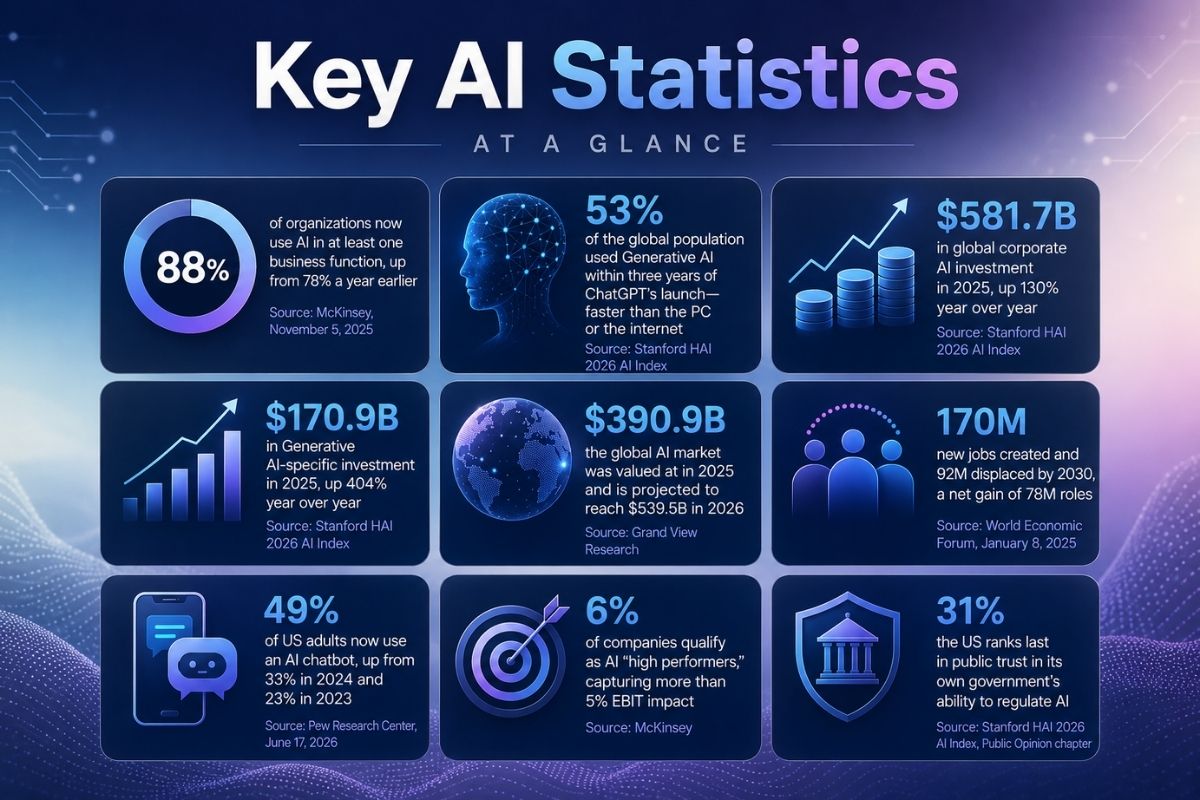
- 88% of organizations now use AI in at least one business function, up from 78% a year earlier (Source: McKinsey, November 5, 2025)
- Generative AI reached 53% of the global population within three years of ChatGPT’s launch, faster than either the personal computer or the internet (Source: Stanford HAI 2026 AI Index)
- Global corporate AI investment hit $581.7 billion in 2025, up 130% year over year (Source: Stanford HAI 2026 AI Index)
- Generative AI-specific investment climbed to $170.9 billion, up 404% year over year (Source: Stanford HAI 2026 AI Index)
- The global AI market was valued at $390.9 billion in 2025 and is projected to reach $539.5 billion in 2026 (Source: Grand View Research)
- The World Economic Forum projects 170 million new jobs created and 92 million displaced by 2030, a net gain of 78 million roles (Source: World Economic Forum, January 8, 2025)
- 49% of US adults now use an AI chatbot, up from 33% in 2024 and 23% in 2023 (Source: Pew Research Center, June 17, 2026)
- Despite near-universal organizational adoption, only about 6% of companies qualify as AI “high performers,” capturing more than 5% EBIT impact (Source: McKinsey)
- The US ranks last among surveyed countries in public trust in its own government’s ability to regulate AI, at just 31% (Source: Stanford HAI 2026 AI Index, Public Opinion chapter)
Also Read: 100+ ChatGPT Statistics and Incredible Facts
Global AI Adoption Statistics
Organizational Adoption Rates
McKinsey’s most recent global AI survey was fielded between June and July 2025, drawing responses from 1,993 participants across 105 countries. It found that 88% of organizations report regular AI use in at least one business function, up sharply from 78% the year before (Source: McKinsey).
Adoption is also getting broader within each organization, not just more common across companies:
- Two-thirds of organizations now use AI in multiple business functions (Source: McKinsey)
- About half report AI deployment across three or more functions (Source: McKinsey)
- 92% of firms plan to increase their AI budgets within the next three years (Source: McKinsey survey data, as reported by High Peak Software)
- 73% of executives say they plan to use generative AI to change their company’s business model outright, not just automate existing tasks (Source: McKinsey survey data, as reported by High Peak Software)
Adoption breadth and adoption depth are two different stories, though, and most coverage of this survey conflates them.
The same McKinsey data shows that nearly two-thirds of organizations have not yet begun scaling AI across the enterprise (Source: McKinsey). That means they’re running a pilot in one corner of the business rather than rewiring how the organization actually operates.
Only about a third report genuine scaling. Within that smaller group, just 6% qualify as “high performers,” attributing more than 5% of EBIT to AI, and only 39% can point to any measurable EBIT impact at all (Source: McKinsey).
Stanford HAI’s 2026 AI Index adds useful historical context. Generative AI specifically reached an estimated 53% of the global population within three years of its public debut, a diffusion rate Stanford describes as faster than either the personal computer or the internet achieved at the same point in their own adoption curves (Source: Stanford HAI 2026 AI Index).
The Pilot-to-Scale Gap
If there’s one number that should reframe how you read every other adoption statistic in this space, it’s this one.
McKinsey’s survey found that 23% of organizations report actively scaling an agentic AI system somewhere in the enterprise, and another 39% say they’ve begun experimenting with agents (Source: McKinsey). Most of the organizations that are scaling are doing so in only one or two functions, not enterprise-wide.
Separate industry reporting citing Gartner’s 2026 forecast adds a sharper edge to that picture: more than 40% of current agentic AI projects are expected to be canceled by 2027, largely over unclear ROI and escalating compute costs (Source: Gartner forecast, as reported by Axis Intelligence).
A few more data points worth flagging on the “adoption vs. real usage” gap:
- Only 8.6% of companies have AI agents actually deployed in production, based on a survey of more than 120,000 enterprise respondents run between March 2025 and January 2026 (Source: Recon Analytics survey, as reported by Axis Intelligence)
- 63.7% of companies report no formalized AI initiative at all, despite the 88% headline adoption figure (Source: Recon Analytics survey, as reported by Axis Intelligence)
- Under the OECD’s stricter methodology (production use only, not any use anywhere in the org), official AI-use statistics sit at just 20.2% for 2025, versus McKinsey’s 88% headline figure using a broader “at least one function” definition (Source: OECD data, as compiled by Paul Okhrem’s industry research)
The practical takeaway for anyone building a business case: citing “88% adoption” without this scaling context overstates how embedded AI actually is inside the average organization. The real competitive divide isn’t between companies using AI and companies not using it. It’s between the small cohort translating pilots into measurable enterprise value and the much larger group still running isolated experiments.
AI Market Size and Investment Statistics
Corporate AI Investment
Stanford HAI’s 2026 AI Index reports that global corporate investment in AI reached $581.7 billion in 2025, a 130% increase year-over-year (Source: Stanford HAI 2026 AI Index).
Generative AI specifically drew $170.9 billion of that total, up 404% from the prior year (Source: Stanford HAI 2026 AI Index).
That gap between overall AI investment growth (130%) and generative AI investment growth (404%) tells you where capital is actually concentrating: generative and agentic systems specifically, not “AI” as a broad category.
On the spending side rather than the investment side:
- Worldwide end-user spending on AI models and platforms is projected to total $64 billion in 2026, up 63.4% from $39 billion in 2025 (Source: Gartner, July 20, 2026)
- Spending on generative AI models specifically is forecast to grow 117% in 2026 (Source: Gartner, July 20, 2026)
- AI platform spending overall (the infrastructure layer beneath the models) is projected to rise 36.9% in 2026 (Source: Gartner, July 20, 2026)
Gartner’s research notes that enterprise AI budgets are coming under closer scrutiny even as they grow. Buyers are increasingly favoring vendors who can demonstrate concrete outcomes on cost, latency, and reliability rather than raw model capability (Source: Gartner, July 20, 2026).
Global AI Market Size: Why the Numbers Don’t Agree
Global AI market size estimates vary enormously depending on which firm you cite. Any statistics page that quotes a single number without naming the source and methodology is hiding something.
Here’s what three major research firms actually reported for the same market, in the same year:
- Grand View Research: $390.9 billion in 2025, growing to $539.5 billion in 2026 and reaching $3.5 trillion by 2033 at a 30.6% CAGR (Source: Grand View Research)
- Precedence Research: $757.6 billion for 2025, using a broader definition that includes more of the AI hardware and infrastructure stack (Source: Precedence Research figures, as compiled by Technology Checker)
- Statista Market Insights: roughly $244 billion for the same year, using a narrower, software-only definition (Source: Statista figures, as compiled by Technology Checker)
All three firms are measuring real growth. They’re simply drawing the market’s boundaries differently: some count AI semiconductors, servers, and data-center capex, while others count only software revenue. The honest way to cite AI market size is to name the firm and its scope alongside the number, rather than presenting one figure as the definitive total.
What’s consistent across every methodology is the direction and pace of growth. Generative AI’s slice of the market is growing faster than the AI market overall. One widely cited estimate puts the generative AI segment specifically at $91.6 billion in 2026, up 45% from $63 billion in 2025 (Source: Precedence Research and Menlo Ventures data, as compiled by companieshistory.com).
AI Statistics by Industry
Adoption depth varies substantially by sector, and McKinsey’s sector-level breakdown is the most current authoritative source available.
Technology and financial services lead:
- Technology and software companies lead AI adoption by a wide margin, with reported adoption above 85% (Source: McKinsey sector data, as reported by MedhaCloud)
- Financial services follow closely, with McKinsey reporting overall sector adoption in the low-to-high 70% range across banking, insurance, and related subsectors (Source: McKinsey sector data, as reported by High Peak Software)
- A subset of high-performing financial firms already attributes more than 10% of their EBIT directly to AI deployment, reflecting the sector’s early and heavy investment in fraud detection, algorithmic trading, and automated customer support (Source: McKinsey sector data, as reported by High Peak Software)
- The financial services AI market itself is projected to grow at roughly 86% through 2032, the fastest projected growth rate of any industry vertical tracked (Source: McKinsey sector data, as reported by High Peak Software)
Healthcare, manufacturing, and other sectors show a different pattern:
- Healthcare adoption trails the leaders but is accelerating quickly, driven largely by clinical decision support, medical imaging analysis, and diagnostic reasoning tools (Source: Stanford HAI 2026 AI Index, cited via HAI’s public research summary)
- Manufacturing, automotive, and aerospace show lower headline adoption percentages but concentrated, high-value use in R&D, where AI-assisted design and simulation can meaningfully cut both time-to-market and development costs (Source: McKinsey sector data, as reported by High Peak Software)
- Human resources functions report some of the lowest AI adoption rates of any business function, at around 11%, reflecting both the sensitivity of HR data and slower workflow digitization compared to sales, marketing, or IT (Source: McKinsey sector data, as reported by High Peak Software)
- Software, SaaS, IT services, and customer operations convert from pilot to production fastest of any vertical, largely because of high-volume repetitive work, digital-native workflows already in place, and short feedback loops for measuring results (Source: PwC 2026 AI Performance Study, as reported by GoGloby)
The consistent pattern across every sector-level breakdown available is that regulated, high-stakes industries such as healthcare, financial services, and government adopt more cautiously. That’s not because the technology lacks value there. It’s because the bar for auditability, explainability, and accountability is structurally higher before anything reaches production.
AI and the Job Market
AI-Created vs. Displaced Jobs
The World Economic Forum’s Future of Jobs Report 2025 remains the most rigorous available projection of AI’s net labor market effect. It’s based on a survey of more than 1,000 employers spanning 22 industry clusters, 55 economies, and over 14 million workers, published January 8, 2025 (Source: World Economic Forum).
The headline numbers:
- 170 million new jobs are projected to be created by 2030, equivalent to about 14% of current global employment (Source: World Economic Forum)
- 92 million existing roles are projected to be displaced over the same period (Source: World Economic Forum)
- The net result is a projected gain of 78 million jobs globally (Source: World Economic Forum)
- Roughly 22% of today’s total jobs are expected to be disrupted in some way, meaning the net figure masks substantial underlying churn (Source: World Economic Forum)
That churn is the part most headline summaries skip entirely. A few more findings from the same report worth surfacing:
- 39% of workers’ current skill sets are expected to become outdated between 2025 and 2030 (Source: World Economic Forum)
- 63% of employers cite the resulting skills gap as their single biggest barrier to business transformation, ahead of cost, regulation, or technology access (Source: World Economic Forum)
- 85% of employers surveyed say workforce upskilling is now a top strategic priority, a sharp shift from treating AI training as an optional perk (Source: World Economic Forum)
- Investment in generative AI has increased eightfold since ChatGPT’s public launch (Source: World Economic Forum, as summarized by Sustainability Magazine)
In-Demand AI Skills
Stanford HAI’s 2026 AI Index is produced in partnership with labor-market analytics firm Lightcast, which tracks demand signals across billions of job postings.
- The report now monitors more than 300 distinct AI-related skills across 10 skill clusters, up after Lightcast added agentic AI as a standalone category this year (Source: Lightcast, via Stanford HAI 2026 AI Index)
- 24 new skills were added to the tracking framework this year alone (Source: Lightcast, via Stanford HAI 2026 AI Index)
- The report documents enormous year-over-year growth between 2024 and 2025, specifically in postings mentioning agentic AI, AI agents, and orchestration frameworks like LangGraph (Source: Lightcast, via Stanford HAI 2026 AI Index)
That’s a clear signal that employer demand is shifting from general “AI familiarity” toward more specialized, tool-building skill sets, and it’s worth tracking closely if you’re advising on hiring or curriculum design.
Consumer and Demographic AI Statistics
Usage Patterns
Pew Research Center’s “Americans and AI 2026” report is the clearest current picture of everyday AI use in the United States. It’s based on a probability survey of 5,119 US adults conducted in February 2026 and published June 17, 2026 (Source: Pew Research Center).
The core adoption numbers:
- 49% of US adults now use an AI chatbot in some form, up from 33% in 2024 and 23% in 2023, essentially doubling adoption in three years (Source: Pew Research Center)
- 24% of US adults now use a chatbot daily, including 12% who use it several times a day and 4% who describe their use as almost constant (Source: Pew Research Center)
- 44% of US adults now report using ChatGPT specifically, up from 34% the year before and more than double the share who reported using it in 2023 (Source: Pew Research Center)
- 60% of US adults say they now read AI-generated summaries within their search results, a separate and arguably more consequential behavior shift for anyone who depends on organic search traffic (Source: Pew Research Center)
Workplace usage is growing more slowly than consumer usage. The share of US workers who say at least some of their job is done with AI rose from 16% in 2024 to 21% in a September 2025 survey, but a majority of workers, 65%, still say they use AI little or not at all on the job (Source: Pew Research Center, cited in short-reads summary).
That gap between fast-growing personal use and slower workplace integration is one of the more underreported dynamics in the current data.
Generational Gaps
Age remains the single strongest predictor of chatbot use.
- Adults under 50 use chatbots at far higher rates than older adults, and roughly three-quarters of adults 65 and older say they never use a chatbot at all (Source: Pew Research Center)
- About three in ten adults under 30 say they feel extremely or very confident using chatbots, a figure that drops to just 6% among adults 65 and older (Source: Pew Research Center)
- Roughly half of adults under 30 say AI will negatively impact society over the next 20 years, far more pessimistic than older age groups, even though younger adults use the tools more (Source: Pew Research Center)
Teen usage tells a related but distinct story. Pew tracked this separately in a fall 2025 survey of 1,458 US teens aged 13 to 17:
- 64% of teens have used an AI chatbot, with 28% using one daily (Source: Pew Research Center, short-reads summary)
- More than half of teen users say they rely on chatbots for help with schoolwork, and about one in ten say they use a chatbot for help with all or most of their assignments (Source: Pew Research Center, short-reads summary)
- Roughly six in ten teens say chatbot-assisted cheating is at least somewhat common at their school (Source: Pew Research Center, short-reads summary)
On the institutional side, Stanford’s 2026 AI Index reports that four out of five US high school and college students now use AI for schoolwork in some capacity. Only about half of middle and high schools have any formal AI use policy in place, and just 6% of teachers say existing policies are clearly defined (Source: Stanford HAI 2026 AI Index, as reported by Unite.AI).
Enterprise AI Vendor Statistics: ChatGPT, Claude, and Gemini
The chatbot market has gone from a near-monopoly to a genuinely competitive field over the past eighteen months. Any current AI statistics resource needs to reflect that shift rather than treating ChatGPT as the only product worth measuring.
ChatGPT / OpenAI:
- OpenAI reported more than 900 million weekly active users as of February 27, 2026, disclosed alongside a new $110 billion funding round (Source: Search Engine Land, February 27, 2026)
- The same announcement disclosed more than 50 million consumer subscribers and over 9 million paying business users (Source: Search Engine Land, February 27, 2026)
- The ChatGPT app separately crossed 1 billion global monthly active users in May 2026, the fastest app in history to reach that scale, according to Sensor Tower data (Source: Sensor Tower’s State of AI Report 2026)
- Even so, ChatGPT’s share of overall AI chatbot web traffic has fallen substantially, from roughly 87% in January 2025 to around 53% by May 2026, as competitors have grown quickly off smaller bases (Source: Similarweb data, as reported by AI Funding Tracker)
Gemini / Google:
- Google’s Gemini app crossed 900 million monthly active users at Google I/O on May 19, 2026, up from 750 million just five months earlier (in December 2025) and roughly double the 400 million reported a year prior (Source: Sundar Pichai’s I/O 2026 keynote)
- Gemini’s web traffic share grew from roughly 6% to nearly 28% between January 2025 and March 2026, the fastest market share expansion tracked in the AI chatbot category (Source: Similarweb data, as reported by AI Funding Tracker)
Claude / Anthropic:
- Claude’s app had roughly 56 million global monthly active users as of Reuters’ June 2026 reporting, growing at approximately 640% year over year, a much faster growth rate than ChatGPT off a far smaller base (Source: Reuters, via Yahoo Finance, June 2, 2026)
- Anthropic’s annualized revenue run rate crossed $47 billion in May 2026, ahead of OpenAI’s comparable figure at the time (Source: Reuters, via NBC News, May 28, 2026)
- The company closed a $65 billion Series H funding round at a $965 billion post-money valuation, surpassing OpenAI’s $852 billion mark from March 2026 (Source: Reuters, via NBC News, May 28, 2026)
- Anthropic publishes its own primary research on AI’s economic effects through the Anthropic Economic Index, a resource worth citing directly for Claude-specific usage patterns rather than relying on third-party aggregator estimates (Source: Anthropic Economic Index)
AI Trust, Risk, and Regulation Statistics
Public sentiment toward AI is becoming more polarized rather than more settled. Stanford HAI’s 2026 AI Index public opinion chapter, drawing on global survey data including Pew Research’s cross-country work, is the most current authoritative source on this.
Optimism and anxiety are both rising at once:
- Globally, the share of people who say AI products offer more benefits than drawbacks rose from 55% in 2024 to 59% in 2025 (Source: Stanford HAI 2026 AI Index, Public Opinion chapter)
- The share of people who say AI makes them nervous rose to 52% in parallel (Source: Stanford HAI 2026 AI Index, Public Opinion chapter)
- 73% of AI experts surveyed expect a positive impact on how people do their jobs, compared with just 23% of the general public, a 50-point gap. Stanford flags this as one of the widest divides tracked anywhere in the report (Source: Stanford HAI 2026 AI Index, Public Opinion chapter)
- Similar expert-versus-public gaps appear on AI’s expected impact on the economy and on medical care (Source: Stanford HAI 2026 AI Index, Public Opinion chapter)
Trust in government regulation varies enormously by country:
- The United States reports the lowest public trust in its own government’s ability to regulate AI, at just 31%, the lowest of any country surveyed (Source: Stanford HAI 2026 AI Index, Public Opinion chapter)
- Singapore ranks highest at 81% (Source: Stanford HAI 2026 AI Index, Public Opinion chapter)
- Within the US specifically, 41% of respondents say federal AI regulation doesn’t go far enough, compared with 27% who say it goes too far, with roughly a third unsure (Source: Stanford HAI 2026 AI Index, Public Opinion chapter)
- A separate Pew Research 25-country survey cited in the same report found a median of 53% of respondents trust the EU to regulate AI effectively, compared with 37% for the United States and 27% for China (Source: Stanford HAI 2026 AI Index, Public Opinion chapter)
One overlooked economic finding from this year’s Index: the estimated value of generative AI tools to US consumers reached $172 billion annually by early 2026, with the median value per user roughly tripling between 2025 and 2026 (Source: Stanford HAI 2026 AI Index, as reported by Unite.AI).
That’s a sign that even as trust in institutions lags, the personal utility people derive from these tools is climbing fast, and the two trends are moving in opposite directions rather than together.
Frequently Asked Questions About AI Statistics
Q: What percentage of businesses will use AI in 2026?
A: 88% of organizations report using AI in at least one business function, according to McKinsey’s November 2025 State of AI survey (Source: McKinsey). However, fewer than half have moved beyond isolated pilots to enterprise-wide scaling, and stricter, production-only measures, such as those from the OECD, put actual AI use closer to 20% (Source: OECD data, as compiled by Paul Okhrem).
Q: How much is being invested in AI globally?
A: Global corporate AI investment reached $581.7 billion in 2025, up 130% year over year (Source: Stanford HAI 2026 AI Index). The broader global AI market itself was valued at $539.5 billion for 2026 by Grand View Research (Source: Grand View Research), though estimates from other firms range from roughly $244 billion to over $750 billion depending on methodology.
Q: What percentage of AI projects deliver measurable ROI?
A: Only about 6% of organizations qualify as AI “high performers,” attributing more than 5% of EBIT to AI, and just 39% report any measurable EBIT impact at all, according to McKinsey’s 2025 survey (Source: McKinsey).
Q: Which industries have the highest AI adoption rates?
A: Technology and software companies lead, with reported adoption above 85%, followed by financial services in the low-to-high 70% range (Source: McKinsey sector data, as reported by High Peak Software). Healthcare, manufacturing, and human resources trail, with HR reporting the lowest adoption of any function at around 11% (Source: McKinsey sector data, as reported by High Peak Software).
Q: How is AI affecting jobs?
A: The World Economic Forum’s Future of Jobs Report 2025 projects 170 million new jobs created and 92 million displaced by 2030, a net gain of 78 million roles globally (Source: World Economic Forum), though 39% of current worker skill sets are expected to become outdated in the same window (Source: World Economic Forum).
Conclusion
The honest summary of where AI adoption actually stands in 2026 is more nuanced than either the hype or the backlash suggests.
Adoption is genuinely close to universal at the surface level. Investment is compounding at triple-digit rates. Consumer usage has roughly doubled in three years.
At the same time, the share of organizations converting that adoption into measurable financial return remains small. Public trust in oversight is falling even as usage climbs. The skills gap employers cite as their top barrier isn’t closing on its own.
Citing any single statistic from this page without its source and date attached is how a page like this one goes stale the way most competing “AI statistics” roundups already have. I’ll keep the sourcing current as new Stanford, McKinsey, WEF, and Pew reports are published through the rest of 2026 and beyond.
