
How to Start a Faceless YouTube Channel and Make Money in 2026

Thousands of creators are building profitable YouTube channels right now without ever appearing on camera. The technology to do it is cheaper, faster, and more accessible than it has ever been — and the market data backs up why this model keeps growing. YouTube Shorts alone crossed 200 billion daily views in 2025, a figure YouTube CEO Neal Mohan confirmed publicly. That is a massive pool of traffic to tap, and faceless channels are well-positioned to capture it.
This guide covers everything you need to start a faceless YouTube channel from scratch and reach monetization: niche selection backed by real CPM data, the exact tools that power professional-level production, the step-by-step channel setup process, and the monetization rules that have changed significantly since mid-2025. Whether you want a side income stream or a scalable content business, the path is the same. Get the strategy right first, then execute consistently.
Why Faceless YouTube Channels Work in 2026
The model works because audiences follow value, not faces. WatchMojo has 25.9 million subscribers built entirely on compilation content. 5-Minute Crafts commands over 80 million subscribers without a consistent human host. The algorithm does not reward appearance — it rewards watch time, click-through rate, and engagement.
There are 3 structural advantages that make faceless channels especially viable right now.
Lower production cost
Stock footage, screen recordings, and AI-generated visuals cost a fraction of what on-camera gear requires. A full video can be produced for under $5 in tool costs once your workflow is set up.
Scalability
Because the channel is not tied to your face or schedule, you can systematize production. Many established faceless channels hire editors and run 3 to 5 videos per week as a near-passive operation.
High-CPM niche access
Faceless formats work exceptionally well in finance, technology, and education — exactly the niches where advertisers pay the most. That CPM advantage is significant and worth understanding before you choose a niche.
Niche Selection: The Decision That Sets Your Revenue Ceiling
Most creators pick a niche based on what they know or like. That is a mistake if income is the goal. Niche selection is the single largest revenue lever a faceless creator controls, because the CPM difference between a top-tier and bottom-tier niche can be 200 times higher for the same view count.
Here is what the 2026 RPM data actually shows:
| Niche | RPM Range (USD) | Faceless-Friendly? |
|---|---|---|
| Personal Finance / Investing | $15 to $30 | Yes |
| Real Estate | $18 to $35 | Yes |
| Legal / Attorney Content | $15 to $28 | Yes |
| AI / Technology Education | $8 to $20 | Yes |
| Make Money Online | $8 to $15 | Yes |
| Motivational / Self-Help | $5 to $9 | Yes |
| True Crime Documentary | $8 to $12 | Yes |
| Entertainment / Gaming | $2 to $5 | Yes, but low payout |
RPM is what you actually earn per 1,000 views after YouTube’s 45% cut. A finance channel at $20 RPM earning 100,000 views per month takes home $2,000. An entertainment channel at $3 RPM with the same views earns $300. Same effort, same views, entirely different outcome.
The fastest-growing faceless category in 2026 is AI and technology education. RPMs consistently land above $15, demand is outpacing the supply of quality content, and the topic lends itself to research-based scripts that can be produced without showing a face.
The caveat: high-CPM niches are competitive. Finance and legal content require genuine research — audiences in those niches detect lazy scripts quickly and click away, which kills watch time and drops your RPM. Pick a niche you can produce credibly, not just profitably.
If you want a shortcut to niche validation, use vidIQ to check search volume and competition before committing. It shows you exactly how many channels are competing for a keyword and what the top performers are already doing.
How to Set Up Your Faceless YouTube Channel
Setting up the technical foundation correctly saves you from having to redo things once you are 30 videos in.
Step 1: Create and Brand Your Channel
Create a Google account dedicated to this channel. Use a brand account so you can add team members later without sharing your personal login.
Channel name rules: keep it 2 to 3 words, topic-relevant, and easy to remember. Avoid names that lock you into a narrow sub-niche — “FinanceBasicsNow” has more room to grow than “2026StockPicks.”
For branding without showing your face: use a logo, a strong color palette, and consistent typography. Your channel icon and banner establish the visual identity that makes your channel feel professional before someone has watched a single video. Canva is the fastest way to build both, and its brand kit feature keeps everything consistent across assets.
Write a channel description of 100 to 150 words that includes your primary topic and the specific value you deliver. This text is indexed by YouTube’s search system and matters for early discoverability.
Step 2: Set Up YouTube Studio for Growth
Before your first upload, configure these settings in YouTube Studio:
- Enable all default monetization settings, so they apply automatically once you are approved
- Set a default end screen template with a subscribe CTA
- Create at least 3 playlists that match your core content categories — playlists improve session watch time, which accelerates the path to 4,000 hours
- Connect your channel to a dedicated email for business inquiries early; brand deals become available before you expect them
Step 3: Plan Your First 10 Videos as a System
Do not upload a random first video and wait to see what happens. Plan your first 10 videos before you shoot any of them.
Pick a core topic cluster — 1 broad topic, 3 to 4 subtopics underneath it. This is how topical authority is built on YouTube, the same way it is built on Google. A channel that publishes 10 coherent videos around one topic signals expertise to the algorithm more clearly than 10 unrelated uploads.
For each video, define: the target keyword, the hook concept for the first 30 seconds, and the CTA. Writing this out as a production brief before you script saves significant revision time.
The AI Toolstack for Faceless YouTube Production in 2026
The standard production workflow for a faceless channel in 2026 uses a stack of 5 to 7 tools, each handling a specific stage. Here is how the pieces fit together.
Research and SEO: vidIQ
VidIQ is the first tool in the workflow, not the last. Use it to identify topics with real search demand and beatable competition before scripting. Its AI-powered “Daily Ideas” feature surfaces trending topics in your niche that have upward momentum but not yet saturated competition. For a new channel, this is how you find the windows — search terms where a new channel can actually rank against established ones.
Keyword and Topic Research: Semrush
For deeper keyword research across both YouTube and Google, Semrush gives you the search volume data and competitive difficulty scores that vidIQ does not cover for the web. Since YouTube videos frequently rank in Google as well, cross-platform keyword validation is worth the effort, especially in high-CPM niches.
Scripting: ChatGPT or Claude
Script your videos yourself, using AI to accelerate the drafting process. Write an outline, generate a draft, then rewrite it in your channel’s voice. The key is editorial ownership — a script that sounds like you wrote it (because you effectively did, just faster) will pass YouTube’s authenticity standards. A script that sounds like a raw AI output will not hold viewer attention.
AI Voiceover: ElevenLabs
ElevenLabs is the production standard for AI voice in 2026. It generates narration that is realistic enough to sustain a 10 to 15-minute video without the viewer checking out. The Creator plan at $22 per month gives you commercial rights and access to voice cloning, so you can train a consistent voice identity for your channel. Consistency here matters for audience retention just as much as a consistent visual brand.
Free plans on ElevenLabs prohibit commercial use. If your channel is monetized or monetization-intended, budget a minimum for the Starter plan.
Video Editing: Descript or CapCut
Descript is the best choice for long-form faceless content. It lets you edit the video by editing the transcript, deleting words from the script, and automatically cutting the corresponding footage. For a script-driven, voiceover-led video, this is 40 to 60 percent faster than timeline editing. Descript also adds captions, removes filler words, and improves audio quality with its Studio Sound feature.
CapCut is the better pick for Shorts. It is free, handles vertical video natively, and its auto-caption feature is fast and accurate. Many successful faceless creators use both: Descript for long-form, CapCut for the Shorts they repurpose from each long video.
Thumbnails: Canva
Thumbnails are one of the highest-leverage variables in your click-through rate — and click-through rate is one of the biggest drivers of how broadly YouTube surfaces your content. Build a thumbnail template that uses 2 to 3 consistent design elements: a bold text overlay, your brand color, and high-contrast imagery. Do not start from scratch for every video. Systematic thumbnail production is faster and builds visual brand recognition over time.
Email and Audience Building: beehiiv
The one mistake most faceless channel operators make is treating YouTube as their only distribution layer. Beehiiv lets you build an email list from your YouTube audience — linked in your channel description, pinned comment, and video descriptions. An email list converts better than YouTube traffic for affiliate offers and digital products, and it insulates your income from algorithm changes.
The YouTube Content Strategy That Builds Toward Monetization
Reaching 1,000 subscribers and 4,000 watch hours is not a matter of luck. It is a matter of publishing the right content at the right cadence.
Long-Form vs. Shorts: Run Both
Long-form videos (10 to 20 minutes) are where your watch hours accumulate. YouTube Shorts are your discovery engine. The ideal 2026 strategy is to publish 1 to 2 long-form videos per week, then cut 2 to 3 Shorts from each. This doubles your upload cadence without doubling your production time.
YouTube Shorts now generates 200 billion daily views globally, making it the single fastest channel for getting a new account in front of fresh audiences. A strong Short can drive a subscriber spike that takes a new channel weeks of long-form publishing to achieve organically.
Audience Retention Is the Core Metric
YouTube’s algorithm optimizes for engagement — watch time percentage, click-through rate, and audience retention. A 10-minute video where 60% of viewers stay until the end outperforms a 20-minute video where 30% drop off halfway through, even though the total watch time is similar.
Structure every video around retention:
- Open with the payoff or the question — give the viewer a reason to stay in the first 30 seconds
- Break the video into 3 to 4 distinct sections, so the topic feels like it is progressing
- Use pattern interrupts every 60 to 90 seconds: a new visual, a data point, a transition
Publish Consistently Before You Optimize
The biggest mistake new faceless channel creators make is obsessing over per-video optimization before they have enough data to optimize from. Upload 20 to 30 videos first. Study your YouTube Analytics. The videos with the highest average view duration in your early batch are showing you what your audience actually responds to — that is the content direction to double down on.
YouTube Monetization Requirements in 2026: What Has Actually Changed
YouTube’s Partner Program has two tiers in 2026, and most guides only explain one of them.
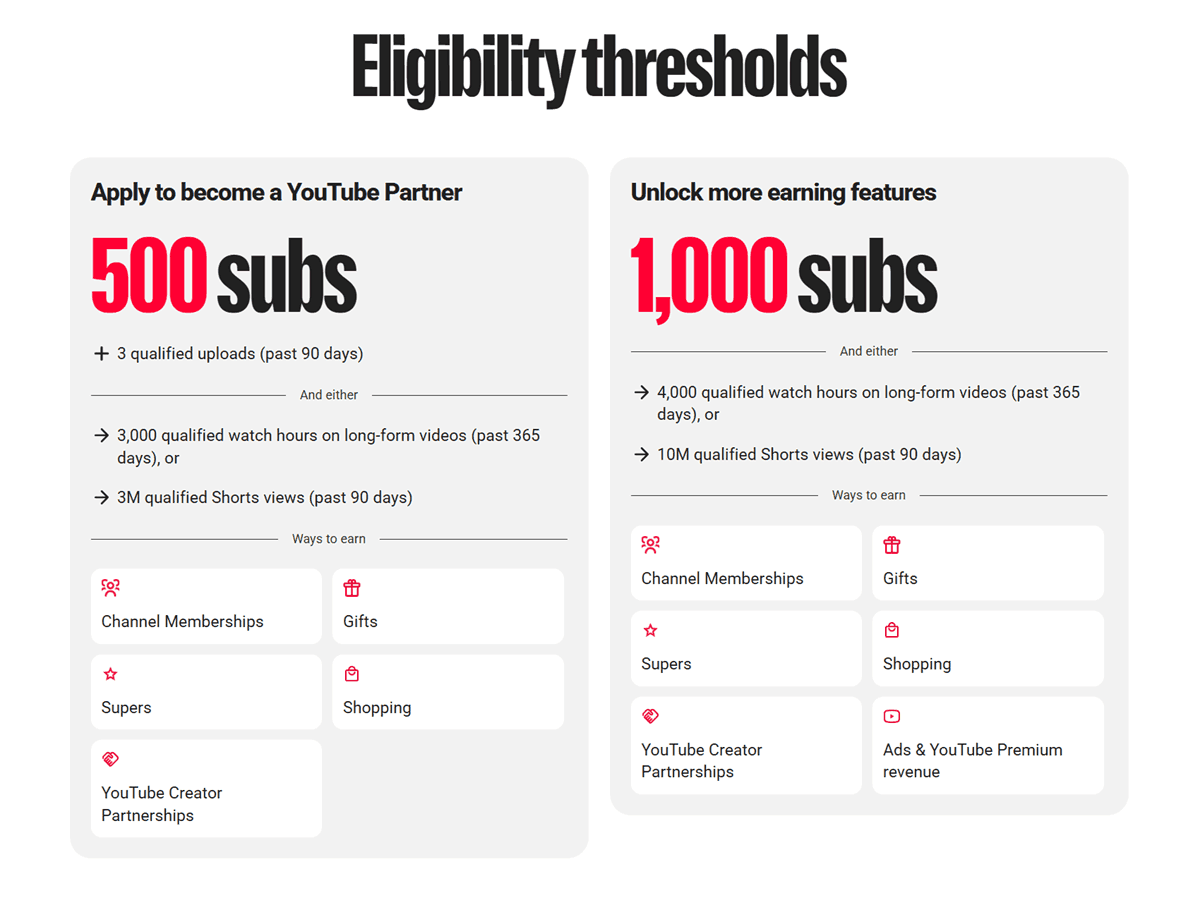
Early Access YPP (Fan Funding)
500 subscribers, 3 uploads in the past 90 days, and 3,000 watch hours in the past 12 months (or 3 million Shorts views in 90 days). This tier unlocks channel memberships, Super Chats, and YouTube Shopping. No ad revenue yet.
Standard YPP (Full Ad Revenue)
1,000 subscribers plus either 4,000 public watch hours in the past 12 months or 10 million Shorts views in the past 90 days. This is where AdSense kicks in, and CPM becomes relevant.
The early access tier is genuinely useful. Channel memberships can generate income before your ad revenue is live. Several creators in high-engagement niches report earning $200 to $500 per month from memberships alone at the 500 to 800 subscriber stage.
After you apply for standard YPP, the review process typically takes 30 days. Meeting the thresholds does not guarantee approval. YouTube reviews your full channel for content quality and policy compliance before approving. Reused or templated content is the most common rejection reason — more on that below.
The July 2025 Policy Change Every Faceless Creator Must Understand
On July 15, 2025, YouTube updated its monetization policy language, changing the risk profile of the entire faceless YouTube model. What was called “repetitious content” was renamed “inauthentic content,” and the scope of what qualifies was significantly expanded.
The old policy targeted volume-based abuse: channels uploading the same video dozens of times with minor differences. The new policy targets something broader: content that lacks genuine human creativity, regardless of how many times it has been uploaded.
What this means in practice: a channel that publishes AI-scripted, AI-voiced, template-formatted videos consistently — even if each video is technically on a different topic — is now at risk of demonetization or YPP rejection if the content does not demonstrate editorial contribution from a human.
In January 2026, YouTube carried out one of its largest mass-channel termination waves, targeting AI-driven faceless channels. The channels removed shared one pattern: synthetic voiceovers over stock footage on templated scripts, uploaded at high volume with no original perspective.
How to stay compliant:
- Edit every AI-generated script significantly before production. Add a specific example, a contrarian point of view, or a real data reference that the AI draft did not include.
- Vary your video structure across uploads. If your intros, transitions, and CTAs follow the same exact pattern in every video, that is a flag.
- Treat your AI voiceover as a production tool, not the creative layer. The creative layer should be your research, your framing, and your editorial judgment.
Faceless AI channels can absolutely be monetized in 2026. The channels winning are the ones where AI handles production speed and the creator provides genuine intellectual input.
How to Monetize a Faceless YouTube Channel Beyond AdSense
AdSense should be the floor of your income, not the ceiling. The highest-earning faceless channels report that ad revenue accounts for only 30 to 50 percent of their total income.
Affiliate Marketing
Affiliate marketing is the most natural revenue layer for a faceless channel. You recommend a tool, product, or service in your video description and earn a commission when viewers purchase through your link. The best affiliate placements are native — you mention a tool because it is genuinely relevant to the video topic, not because you are chasing a commission.
For a faceless channel in the AI or tech niche, tools like vidIQ and SEMrush offer affiliate programs with recurring commissions. For business and make-money content, software platforms typically pay $30 to $100 per referred customer.
The key is disclosure. YouTube requires clear affiliate disclosures in your description. FTC rules in the US apply. Non-disclosure is not just a legal risk — viewers who feel sold to without transparency unsubscribe faster.
Digital Products
Faceless channels in educational niches have an advantage here that personality-led channels do not: the audience is there for information, not personality. That information appetite translates directly into digital product demand. Templates, checklists, mini-courses, and PDF guides all sell well when they extend the value of your video content.
If your faceless channel covers a specific topic with depth — personal finance, video editing, AI tools, business strategy — a paid digital product priced at $17 to $47 can generate more monthly income than your AdSense at the same view count.
Sponsorships
Brand sponsors reach out to channels significantly earlier than most new creators expect. A focused niche channel with 2,000 to 5,000 engaged subscribers often receives sponsorship inquiries from software companies or online services looking for targeted reach. The CPM a sponsor pays you directly ($20 to $50 per 1,000 views in high-value niches) is typically higher than what AdSense delivers.
Do not wait to be discovered. Identify 5 to 10 brands that align with your niche and send a media kit once you cross 1,000 subscribers.
YouTube Channel Memberships
Once you hit the early access YPP threshold (500 subscribers), activate channel memberships immediately. Offer 1 tier at $4.99 per month with a single benefit — early access to videos, a monthly Q&A, or a bonus resource. Even 20 members at $4.99 is $100 per month before your AdSense is live.
YouTube SEO for Faceless Channels: Getting Found Without a Personal Brand
Faceless channels cannot rely on a creator’s personality to drive return visits. You cannot rely on brand loyalty. You earn views through search and suggested traffic — which means YouTube SEO is not optional.
Title and Thumbnail Optimization
Your title and thumbnail together determine your click-through rate. YouTube surfaces your video to a sample audience first. If your CTR is strong (above 6 to 8 percent is solid for most niches), YouTube expands distribution. If it is weak, distribution stops.
Title structure that works: lead with the search term, follow with the specific value or intrigue. “Faceless YouTube 2026: How to Monetize Before 1,000 Subscribers” beats “My Monetization Strategy” every time for a channel without a personal brand.
For thumbnails: test 2 versions if your channel tools allow it. vidIQ includes thumbnail A/B testing. Even small improvements in CTR compound significantly over time.
Video Description SEO
Write a description of at least 200 words. Include your primary keyword in the first 2 sentences. Add 3 to 5 related terms naturally throughout. Include your affiliate links, subscribe link, and related video links in every description. This is not about stuffing — it is about giving YouTube context for what your video covers and giving viewers a clear next action.
Tags and Chapters
Tags carry less weight than they did in 2020, but they are still a signal. Include 5 to 10 tags: your primary keyword, 2 to 3 broad topic tags, and 2 to 3 specific subtopic tags.
Chapters (timestamp markers) improve viewer experience and are directly tied to chapter appearance in Google search results. Any video over 5 minutes should have chapters. This is a 5-minute addition to your upload workflow that meaningfully improves search visibility.
Building a Scalable Faceless YouTube Workflow
Once your channel is producing consistently, the goal is to build a system rather than repeat manual effort. Here is the production workflow that scales.
Week 1 of each month: Research and scripting. Use vidIQ to identify 4 to 6 video ideas with clear search demand. Script all 4 to 6 in one block. Batch scripting is significantly faster than writing one script at a time because your research session covers multiple topics at once.
Week 2: Production. Generate voiceovers for all scripted videos in one ElevenLabs session. Source and organize stock footage. Export rough-cut versions in Descript.
Week 3: Polish and scheduling. Add final music, captions, end screens, and thumbnails. Schedule all videos for the following 2 to 3 weeks. Write descriptions and upload to YouTube with chapters completed.
Ongoing: Cut 2 to 3 Shorts from each long-form video. Upload Shorts within 48 hours of the long-form publish date to capture any search momentum from the main video.
This workflow allows a single creator to produce 4 to 6 videos per month without treating content production as a full-time job. Once the channel is generating revenue, outsourcing the editing to a freelance editor extends that capacity to 8 to 12 videos per month.
Five Common Mistakes That Delay YouTube Monetization
1. Picking a low-CPM niche for an “easier” start
There is no such thing as an easy niche on YouTube. If you are going to put in 6 months of consistent effort, do it in a niche where monetization pays proportionally.
2. Using a 100% automated AI production workflow
Post the July 2025 policy change, this is the fastest path to a rejected YPP application or a demonetized channel. AI assists production — it does not replace editorial judgment.
3. Ignoring watch time in favor of upload volume
20 videos that each hold 60% average view duration will outperform 60 videos that each hold 25% average view duration. YouTube’s algorithm rewards sustained watch time, not upload frequency alone.
4. Not building an email list
Every algorithm shift on YouTube has affected traffic for creators who had no audience outside the platform. An email list is the one asset you own outright. Start building it from your first 100 subscribers. Get your free Beehiiv account here.
5. Treating the early access YPP as irrelevant
Many new creators wait to build channel memberships until they hit full AdSense eligibility. That is leaving money on the table. Activate fan funding features at 500 subscribers.
How Long Does It Take to Monetize a Faceless Channel?
The honest answer varies widely by niche, upload frequency, and content quality. The broad range based on reported creator data is 3 to 8 months for standard YPP from the first upload, for creators publishing 2 to 4 videos per week.
What moves the timeline faster: starting in a niche with active search demand (not entertainment or lifestyle), producing videos with strong retention hooks, publishing at least 2 long-form videos and 4 to 6 Shorts per week, and building early watch time through strategic keyword targeting.
What slows it down: publishing without keyword research, choosing entertainment-adjacent niches where suggested traffic is the primary growth mechanism (which requires scale before it kicks in), and spending too long perfecting early videos instead of learning from publishing volume.
The 6-month milestone is realistic with consistent effort. Getting to 1,000 subscribers before 4,000 hours is common — focus on watch time more than subscriber count, because that is what new creators tend to underestimate as a constraint.
FAQ: Starting and Monetizing a Faceless YouTube Channel
Q: How do I start a faceless YouTube channel with no experience?
A: Pick a niche with active search demand, create a YouTube brand account, build a basic logo and channel art in Canva, script your first 5 videos around keyword-targeted topics, and use ElevenLabs for AI voiceover and Descript for editing. Produce 3 videos before publishing any of them so you can evaluate quality with fresh eyes before going live.
Q: What are the best faceless YouTube niches for high earnings in 2026?
A: Personal finance, AI and technology education, real estate investing, and legal/business content are the highest-RPM niches for faceless formats in 2026. Finance channels consistently report RPMs between $15 and $30 per 1,000 views, compared to $2 to $5 for entertainment niches. The gap is driven by high advertiser intent — banks, brokerages, and software companies pay premium CPMs to reach audiences already seeking financial or business guidance.
Q: Can AI-generated faceless YouTube channels still be monetized in 2026?
A: Yes, but only when the creator demonstrates genuine editorial contribution beyond the AI output. YouTube’s July 2025 “inauthentic content” policy targets mass-produced, templated AI content with no original perspective. Channels using AI tools to assist scripting and voiceover while maintaining human research, fact-checking, and editorial framing are not at risk. The test is whether a viewer could replace your channel with any other AI-generated channel on the same topic and get identical value — if yes, your channel is at risk.
Q: What are the YouTube monetization requirements for faceless channels in 2026?
A: Full ad revenue (AdSense) requires 1,000 subscribers and either 4,000 public watch hours in the past 12 months or 10 million Shorts views in the past 90 days. An early access YPP tier at 500 subscribers unlocks memberships, Super Chats, and YouTube Shopping before the full ad threshold is met. Meeting the thresholds alone does not guarantee approval, as YouTube reviews your content for originality and policy compliance during the application review.
Q: How do faceless YouTube channels make money without AdSense?
A: The strongest revenue stack for faceless channels combines AdSense with affiliate marketing (software tools, financial products, or digital services relevant to the niche), digital product sales (templates, courses, or guides), brand sponsorships, and channel memberships. High-earning faceless creators typically report that AdSense accounts for 30 to 50 percent of total income, with affiliate and digital product revenue filling the rest.
Q: What AI voice generator is best for faceless YouTube videos?
A: ElevenLabs is the production standard in 2026 for long-form faceless YouTube narration. It produces realistic narration with emotional inflection that holds the viewer’s attention across 10 to 20-minute videos. Commercial rights start at the Starter plan ($5 per month). For channels that require multilingual output or high weekly video volume, the Creator plan at $22 per month unlocks voice cloning, allowing you to build a consistent voice identity for your channel across all content.
Q: How many videos should I upload before applying for YPP?
A: Apply as soon as you meet the thresholds, not before. What matters before applying is that your channel contains no policy-violating content — go through your full upload history and set to private any early videos that were templated, heavily AI-generated without editorial input, or keyword-stuffed. YouTube reviews your channel holistically at the time of application, and a few bad early videos can result in rejection even if your recent content is strong. Most creators recommend having at least 20 to 30 videos live that represent your current quality standard.
Q: Is YouTube without showing your face sustainable as a long-term business in 2026?
A: The most durable faceless channels are built around expertise and research quality, not just production automation. Channels covering finance, technology, education, and business that consistently produce well-researched, clearly structured videos can sustain and grow over the years. The channels that failed post-July 2025 enforcement were those built entirely around production speed with no content differentiation. If your channel has a clear niche, consistent editorial standards, and multiple income streams, faceless YouTube is a viable long-term business model.
What to Do Next
The Faceless YouTube Channel model works. The tools are accessible. The monetization path is clear. The one variable that separates channels that reach YPP in 6 months from those still waiting at 18 months is execution consistency — showing up weekly with content that is a step better than the previous one.
Start with niche selection and validate it with VidIQ before committing to a production workflow. Then build your first 10 videos as a coherent content cluster rather than isolated uploads. Once your channel is live, capture your audience beyond YouTube by building an email list with beehiiv from day one.
Two posts to read next: learn how to build your YouTube content strategy and publishing calendar for consistent output, and review how to use affiliate marketing on YouTube to stack income streams before AdSense goes live.
