
AI Chatbot Statistics 2026: Market Share, Adoption, and ROI

Search “AI chatbot statistics,” and you’ll land on one of two completely different articles. Half the results cover business customer-service bots: adoption rates, ROI, cost per interaction. The other half, when they exist at all, cover consumer AI platforms: ChatGPT, Gemini, Claude, and how many people actually use them. Almost nothing covers both.
That split matters because the two questions have different answers and different sources. The chatbot software market, as tracked by Gartner and Grand View Research, is worth $11.8 billion in 2026. Separately, ChatGPT alone has somewhere around 900 million weekly users, more than the population of every country except China and India.
Both facts are true; they’re just measuring different things, and a reader searching this term usually wants to understand where both pictures fit together.
Here is the combined overview: it shows platform-level market share for consumer AI chatbots, along with adoption, ROI, and satisfaction data for the business chatbots category. All information includes the source and date. When analyst firms disagree, especially about chatbot market size, and the difference is in the billions of dollars, those disagreements are explained instead of being averaged into a single number.
Key AI Chatbot Statistics at a Glance
- The global chatbot software market reached $11.8 billion in 2026, up from $9.6 billion in 2025, according to Grand View Research’s own published industry report (Source: Grand View Research)
- ChatGPT holds roughly 53% of worldwide AI chatbot web traffic as of May 2026, down from about 76% a year earlier, as Gemini and Claude have both grown their share (Source: Similarweb, 2026 Generative AI Landscape report)
- ChatGPT reported more than 900 million weekly active users in February 2026, and the app separately crossed 1 billion monthly active users by June 2026 (Source: Reuters, via Yahoo Finance, June 2, 2026)
- Google’s Gemini app reached 950 million monthly active users as of Alphabet’s Q2 2026 earnings call on July 22, 2026 (Source: Alphabet Q2 2026 earnings release)
- Microsoft Copilot’s user count is genuinely disputed across sources, ranging from roughly 33 million to more than 400 million depending on which surfaces and license types are counted, a discrepancy explained in detail below
- About 60% of B2B companies and 42% of B2C companies use chatbot software, so B2B adoption is higher right now. In addition, 96% of consumers believe companies should use chatbots instead of traditional support teams, based on Tidio’s own tracking. (Source: Tidio)
- Gartner projects that by 2029, agentic AI will autonomously resolve 80% of common customer service issues without human intervention, up from roughly 45% today (Source: Gartner, March 5, 2025)
AI Chatbot Market Size and Growth
Analyst firms don’t agree on the chatbot market’s exact size, and the gap is wide enough that citing a single number without naming the source is misleading. Here’s what four independent research firms actually published for the same market:
| Research Firm | 2026 Market Size | Long-Range Forecast |
|---|---|---|
| Grand View Research | $11.8 billion | $41.2 billion by 2033 (19.6% CAGR) |
| Mordor Intelligence | $11.45 billion | $32.45 billion by 2031 |
| Fortune Business Insights | $10.42 billion | $60.21 billion by 2034 |
(Source: Grand View Research; Mordor Intelligence and Fortune Business Insights figures, as compiled by Quantumrun)
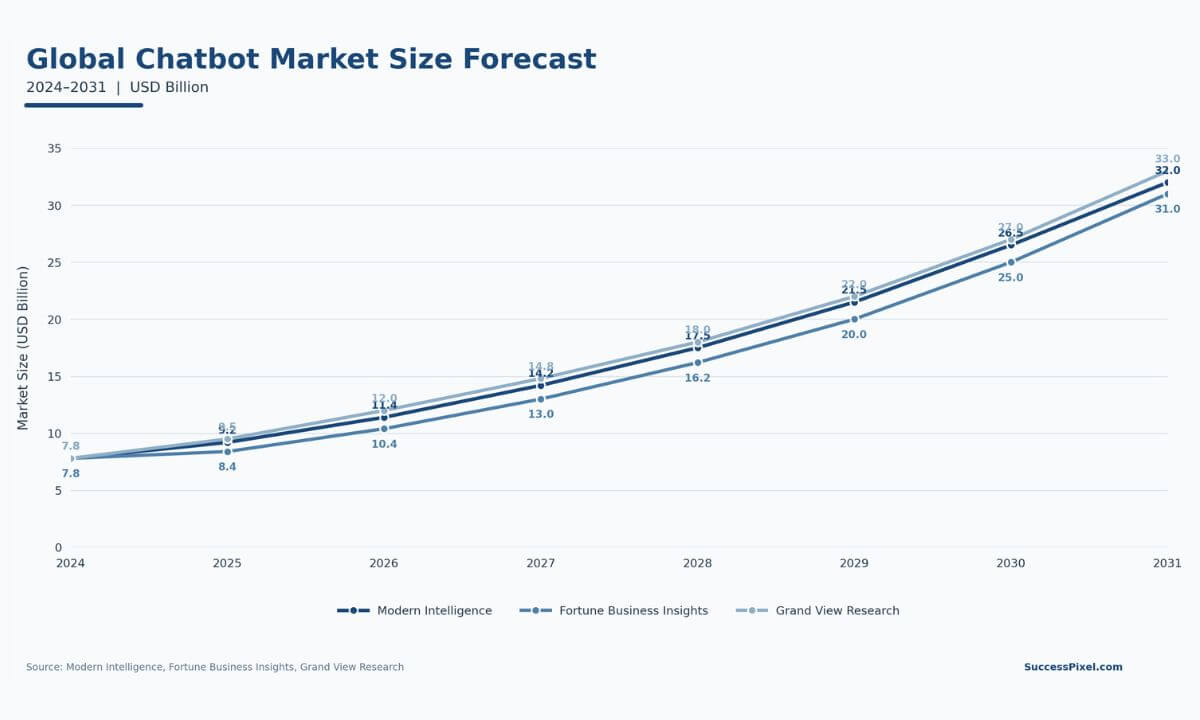
The three firms land within about 13% of each other on the 2026 figure itself, which is a reasonably tight cluster for market forecasting. Where they diverge sharply is the long-range multiplier: Fortune Business Insights projects nearly 6 times growth by 2034, while Grand View Research projects roughly 3.5 times growth by 2033 on a shorter timeline.
That gap traces to scope differences; some forecasts include a broader set of consumer-facing AI apps under “chatbot,” while others limit the category to enterprise customer-service platforms specifically.
A separate, faster-growing segment worth tracking on its own: the generative AI chatbot category specifically (as opposed to the older rule-based chatbot market) is valued at roughly $11.45 billion in 2026 and growing at approximately 23.15% annually, faster than the chatbot market overall, according to Mordor Intelligence’s dedicated generative AI chatbot report (Source: Mordor Intelligence).
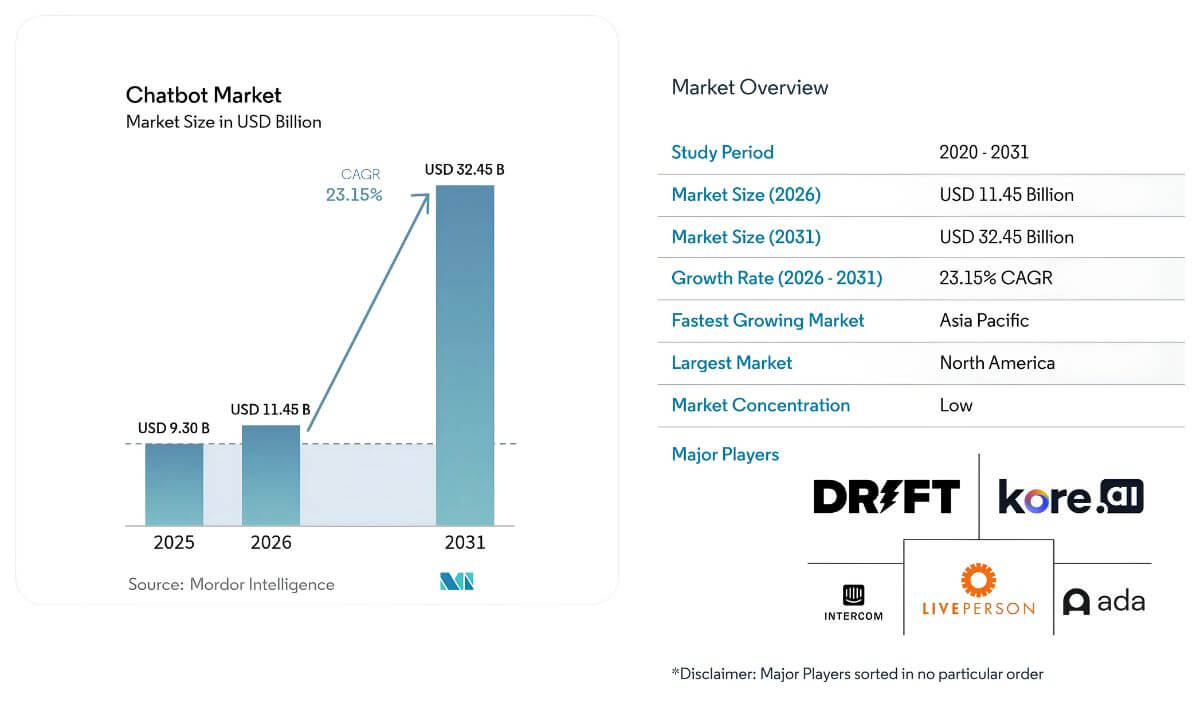
That faster growth rate is the clearest market-level signal that generative AI capability, not chatbot software in general, is where new spending is concentrated.
That distinction, rule-based versus generative, is worth defining precisely, since much of the market-size confusion traces back to blending the two categories together.
- A rule-based chatbot follows a fixed decision tree: it matches a customer’s message against a predefined set of intents and returns a scripted response, which is fast and predictable but breaks down the moment a query falls outside its trained scope.
- A generative AI chatbot, built on a large language model, generates a novel response for each query rather than selecting from a fixed script, which handles a far wider range of questions but introduces new risks around accuracy and consistency that rule-based systems never had to manage.
Most of the adoption and ROI statistics circulating in 2026 blend both categories together under “chatbot,” even though a business evaluating a $0.50-per-interaction cost figure should know whether that number came from a simple rule-based FAQ bot or a full generative AI deployment, since the two have meaningfully different cost structures and failure modes.
One widely circulated figure worth flagging and setting aside: you’ll see “987 million chatbot users worldwide” cited across dozens of statistics pages, usually attributed to “DemandSage” with no clear underlying methodology. Independent researchers who’ve specifically audited chatbot statistics for sourcing accuracy have flagged this figure as unverifiable and excluded it for that reason (Source: Brilo AI, sourcing methodology note).
This piece uses platform-specific, company-disclosed user figures instead, laid out in the next section, rather than repeating an aggregate number that can’t be traced to a named methodology.
AI Chatbot Market Share by Company
ChatGPT vs. Gemini vs. Claude vs. Others
Consumer AI chatbot platforms have shifted meaningfully in 2026, and Similarweb’s worldwide web traffic panel is the clearest source for tracking that shift over time.
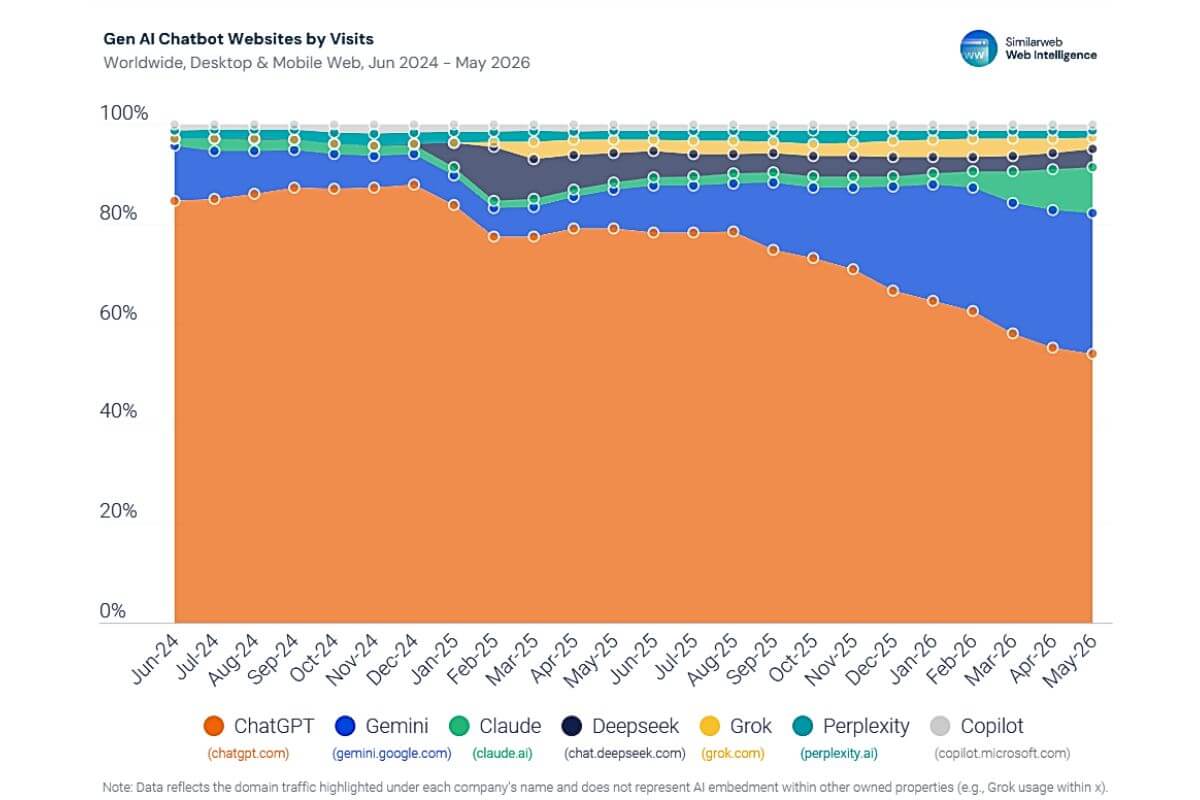
| Platform | Traffic Share, June 2025 | Traffic Share, May 2026 |
|---|---|---|
| ChatGPT | ~76% | ~53% |
| Gemini | under 9% | ~27 to 28% |
| Claude | ~2% | ~9% |
(Source: Similarweb, 2026 Generative AI Landscape report)
A separate tracking source, StatCounter, measures referral share specifically rather than total web visits, and shows a smaller decline for ChatGPT over roughly the same window, from about 82.65% in July 2025 to about 77.89% in July 2026.
Source: StatCounter Global Stats – AI Chatbot Market Share
Both trend lines point in the same direction, ChatGPT losing share to challengers, but the size of that decline depends heavily on whether a tracker measures total web traffic or specifically inbound referral clicks. Neither number is wrong. They’re measuring different behaviors.
Raw user counts tell a related story. ChatGPT still leads by absolute scale: more than 900 million weekly active users as of February 2026, and the standalone app crossed 1 billion monthly active users by June 2026, according to Sensor Tower data reported by Reuters (Source: Reuters, via Yahoo Finance, June 2, 2026).
Gemini’s 950 million monthly active users, disclosed directly by Alphabet on its July 22, 2026 earnings call, puts it in a broadly comparable range to ChatGPT by raw scale, even though the two companies report on different cadences, weekly versus monthly, which makes an exact comparison imprecise (Source: Alphabet Q2 2026 earnings release).
Claude trails both by a wide margin, and its own user count needs a scope qualifier to be accurate. Reuters reported roughly 56 million monthly active users for Claude’s standalone app specifically, while a broader estimate covering combined web and app usage runs closer to 245 million (Source: Reuters, via Yahoo Finance, June 2, 2026; Sensor Tower’s State of AI 2026 Report).
Meta AI is worth including even though it’s rarely covered alongside the other three. It reported 1 billion monthly users in late 2025, ahead of both Gemini and Claude by that specific metric at the time, though its usage is embedded inside WhatsApp, Instagram, and Facebook rather than driven by a standalone destination the way the other three platforms are (Source: TechCrunch).
Microsoft Copilot: A Measurement Problem
Copilot deserves its own subsection because no other major AI platform has this much disagreement across sources about a basic question: how many people actually use it. Independent trackers published in 2026 report wildly different figures, and the differences aren’t random noise; they trace to genuinely different definitions of “user.”
| Reported Figure | What It Measures | Source |
|---|---|---|
| ~33 million | Total active users across all surfaces | XtendedView |
| ~145 million | Consumer Copilot (web and Bing-integrated) MAU | Presenc AI |
| ~218 million | Active users across Windows, app, and website | Business of Apps |
| ~420 million | Monthly active users across all surfaces (Windows, Edge, M365, Bing, mobile) | Stackmatix |
| 20 million | Paid Microsoft 365 Copilot seats specifically | SQMagazine, citing Microsoft’s own FY26 disclosures |
Part of the gap is a real structural issue rather than a sourcing failure: Microsoft doesn’t publish one unified Copilot usage metric the way OpenAI publishes a weekly active user figure. Copilot is embedded across Windows, Microsoft 365 apps, Bing, Edge, and a standalone app, and Microsoft’s own quarterly disclosures tend to emphasize seat counts and growth rates rather than a single active-user total (Source: SeoProfy).
What Microsoft has disclosed directly is more useful than any of the estimates above: 20 million paid Microsoft 365 Copilot seats, against a commercial Microsoft 365 base of more than 450 million paid seats, meaning Copilot penetration into Microsoft’s own existing customer base sits at roughly 4 to 6% depending on which total seat count you use as the denominator (Source: SQMagazine; AI Business Weekly).
Daily active users for Microsoft 365 Copilot grew roughly 10 times year over year by the FY26 Q2 close, and queries per user grew nearly 20% quarter over quarter into Q3, which are genuine Microsoft-disclosed growth signals even without a single confirmed total user count to attach them to (Source: SQMagazine).
The honest summary: Copilot has a real and growing enterprise footprint, distributed through one of the largest software installed bases in the world, but any specific total user number attached to it right now should be treated as an estimate with a stated methodology, not a settled fact.
Business AI Chatbot Adoption Statistics
Adoption of customer-facing AI chatbots has climbed sharply across company sizes, though the sourcing quality varies. A few figures come from chatbot vendors themselves, which carries an obvious incentive to report favorable numbers, and that’s flagged explicitly below where it applies.
Between 2020 and 2025, the number of businesses using chatbots grew by about 4.7 times, showing how quickly adoption increased. By 2025, 34% more businesses were using AI chatbots, which shows ongoing investment in automation. (Source: Tidio)
67% of Fortune 500 companies have implemented AI chatbots, up from 23% in 2023, per chatbot vendor Botpress’s tracking (vendor-reported figure) (Source: Juniper Research’s Conversational AI Market Report 2026-2030)
60% of B2B companies and 42% of B2C companies use chatbot software, a gap that likely reflects longer B2B sales cycles and more complex lead qualification needs (Source: Tidio)
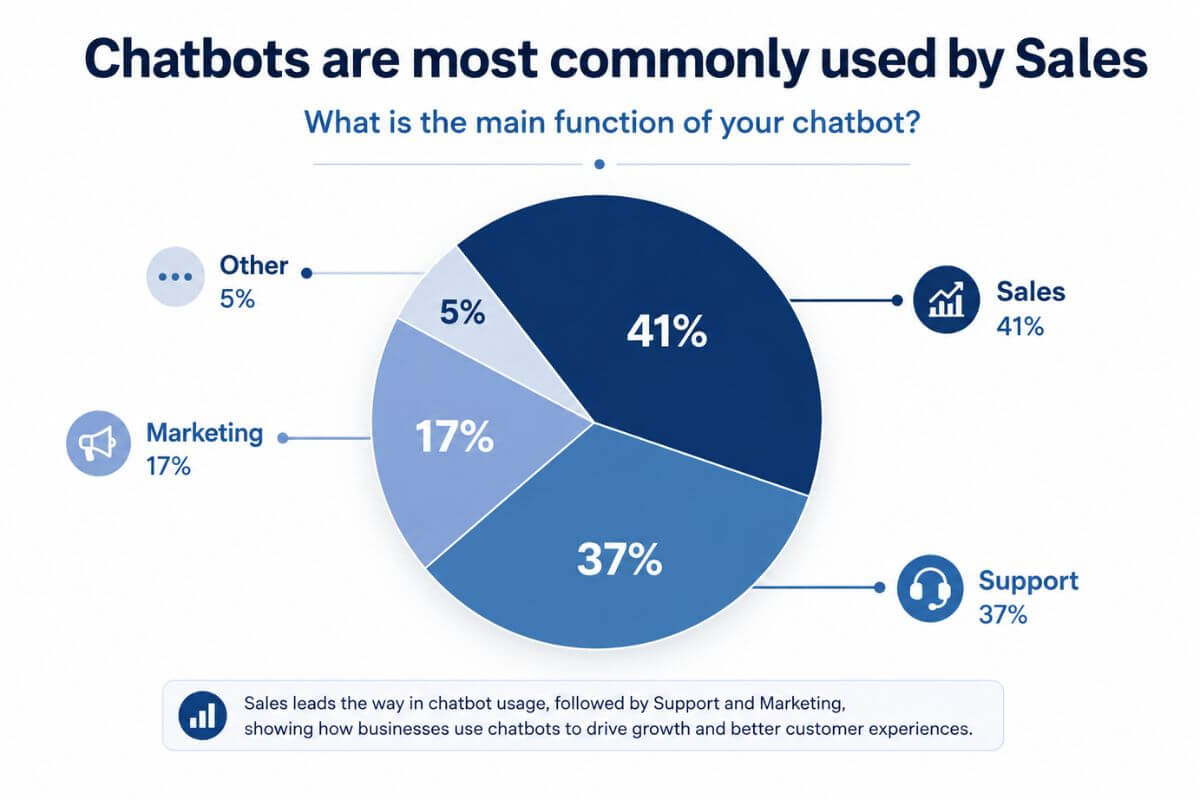
Sales is the most common chatbot use case at 41% of deployments, followed by customer support at 37% and marketing at 17% (Source: Intercom)
Only 44% of companies track chatbot performance with message analytics, meaning more than half deploy chatbots without measuring what they actually do (Source: Tidio)
Independent, non-vendor forecasting adds useful texture here. Gartner, which has no chatbot product to sell, predicted in 2022 that chatbots would become a primary customer service channel for 25% of organizations by 2027, a forecast that current adoption trajectories still track toward (Source: Gartner).
More recently, Gartner has sharpened that prediction: by 2027, self-service and live chat will surpass traditional phone and email as the top customer service technologies (Source: Gartner, August 27, 2025), and by 2028, 30% of Fortune 500 companies will offer service through a single AI-enabled channel entirely (Source: Gartner, December 11, 2024).
Gartner has also flagged a correction already underway: it predicts 50% of companies that cut customer service staff too aggressively because of AI will rehire by 2027, since AI handles volume well but still struggles with the nuance that complex cases require (Source: Gartner, February 3, 2026).
AI Chatbot ROI and Cost Savings Statistics
ROI figures in this category need the same vendor-bias caveat as the adoption numbers above, since several of the most-cited return figures come from companies selling chatbot software.
Businesses report an average $8 return for every $1 invested in chatbots (Source: LITSLINK).
You can learn about chatbot conversion and business impact in the table below.
| Statistic | Value | What it means |
|---|---|---|
| Chatbot lead conversion vs. traditional lead capture | 3× higher | Chatbots can generate up to three times more conversions than traditional forms or email sign-ups. |
| Average ROI per $1 invested in chatbot development | $8 | Businesses can potentially generate significant returns through improved sales, marketing, and productivity. |
| Reported increase in sales from chatbot interactions | 67% | Businesses using chatbots have reported substantial sales growth through automated customer interactions. |
| Conversion rate increase in some industries | Up to 70% | In certain sectors, adding chatbot functionality can produce a dramatic lift in conversions. |
| Website visitors converted into leads through chatbots | 28% | Chatbots can turn a meaningful share of website visitors into qualified leads through real-time engagement. |
| Revenue increase from effective chatbot implementation | 7–25% | Businesses may see measurable revenue growth when chatbots are integrated effectively into customer journeys. |
| Typical AI chatbot ticket resolution time | 6 min 25 sec | AI chatbots can resolve routine support requests much faster than traditional customer service channels. |
Some leading implementations report up to 533% ROI within nine months, according to chatbot vendor Botpress (vendor-reported figure, likely reflects successful implementations rather than a representative average).
Chatbot interactions cost roughly $0.50 per interaction compared to $6.00 for a human agent, a 12-times cost difference, according to chatbot vendor Master of Code (vendor-reported figure) (Source: Magai)
| Aspect | AI Agents | Human Agents |
|---|---|---|
| Cost per interaction | Around $0.50 (with some interactions costing as little as $0.006) | Around $6.00 |
| Availability | Available around the clock, including weekends and holidays | Usually limited to scheduled business hours |
| Response time | Near-instant responses for routine requests | Can take hours during busy periods |
| Best at | Handling repetitive, predictable tasks at scale | Managing complex issues that require emotional intelligence and empathy |
| Main limitation | Can struggle with nuance, empathy, and unusual situations | More expensive and slower to scale |
On average, chatbots reduce customer service costs by 30% across overall business operational expenses. (Source: IBM)
McKinsey’s Global AI Survey found organizations report an average 5.8 times return on AI investment within 14 months of production deployment, a broader figure covering AI investment generally rather than chatbots specifically (Source: McKinsey Global AI Survey, as compiled by MedhaCloud)
Gartner projects conversational AI, chatbots plus voice AI combined, will save $80 billion in contact center labor costs globally by 2026, a genuinely independent, non-vendor projection (Source: Gartner)
The pattern worth noting across all of these: independently sourced figures (Gartner, McKinsey) tend to describe more conservative, longer-horizon returns, while vendor-sourced figures (Botpress, Master of Code) tend to describe faster, larger returns. Both categories are useful, but they answer different questions: what’s realistic across a broad population of deployments, versus what’s achievable in a single well-executed implementation the vendor chose to publish.
AI Chatbot Customer Satisfaction and Preference Statistics
Customer sentiment toward chatbots is more divided than either “customers love bots” or “customers hate bots” framing suggests.
On the positive side: 74% of consumers now expect 24/7 support availability as a baseline standard rather than a bonus feature, and 88% expect faster response times than they did just a year earlier, according to Zendesk’s own CX Trends 2026 report, based on a survey of more than 11,000 consumers and business leaders across 22 countries (Source: Zendesk CX Trends 2026).
81% of consumers also want support to continue from where they left off across channels, without having to repeat themselves, a convenience expectation that well-integrated chatbots are positioned to meet (Source: Zendesk CX Trends 2026).
On the more cautious side, and this is the finding most vendor-written chatbot content leaves out entirely: Gartner’s own 2024 survey found that 64% of customers say they’d prefer that companies didn’t use AI for customer service at all, a genuinely independent finding that sits in real tension with the adoption numbers above (Source: Gartner, July 9, 2024).
SurveyMonkey’s own December 2025 research, a probability-weighted survey of 2,017 US adults with a margin of error of plus or minus 2.5 percentage points, found that 79% of Americans strongly prefer interacting with a human over an AI agent for customer service (Source: SurveyMonkey).
Asked why, respondents gave concrete reasons rather than general distrust: 61% said humans understand their needs better, 53% said humans give more thorough explanations, 52% said humans are less likely to frustrate them, and 50% said humans offer more options to resolve an issue (Source: SurveyMonkey).
Those findings aren’t actually contradictory once you separate the question being asked. Expecting 24/7 availability and faster response times, which Zendesk’s data shows clearly, is different from preferring AI generally over a human, which SurveyMonkey and Gartner’s data both show customers still don’t. Customers can reasonably want speed and availability from a channel while still preferring a human the moment a question gets complicated.
The practical takeaway for anyone deploying a chatbot: the data supports using AI for narrow, well-scoped, high-volume tasks, and supports keeping a visible, easy path to a human for anything that isn’t.
AI Chatbot Adoption by Industry
Adoption varies sharply by sector, and the gap between leaders and laggards is wide.
Retail and ecommerce lead chatbot adoption with roughly 30% of the total chatbot market, more than any other single vertical, driven by high volumes of repetitive queries like order status and return policy questions (Source: Emulent). Banking follows closely: 88 to 92% of North American Tier 1 banks use AI chatbots, and banks using digital assistants report up to a 25% revenue increase tied to improved customer engagement (Source: Emulent).
Telecom shows the highest customer-service-specific AI adoption of any sector at 95%, ahead of banking at 92% and healthcare at 79%, reflecting how high call volumes and repetitive query types drive adoption in these three sectors specifically (Source: AllAboutAI).
| Sector | 2023 Adoption | 2024 Adoption | 2025 Adoption | Growth Rate (3-Year) |
|---|---|---|---|---|
| E-commerce | 68% | 78% | 88% | +29.4% |
| Banking | 74% | 85% | 92% | +24.3% |
| Healthcare | 52% | 66% | 79% | +51.9% |
| Telecom | 82% | 89% | 95% | +15.9% |
| Insurance | 63% | 74% | 85% | +34.9% |
| Hospitality | 59% | 71% | 83% | +40.7% |
Healthcare tells a more complicated story than a single adoption number can capture. The healthcare chatbot market is growing at roughly 36.8% annually, the fastest of any industry tracked, and is projected to reach $543.65 million by 2026. But patient acceptance of chatbots sits at just 27%, far below retail or banking, a gap between supply-side investment and demand-side comfort that’s unique to healthcare among the sectors covered here (Source: Emulent).
AI Chatbot Usage Patterns and User Behavior
Response Time and Engagement
Speed is where chatbots most clearly outperform human support. The average chatbot response time is roughly 1.1 seconds, compared to 4 or more hours for email support and 10 or more minutes for phone queue wait times (Source: Fullview).
Over two-thirds (68%) of support teams report that AI has raised customer expectations, especially regarding key metrics such as response times. (Source: Intercom).
89% of clients say a rapid response to initial inquiries influences their purchasing decisions. Among the top factors affecting customer service quality, 53.5% of consumers identify fast response time as critical. (Source: Tidio).
Websites using chatbots report a 23% increase in conversion rates, according to a Glassix study comparing sites with and without chatbot implementations, and ecommerce businesses specifically report a 67% increase in sales tied to chatbot deployment (Source: Glassix AI Chatbot Study).
A Note on Usage Intensity and Emotional Attachment Research
A small but growing body of research looks at heavier patterns of AI chatbot use rather than typical customer-service interactions, and it’s worth covering factually rather than ignoring, since it’s a genuinely searched topic.
OpenAI’s own disclosure, a report backed by multiple national governments and independent AI safety researchers, found that approximately 0.15% of ChatGPT’s weekly active users and 0.03% of total messages sent show indicators of potentially heightened emotional attachment to the chatbot (Source: International AI Safety Report 2026).
Separately, a nationally representative RAND survey published in JAMA Pediatrics in June 2026 examined how US adolescents and young adults use AI chatbots specifically for mental health advice, an active area of ongoing academic research rather than a settled finding (Source: RAND, published in JAMA Pediatrics, June 3, 2026).
Both of these are legitimate, cited findings, but the wider claims circulating online- specific percentages of “AI addiction” drawn from small convenience-sample surveys rather than nationally representative data should be treated with real caution.
Researchers publishing in this space consistently caveat that current prevalence estimates rest on limited samples and that causality between chatbot use and emotional dependence remains unproven. This is a developing research area, not a settled statistic, and figures should be sourced individually rather than cited as a single “addiction rate.”
Also Read: AI Statistics 2026: Adoption, Investment, and Industry Trends
Frequently Asked Questions About AI Chatbot Statistics
Q: How big is the AI chatbot market in 2026?
A: The chatbot software market reached $11.8 billion in 2026 according to Grand View Research, though estimates from other firms range from roughly $10.4 billion to $11.45 billion depending on methodology and market scope.
Q: Which AI chatbot has the most users?
A: ChatGPT leads with more than 900 million weekly active users and 1 billion monthly app users as of mid-2026. Google’s Gemini follows closely at 950 million monthly active users. Claude trails both, with estimates ranging from 56 million to 245 million depending on whether app-only or combined web-and-app usage is measured.
Q: What percentage of businesses use AI chatbots?
A: 91% of businesses with 50 or more employees use AI chatbots in some capacity, according to chatbot platform Tidio’s tracking, and 67% of Fortune 500 companies have implemented them.
Q: What is the ROI of AI chatbots?
A: Vendor-reported figures cite average returns around $8 for every $1 invested, though independent research from McKinsey points to a more conservative 5.8 times return within 14 months for AI investment broadly. Gartner projects $80 billion in contact center labor savings globally by 2026.
Q: How does ChatGPT compare to Gemini and Claude in market share?
A: ChatGPT held roughly 53% of worldwide AI chatbot web traffic as of May 2026, down from about 76% a year earlier. Gemini grew to roughly 27 to 28% over the same period, and Claude grew to roughly 9%, the fastest proportional gain of the three.
Q: Do customers prefer chatbots or human agents?
A: It depends on the task. 75% of customers prefer chatbots for simple inquiries, but 64% say they’d prefer companies didn’t use AI for customer service at all when asked in general terms, and 79% say they still prefer a human when given a direct choice.
Q: Which industries use AI chatbots the most?
A: Retail and ecommerce lead with roughly 30% of the total chatbot market. Telecom has the highest customer-service-specific adoption at 95%, followed by banking at 92% and healthcare at 79%.
Q: How many active users does Microsoft Copilot have?
A: This is genuinely disputed. Estimates range from about 33 million to more than 400 million, depending on which surfaces (Windows, Microsoft 365, Bing, mobile) and license types are counted. Microsoft’s own confirmed figure is 20 million paid Microsoft 365 Copilot seats.
What This Means in Practice
Two different decisions hide inside “AI chatbot statistics,” and the data above supports different answers for each.
If you are considering adding a customer-service chatbot, adoption and ROI data suggest starting with narrow, high-volume, low-complexity queries such as order status, return policy, and account questions. Avoid attempting to automate the entire support workload initially.
That’s where the 1.1-second response time and 75% customer preference figures actually apply. It’s also where the 44% of companies not tracking analytics tend to fail: deploying a bot without a resolution-rate baseline makes it impossible to know later whether it’s actually working.
If you’re deciding which underlying AI platform to build on or write about, ChatGPT still carries the largest raw audience, but Gemini has closed roughly two-thirds of the traffic-share gap in a single year, and Claude’s proportional growth rate outpaces both.
None of that momentum is guaranteed to continue at the same pace, but treating ChatGPT as the only consumer AI platform worth tracking, which is exactly what most competing chatbot statistics pages currently do, means missing where user attention is actually shifting.
Conclusion
Two different chatbot stories are unfolding at once in 2026, and most coverage only tells one of them. The business chatbot software market is real but modestly sized, worth roughly $11 to $12 billion, growing steadily, and still working out basic measurement problems like the 56% of companies that don’t track their own chatbot’s performance.
The consumer AI platform story is an entirely different scale: ChatGPT, Gemini, and increasingly Claude are approaching a billion users each, reshaping search behavior, and doing it while analyst firms still can’t agree on Microsoft Copilot’s actual user count within a factor of ten.
Both stories are worth tracking, and they inform each other more than most coverage acknowledges. The customer-service ROI data explains why businesses keep adopting chatbots despite real customer skepticism. The platform-level market share data explains which underlying AI models are actually powering that adoption.
🔖Bookmark Now: We will update the data here as Similarweb, Gartner, and major AI labs release new figures throughout 2026. So, save this page for future reference.
