
Claude Statistics 2026: Users, Revenue, and Market Position


Most Claude statistics pages on the internet right now describe a chatbot from early 2024: Claude 3. A 200K-token context window presented as a headline feature. A single traffic snapshot from a year when Anthropic was still a research lab racing to catch up with ChatGPT.
That version of the Claude AI assistant no longer exists.
Anthropic’s annualized revenue crossed $47 billion in May 2026. The company is valued higher than OpenAI. It filed confidentially for an IPO. Claude’s own app usage has grown roughly tenfold in a year, and Anthropic now runs a coding product, Claude Code, that brought in more revenue in six months than the entire company generated in all of 2024.
This page tracks where those numbers actually stand today, with the source and date attached to every figure. Where third-party trackers disagree on a number, and on Claude’s exact traffic and user counts, they disagree quite a bit; that disagreement is explained rather than smoothed over with a single confident-sounding statistic.
Everything below is organized to be scanned rather than read start to finish. Jump to the section you need: user and traffic numbers, revenue and valuation, pricing, model capabilities, enterprise adoption, competitive market share, or demographics. Each section leads with the headline figures before getting into the details behind them.
Key Claude Statistics at a Glance
- Anthropic’s annualized revenue run rate crossed $47 billion in May 2026, up from roughly $9 billion at the end of 2025 (Source: Anthropic, May 28, 2026)
- Anthropic closed a $65 billion Series H round at a $965 billion post-money valuation, surpassing OpenAI’s $852 billion private valuation for the first time (Source: Anthropic, May 28, 2026)
- Anthropic confidentially filed an S-1 with the SEC on June 1, 2026, targeting a listing later this year (Source: Anthropic)
- By June 2026, around 245 million people worldwide were using the Claude AI chatbot each month. This was a big jump from about five million monthly users in January 2025. Claude, an AI assistant created by Anthropic, maintained a steady number of active users throughout 2025. (Source: Statista, June 30, 2026)
- Claude’s share of worldwide generative AI web traffic rose from roughly 2% in mid-2025 to close to 9% by May 2026, the largest proportional gain of any tracked AI platform (Source: Similarweb, 2026 Generative AI Landscape report)
- Anthropic reports more than 300,000 business customers, including over 1000 spending more than $1 million annually (Source: Anthropic)
- Anthropic released Claude Code as an initial research preview in February 2025, followed by its general availability rollout in May 2025. Since that launch, run-rate revenue has climbed to over $2.5 billion, more than double what it was at the beginning of 2026. The number of weekly active users has also doubled since January 1. Recent analysis shows that Claude Code now accounts for 4% of all public GitHub commits worldwide, which is twice its share from just a month ago. (Source: Anthropic Announcements, February 12, 2026)
- Anthropic’s current model lineup includes Claude Opus 5, Claude Sonnet 5, Claude Haiku 4.5, and its top-tier Claude Fable 5 (Source: Anthropic’s own model documentation)
Anthropic’s most advanced raw AI model, Claude Mythos 5, is not available to the general public. It is offered in limited availability to approved customers, such as cybersecurity and scientific research groups, via Project Glasswing starting June 9, 2026. This restriction is due to its powerful hacking and vulnerability-scanning capabilities.
Anthropic wants to mitigate the risks of releasing an AI that could cause real-world problems. After all, no one wants to see a science-fiction scenario like the MCU Ultron become reality.
Claude User and Traffic Statistics
Monthly Active Users
Anthropic does not publish an official, single Claude user count the way OpenAI does with ChatGPT’s weekly active user figure. Every user number associated with Claude is a third-party estimate rather than a company-confirmed statistic, which is worth noting before citing any of them.
The most traceable figure comes from Reuters, reporting on Sensor Tower’s app-tracking data in June 2026: Claude’s standalone mobile app had approximately 56 million global monthly active users, growing at roughly 640% year over year (Source: Reuters, via Yahoo Finance, June 2, 2026). That figure covers the app specifically, not web or API usage.
A separate estimate from Sensor Tower’s own State of AI 2026 Report, cited by multiple industry trackers, puts Claude’s combined web and mobile monthly active user count at approximately 245 million. India accounts for 72.3 million users, while the US follows with 40.9 million users (Source: Sensor Tower’s State of AI 2026 Report).
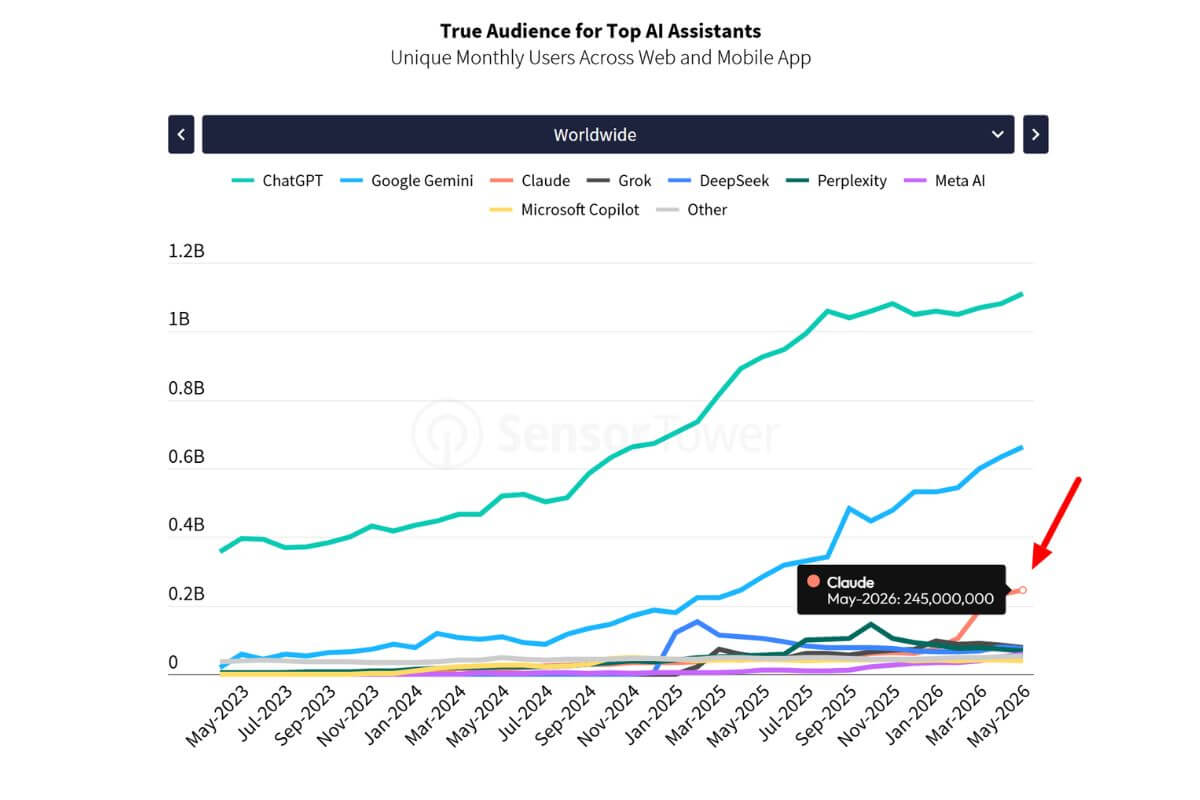
The gap between 56 million and 245 million illustrates exactly why Claude user statistics need their scope stated alongside the number. A stat that says “Claude has X million users” without specifying app, web, or combined is not complete.
Mobile app usage specifically has grown fast in early 2026:
- The Claude mobile app reached 39.81 million monthly active users in June 2026, a 10.79% increase from the prior month, ranking it around #14 among all apps tracked (Source: AICPB Global AI Rankings App Data)
- Card-transaction analysis of roughly 28 million US consumers found Claude’s paying consumer base and associated revenue grew approximately 75% since January 2026 (Source: TechCrunch)
Website Traffic Growth
Claude.ai’s web traffic has scaled unusually fast through 2026. The exact figure depends heavily on which analytics provider you ask, since Semrush and Similarweb measure traffic differently: one leans on search-driven interest signals, the other tracks actual visitor panels.
| Month (2026) | Claude.ai Monthly Visits (Semrush Data) | Claude.ai Monthly Visits (Similarweb Data) |
| February | 287.9 million | 288 million |
| March | 722.2 million | 613.7 million |
| April | 837.7 million | 824 million |
| May | 988.3 million | 952.5 million |
| June | 967.9 million | 946.7 million |
| July | 1.1 billion | 969.3 million |
(Source: Semrush Traffic Analysis and Similarweb Traffic Engagement Data)
What’s consistent across both trackers is the direction, not the exact figure: Claude.ai’s traffic roughly quintupled between January and May 2026, a growth rate that outpaces nearly every other major web property tracked during the same period.
Direct visits make up the largest share of Claude’s traffic by a wide margin. Similarweb’s own site data puts direct traffic at around 73 to 74% of desktop visits, a strong signal of brand-driven, repeat usage rather than traffic acquired through paid channels or search (Source: Similarweb).
YouTube is the largest social referral source into Claude.ai, consistent with the pattern reported since Claude’s earliest traffic data.
Anthropic Revenue and Valuation Statistics
Revenue Growth Timeline
Anthropic’s revenue trajectory in 2026 is, by a wide margin, the steepest recorded in enterprise software history. The company’s annualized run rate moved through the following checkpoints over roughly five months:
| Date | Annualized Revenue Run Rate |
| December 2024 – January 2025 | $1 billion |
| August 2025 | $5 billion |
| December 2025 | $9 billion |
| February 2026 | $14 billion |
| March 2026 | $19 billion |
| April 2026 | $30 billion (confirmed with Broadcom compute deal) |
| May 2026 | $47 billion |
(Source: Anthropic Announcements)
At Anthropic’s Code with Claude developer event, CEO Dario Amodei shared that the company saw about 80 times annualized growth in revenue and usage in the first quarter of 2026, far surpassing its internal goal of 10 times. He also mentioned that this fast growth has challenged the company to keep up with scaling its infrastructure.
Enterprise and API revenue drive most of that growth, not the consumer chatbot subscription business. A few numbers worth isolating:
- Enterprise and startup customers account for approximately 80% of total revenue through pay-per-token API pricing (Source: Sacra)
- More than 100,000 businesses run Claude through Amazon Bedrock as of April 2026 (Source: Anthropic)
- Eight Fortune 10 companies are counted among Anthropic’s paying customers (Source: Anthropic)
Claude Code deserves its own line item. Anthropic’s agentic coding product reached more than $2.5 billion in annualized revenue within six months of its launch, a pace that would be a headline achievement for an entire company, not a single product line inside one.
Since early 2026, business subscriptions to Claude Code have grown four times, and enterprise customers now make up over half of the product’s total revenue.
Funding Rounds and Valuation History
Anthropic’s valuation has climbed in step with its revenue, and the pace of re-rating between funding rounds has compressed sharply through 2026.
| Round | Date | Amount raised | Post-money valuation | Step & runway |
|---|---|---|---|---|
| Series E | Mar 3, 2025 | $3.5 billion | $61.5 billion | Led by Lightspeed. At the time, revenue was running at nearly $1 billion a year, giving the company a strong financial base for its next stage of growth. |
| Series F | Sep 2, 2025 | $13 billion | $183 billion | Led by ICONIQ. The valuation nearly tripled in just six months, while annualized revenue reached roughly $5 billion by August 2025. |
| Series G | Feb 12, 2026 | $30 billion | $380 billion | Led by GIC and Coatue. Annualized revenue had climbed to about $14B, with Claude Code alone reaching a $2.5 billion run rate, up sharply from $500M six months earlier. |
| Series H | May 28, 2026 | $65 billion | $965 billion | A syndicate-led round that pushed the valuation close to $1 trillion. Revenue was reported at a $47 billion annual run rate, making this potentially the company’s final private funding round. |
That’s roughly a 2.5x re-rating in about three months. The May 2026 valuation put Anthropic ahead of OpenAI’s most recent private mark of $852 billion from March 2026, the first time Anthropic has held a higher valuation than its larger rival (Source: Reuters, via NBC News, May 28, 2026).
The Series H round included roughly $15 billion of previously committed hyperscaler investment, including $5 billion from Amazon, alongside memory and infrastructure partners Micron, Samsung, and SK Hynix.
On June 1, 2026, days after closing the Series H, Anthropic confidentially filed an S-1 registration statement with the SEC. That signals preparation for a public listing that multiple reports have pegged for later in 2026. Total funding raised to date across all rounds sits at approximately $125 billion (Source: Sacra).
Claude Pricing in 2026: Every Plan and Model
Claude’s pricing structure spans consumer subscriptions and per-token API pricing, and both have shifted meaningfully since Claude 3 was the newest model on the market.
Consumer Subscription Plans
| Plan | Price | Best For |
| Free | $0 | Casual use with daily limits |
| Pro | $20/month ($17 when billed annually) | Individual power users |
| Max | $100 to $200/month | Heavy individual usage |
| Team | $20/user/month annually, $25 month-to-month (Standard seat); $100/user/month annually, $125 month-to-month (Premium seat with 5x more usage than Standard seats | Small to mid-size teams |
| Enterprise | Custom | Large organizations |
(Source: Claude Pricing, August 2026)
Claude API Pricing Per Million Tokens
Here’s a look at the pricing for all Claude models, updated as of early August 2026:
| Claude AI Model | Base Input Tokens | 5m Cache Writes | 1h Cache Writes | Cache Hits & Refreshes | Output Tokens |
| Claude Fable 5 | $10 | $12.50 | $20 | $1 | $50 |
| Claude Mythos 5 (limited availability with Project Glasswing) | $10 | $12.50 | $20 | $1 | $50 |
| Claude Opus 5 | $5 | $6.25 | $10 | $0.50 | $25 |
| Claude Opus 4.8 | $5 | $6.25 | $10 | $0.50 | $25 |
| Claude Opus 4.7 | $5 | $6.25 | $10 | $0.50 | $25 |
| Claude Opus 4.6 | $5 | $6.25 | $10 | $0.50 | $25 |
| Claude Opus 4.5 | $5 | $6.25 | $10 | $0.50 | $25 |
| Claude Sonnet 5 | $2 | $2.50 | $4 | $0.20 | $10 |
| Claude Sonnet 4.6 | $3 | $3.75 | $6 | $0.30 | $15 |
| Claude Sonnet 4.5 | $3 | $3.75 | $6 | $0.30 | $15 |
| Claude Haiku 4.5 | $1 | $1.25 | $2 | $0.10 | $5 |
(Source: Claude Platform Docs/ Model & Pricing)
A few things worth knowing before budgeting off this table:
- Prompt caching cuts the cost of repeated context by up to 90% on cache hits (Source: Claude Prompt Caching).
- The Batch API applies a flat 50% discount to both input and output pricing for non-time-sensitive workloads (Source: Claude AI Models & Pricing / Batch Processing).
- Output tokens are consistently priced five times higher than input tokens across every tier, so response length affects cost more than prompt length does.
- Routing simple tasks to Haiku or Sonnet and reserving Opus or Fable 5 for tasks that genuinely need the extra capabilities is the most direct lever to control API spend.
Claude Model Lineup and Technical Capabilities
Current Models
Claude’s naming has moved well past the “Claude 3” generation that most stale statistics pages still describe. As of August 2026, Anthropic’s active lineup consists of four tiers:
- Claude Haiku 4.5: fast and low-cost, built for high-volume, latency-sensitive tasks
- Claude Sonnet 5: the balanced everyday model, now handling agentic work like planning, browser and terminal use, and long multi-step tasks
- Claude Opus 5: the most capable general-purpose model, with adaptive thinking that adjusts how much reasoning effort it applies per task
- Claude Fable 5: Anthropic’s top-tier model, reserved for the highest-capability use cases
That’s a meaningfully different lineup from the Claude 3 family (Haiku, Sonnet, and Opus) that most existing Claude statistics content still treats as current. Each generation since then has generally improved reasoning, expanded context handling, and added agentic capabilities like autonomous browser and terminal use that didn’t exist in the Claude 3 era at all.
Context Window and Benchmarks
Claude’s flagship models now share a context window well beyond the 200,000-token figure most older statistics pages present as a current feature.
- Claude Opus 5, Claude Opus 4.8, Claude Opus 4.7, Claude Opus 4.6, Claude Sonnet 5, and Claude Sonnet 4.6 each support a 1M-token context window when accessed via the Claude API, Amazon Bedrock, Google Cloud, or Microsoft Foundry. Claude Mythos Preview also offers a 1M-token context window.
- Anthropic’s advanced AI models, Claude Fable 5 and Claude Mythos 5, also provide a 1M-token context window. For any model with a 1M-token context window, a single request can generate up to 128,000 output tokens (max_tokens). Other Claude models, such as Claude Sonnet 4.5, are limited to a 200,000-token context window.
- For all models with a 1M-token context window, this setting is enabled by default. No beta header is required, and long-context requests are billed at standard rates, without a separate surcharge for using it
- For Claude models with a 1M-token context window, each request can include up to 600 images or PDF pages. To put it another way, a 1 million-token context window can hold a document on the order of 750,000 words, roughly the length of several full-length novels in a single conversation. (Source: Claude Platform Docs / Context Windows, August 2026)
Claude AI models’ benchmark performance has climbed accordingly:
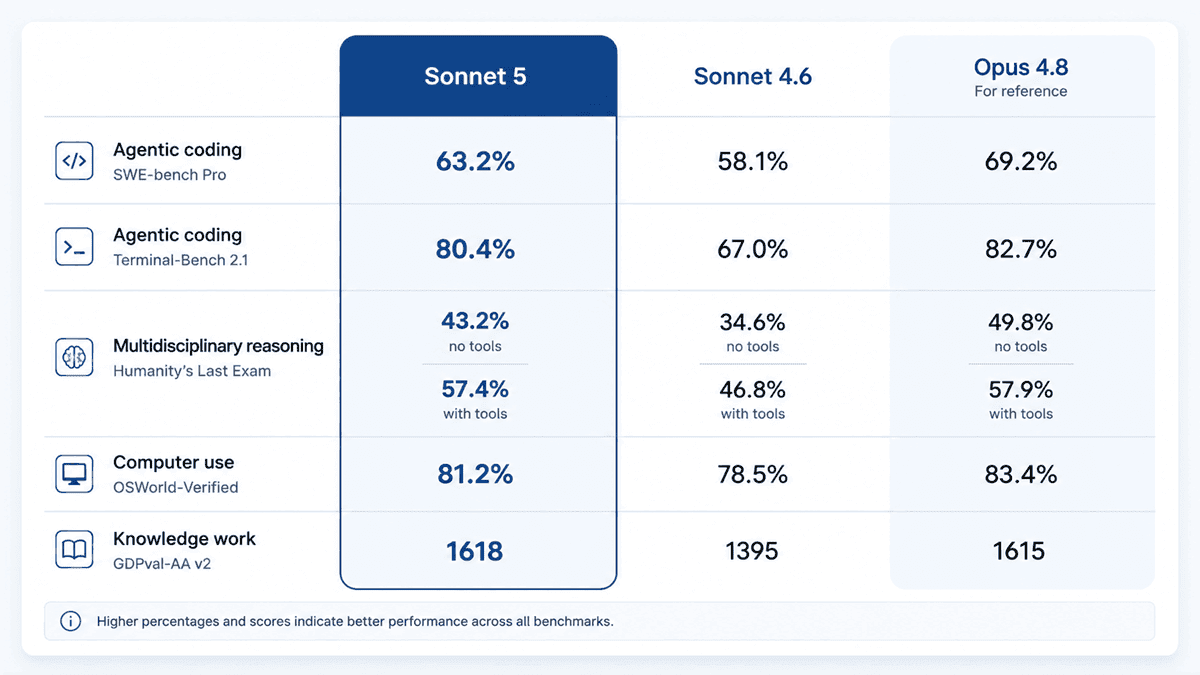
- Claude Sonnet 5 scored 63.2% on SWE-bench Pro and 80.4% on Terminal-Bench 2.1 for Agentic coding tasks (Source: Anthropic).
- Claude Opus 4.8 scored 69.2% on SWE-bench Pro and 82.7% on Terminal-Bench 2.1 for the same tasks, while Sonnet 5 slightly outperformed Opus 4.8 on certain knowledge-work evaluations.
Anthropic’s own tokenizer changed with the 4.7 model generation, which can produce roughly 30 to 35% more tokens for the same input text compared to earlier models. That’s worth accounting for if you’re estimating API costs by migrating usage patterns from an older Claude generation.
Claude Enterprise and Developer Adoption Statistics
Anthropic’s business is now built primarily around enterprise and developer usage rather than the consumer chatbot subscription that most Claude coverage focuses on.
- Anthropic reports more than 300,000 business customers, spanning startups through large enterprises, and more than 1000 of those customers spend over $1 million annually on Claude.
- Enterprise and API usage accounts for approximately 80% of Anthropic’s total revenue.
- More than 100,000 businesses run Claude through Amazon Bedrock as of April 2026.
- Eight Fortune 10 companies are counted among Anthropic’s paying customers.
Claude AI Statistics: Cadences
Anthropic’s own Economic Index breaks down what people and businesses actually use Claude for, and the split is heavily technical compared to competitors:
- 36% of Claude.ai’s consumer usage goes toward coding
- 12.4% goes toward educational work
- 7.2% goes toward scientific tasks
- At the API level, 44% of usage falls under computer and mathematical functions
(Source: Anthropic Economic Index Report, September 2025)
That usage split matters for anyone evaluating Claude against a competitor. It is disproportionately a developer and technical work tool relative to ChatGPT, whose own research shows a far larger share of writing, general advice, and personal use rather than coding.
The Workweek
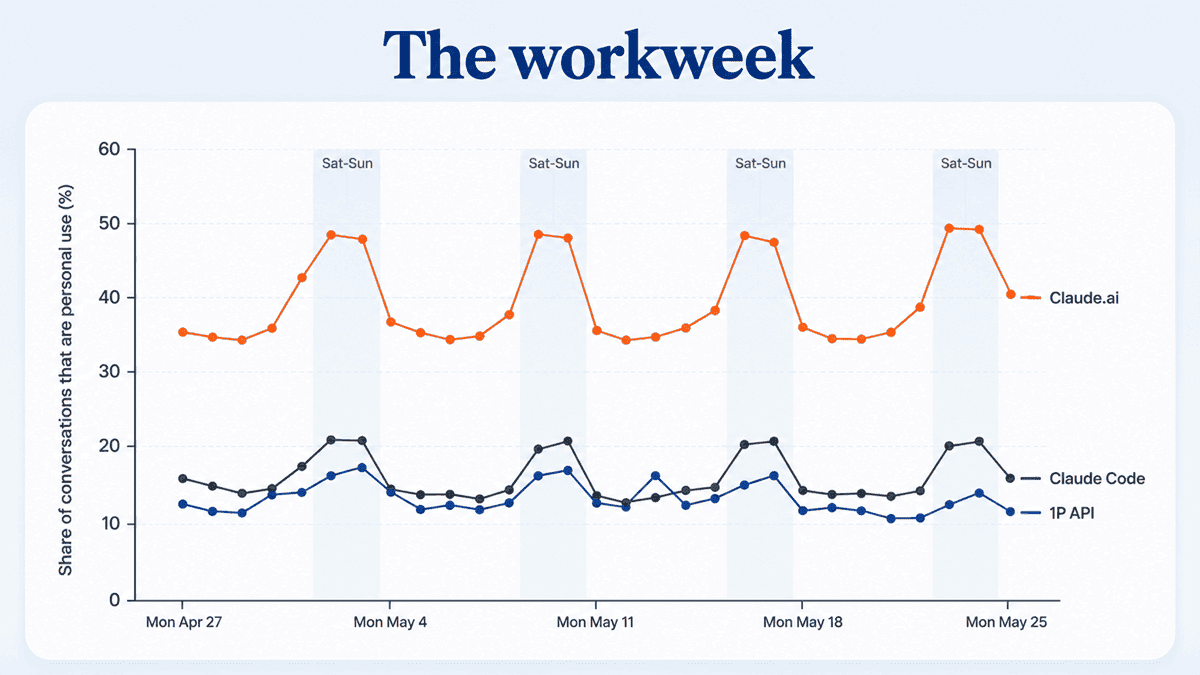
During the sample period, personal use of chat and Cowork conversations rises from about 35% on weekdays to nearly 50% on weekends. On weekends, people talk less about business topics like marketing or slide decks and more about emotional support, medical questions, and investment advice. This change is most noticeable in high-income countries.
Claude Code and 1P API traffic show a similar trend, although personal use is generally lower for both compared to chat and Cowork conversations.
*FYI, 1P API traffic = API traffic routed directly through Anthropic
Daily Rhythms
Claude usage patterns follow daily routines, changing hour by hour. The data shows how often different types of requests occur each hour, relative to the average global traffic.
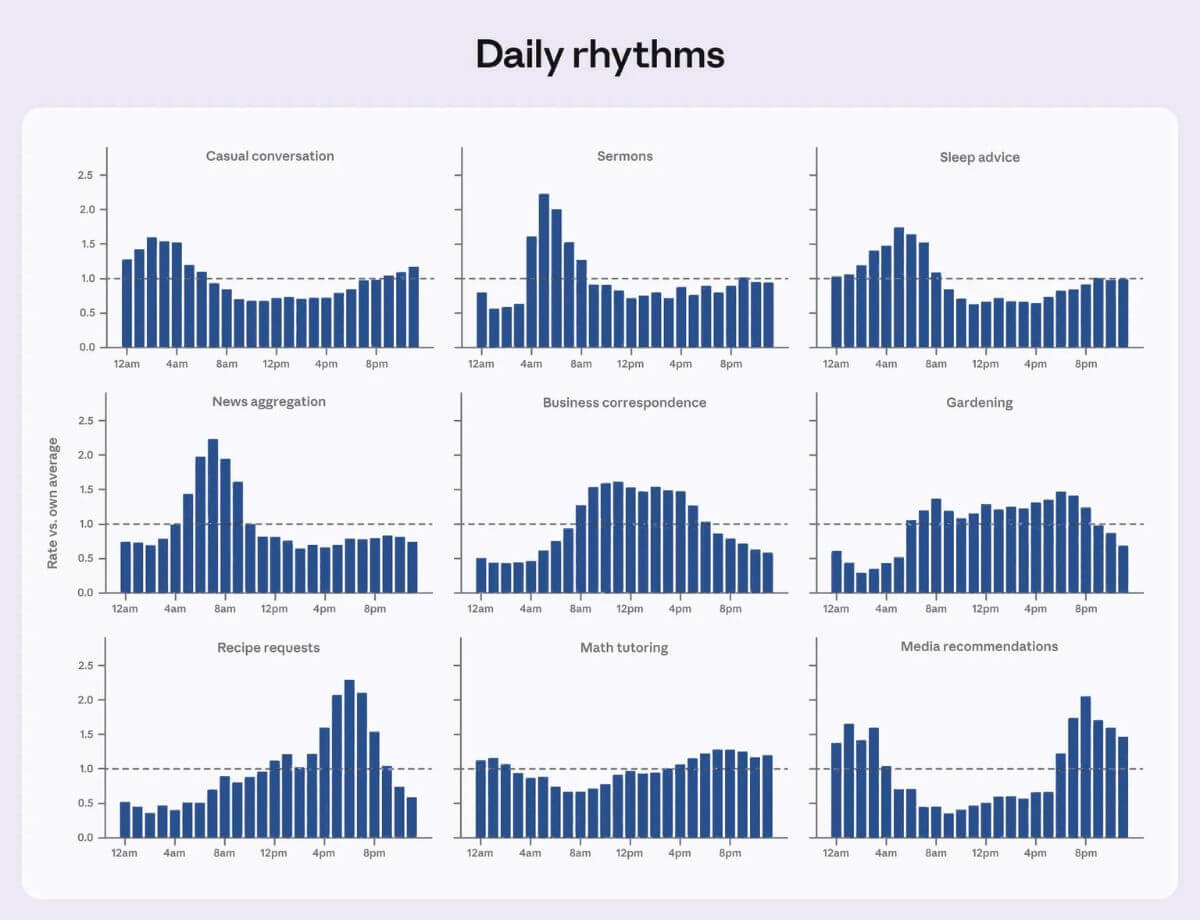
Requests for news are most frequent at 7 a.m. local time. Business correspondence, including email drafting, peaks slightly at 10 to 11 a.m., aligning with the workday. Recipe requests experience one of the largest spikes, occurring 2.3 times more frequently at 6 p.m. than the average. Media recommendations reach their highest frequency in the evening, while requests for sleep advice increase in the hours leading up to dawn.
At night and on weekends, work-related requests to Claude are more frequently associated with higher-wage occupations. Although Claude could not conclusively identify users’ specific occupations, this trend may indicate that individuals in higher-paying roles, such as marketing managers or computer programmers, are more likely to work outside regular hours. In contrast, tasks associated with lower-wage jobs, such as telemarketing and clerical work, account for a smaller share of conversations. This trend is not just due to computer and math jobs; even when those were removed from the data, higher-wage tasks still increased at night and on weekends.
How People Use Claude
According to Anthropic’s data, people use Claude primarily for three things: work, personal tasks, and coursework. What users ask Claude to do often depends on their specific needs.
Many people use Claude for personal reasons. Over 80% of chats about creative writing, advice, or recipes were personal. Creative writing usually included fanfiction, poetry, and worldbuilding. For work, people often asked for help with video scripts, screenplays, or speeches.
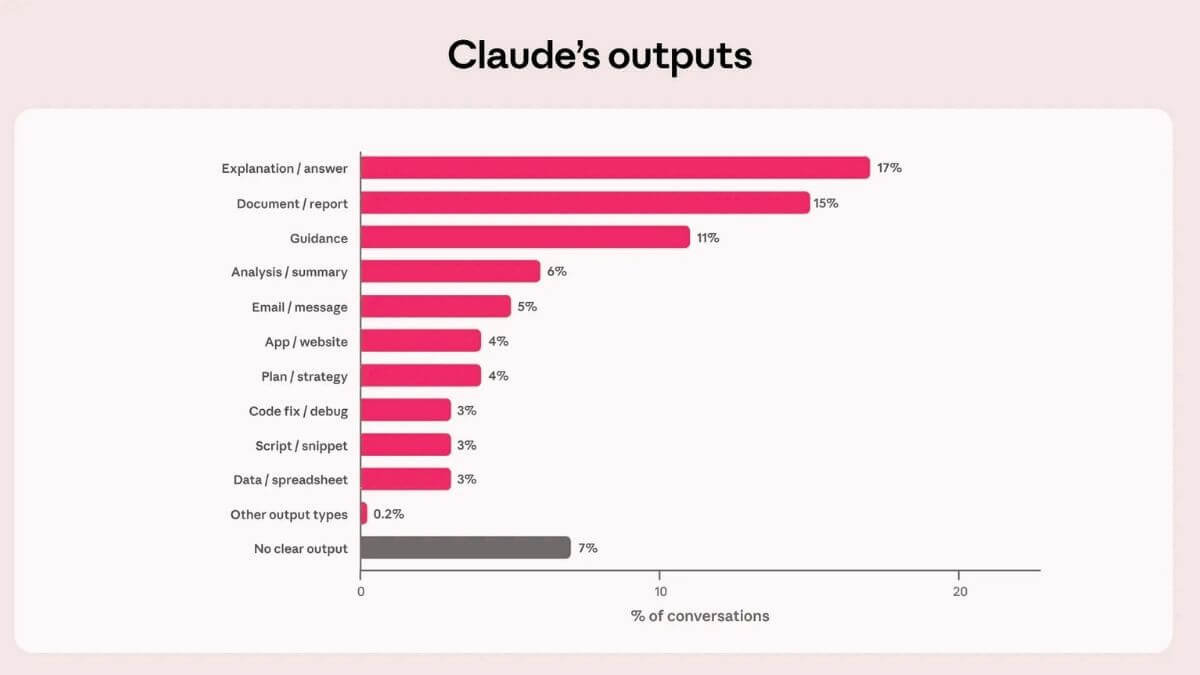
Some tasks were closely connected to work and business:
- Marketing content: 80% work-related
- Blogs and articles: 81% work-related
- Database queries: 82% work-related
Some activities were split almost evenly for work and personal reasons. For example, planning and strategy were 44% work-related and 49% personal. Translation was 42% work-related and 44% personal. Personal planning often meant making travel plans or workout routines, while business users focused on content or business plans.
Coursework showed a different pattern. People often used Claude for academic papers, theses, educational resources, and math questions. Some of these tasks were also done outside of school settings.
What People Create With Claude
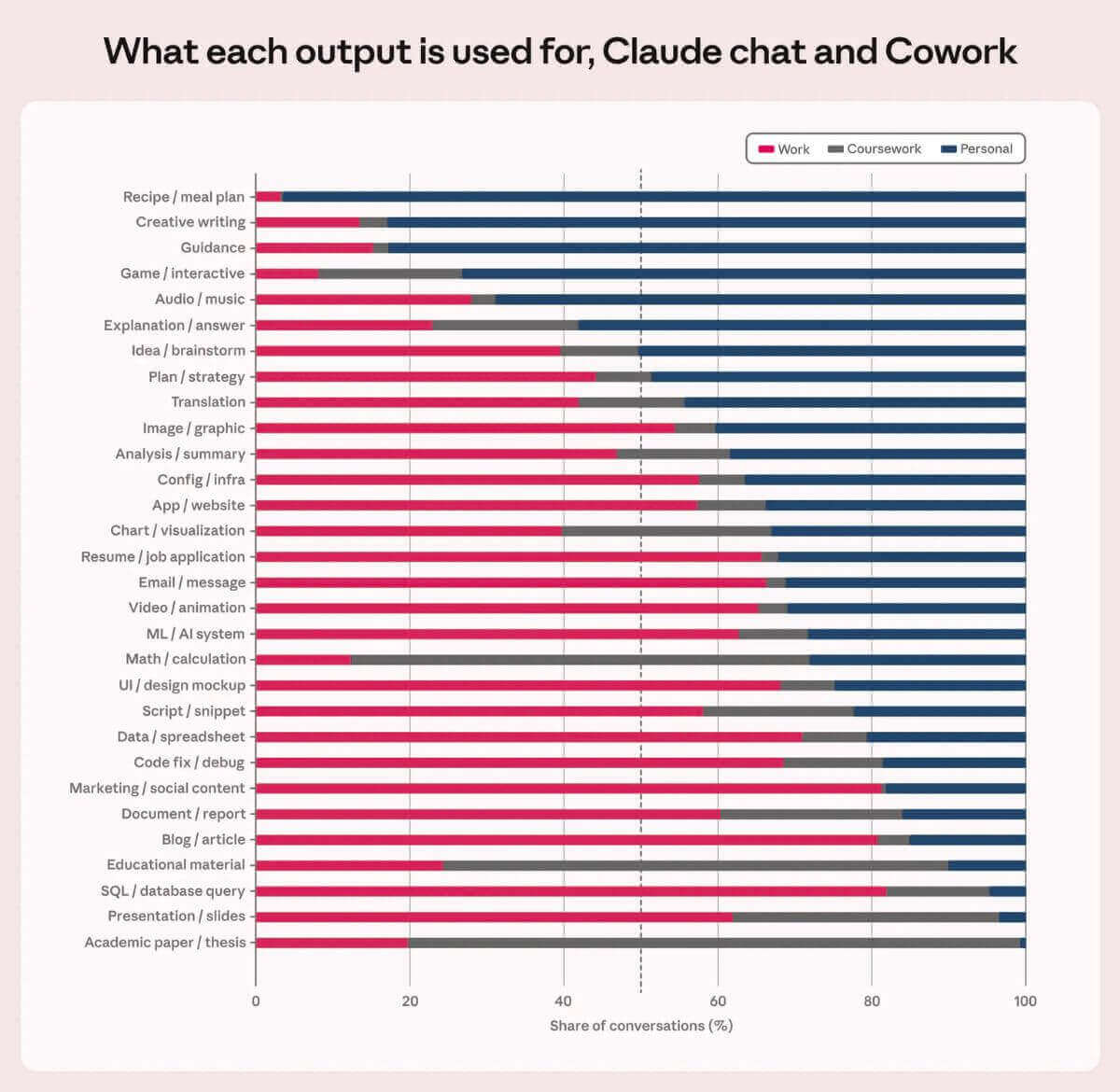
The report also analyzes what people create when they use Claude.
For work:
- Documents and reports: 20%
- Explanations: 9%
- Email drafts: 7%
- Analyses and summaries: 6%
For personal use:
- Explanations: 25%
- Recommendations: 22%
- Documents: 6%
For coursework:
- Documents and reports: 21%
- Explanations: 20%
- Educational materials: 11%
- Academic papers: 6%
Overall, Claude is used for much more than just office work. People rely on it for business writing and marketing, travel planning, recipes, recommendations, creative projects, and schoolwork. Work-related tasks are especially common in marketing, writing articles, and database queries. (Source: Anthropic Economic Index Report, Jun 26, 2026)
Claude Market Share vs. ChatGPT and Gemini
Claude remains the smallest of the three major AI chatbot platforms by raw traffic and user count. It’s also the fastest-growing in proportional terms, and the gap has closed noticeably through 2026.
Web Traffic Share
Similarweb’s own worldwide traffic panel data shows the clearest picture of this shift:
| Platform | Web Traffic Share, June 2025 | Web Traffic Share, May 2026 |
| ChatGPT | ~76% | ~53% |
| Gemini | under 9% | ~27 to 28% |
| Claude | ~2% | ~9% |
(Source: Similarweb, 2026 Generative AI Landscape report)
Gemini captured most of ChatGPT’s lost share by absolute percentage points. Claude’s move from roughly 2% to 9%, though, represents the largest proportional gain of any platform tracked, even though its absolute traffic remains far smaller than either competitor’s.
Users, Revenue, and What the Comparison Actually Means
Putting user counts and revenue side by side tells a more complete story than any single metric on its own.
ChatGPT still leads on every raw scale metric. OpenAI reported more than 900 million weekly active users in February 2026, and the ChatGPT app separately crossed 1 billion global monthly active users by June 2026. (Source: Sensor Tower’s State of AI 2026 Report)
Gemini sits in second place by user count, with Google reporting its app crossed 900 million monthly active users at Google I/O in May 2026, up from 750 million just five months earlier.
Claude trails both by a wide margin on raw user and traffic figures, whether you use the 56 million app-only estimate or the broader 245 million combined estimate. (Source: SuccessPixel AI Statistics)
Revenue inverts part of that ranking. Anthropic’s $47 billion annualized run rate in May 2026 exceeded OpenAI’s comparable figure at the time, even though ChatGPT has somewhere between four and eighteen times Claude’s user base depending on which user metric you compare. That’s only possible because Claude’s revenue is concentrated in high-value enterprise and API contracts rather than a mostly free consumer product, while OpenAI still carries a much larger free-tier user base relative to its paying subscriber count.
A separate estimate cited by industry trackers puts Claude’s overall AI chatbot market share closer to 10%, and describes Claude as winning a disproportionate share, reportedly around 70%, of enterprise deals it competes for directly against OpenAI (Source: Android Headlines, March 13, 2026).
That enterprise win-rate figure is a single third-party estimate rather than a company-confirmed statistic, and it’s worth treating with more caution than the traffic-share numbers above, which come from a named analytics provider’s own published methodology.
For anyone deciding which platform to build on rather than which one has the most users: ChatGPT and Gemini currently offer the broadest consumer distribution, while Claude has built its position around developer tooling, coding capability, and enterprise trust. That’s a narrower but higher-value lane, and its revenue-to-user ratio reflects that clearly.
Claude Demographics: Who Uses Claude
Demographic data on Claude’s audience comes entirely from third-party web analytics rather than anything Anthropic itself publishes. Different providers show meaningfully different splits depending on how they measure interest versus actual visits.
Gender Split
Similarweb’s own site analytics show roughly 57.14% male and 42.86% female visitors (Source: Similarweb)
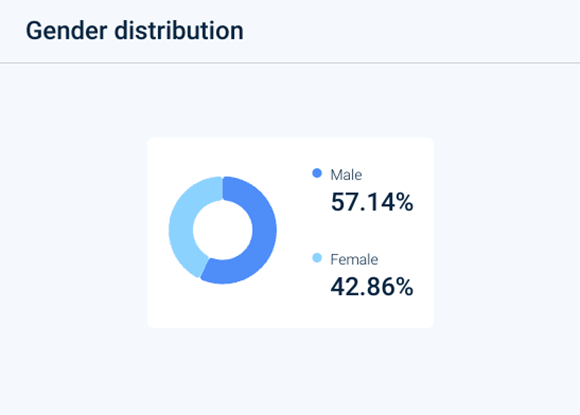
Semrush’s competing estimate, which measures search-driven interest rather than direct visitor tracking, puts the split closer to 77% male.
The gap reflects different methodologies, not a contradiction in the underlying trend.
Age Groups
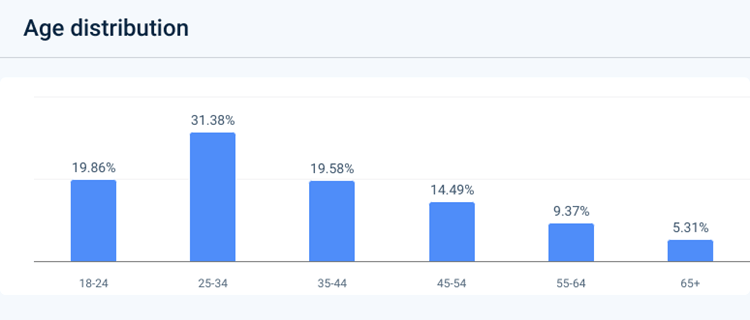
A Similarweb report shows that most Claude AI visitors are between 25 and 34 years old (31.38%). The next largest groups are people aged 18 to 24 (19.86%) and 35 to 44 (19.58%). (Source: Similarweb).
Top Countries by Web Traffic Share
- United States: approximately 32%
- India: approximately 6.5%
- United Kingdom: approximately 4.5%
Claude.ai’s audience shows a strong stated interest in programming and developer software, consistent with usage-pattern data from Anthropic’s own Economic Index, which shows more than a third of consumer conversations are tied to coding.
The honest caveat across every demographic figure in this section: none of it comes directly from Anthropic; all of it is inferred from web analytics panels that sample a fraction of actual traffic, and providers routinely disagree with each other by 15 to 20 % points on the same underlying question. Treat these numbers as directional rather than precise.
Claude Timeline: Key Milestones
- March 14, 2023: Anthropic releases Claude and Claude Instant
- July 13, 2023: Claude 2 launches with improved performance and API access
- March 4, 2024: The Claude 3 family launches (Haiku, Sonnet, Opus)
- February 2026: Anthropic closes a $30 billion Series G round at a $380 billion valuation
- April 2026: Annualized revenue crosses $30 billion, confirmed alongside a Broadcom compute partnership
- May 19, 2026: Claude crosses 245 million monthly active users, intensifying competitive pressure across the category
- May 28, 2026: Anthropic closes a $65 billion Series H round at a $965 billion valuation, surpassing OpenAI
- June 1, 2026: Anthropic confidentially files an S-1 with the SEC
- June 2026: Reuters reports Claude’s app has grown to roughly 56 million monthly active users, up about 640% year over year
Frequently Asked Questions About Claude Statistics
Q: How many people use Claude AI in 2026?
A: Estimates vary by scope. Claude’s standalone app had roughly 56 million monthly active users as of Reuters’ June 2026 reporting on Sensor Tower data, while a broader combined web-and-app estimate from Sensor Tower’s separate State of AI 2026 Report puts total monthly active users closer to 245 million.
Q: How much revenue does Anthropic make?
A: Anthropic’s annualized revenue run rate crossed $47 billion in May 2026, up from roughly $9 billion at the end of 2025, according to Reuters and the company’s own Series H disclosures.
Q: What is Anthropic’s current valuation?
A: Anthropic was valued at $965 billion following its $65 billion Series H round, which closed May 28, 2026, surpassing OpenAI’s $852 billion valuation from March 2026.
Q: How much does Claude Pro cost?
A: Claude Pro costs $20 per month for individual users. Higher-usage plans run from Max at $100 to $200 per month, up through custom Enterprise pricing for large organizations.
Q: How does Claude compare to ChatGPT in market share?
A: Claude holds roughly 9% of worldwide generative AI web traffic as of May 2026, up from about 2% a year earlier, per Similarweb, compared with ChatGPT’s approximately 53% share and Gemini’s roughly 27 to 28%. Claude’s growth rate over that period was the fastest proportional gain of any major AI chatbot platform tracked.
Conclusion
The Claude that most existing statistics pages describe stopped being an accurate picture sometime in 2025. That version was a research-lab chatbot with a couple hundred thousand waitlist signups and a modest handful of million monthly visitors.
The current version of the story is different. It’s a company running a $47 billion annualized revenue business, valued above its largest competitor, filing for a public listing, while still holding a single-digit percentage of overall AI chatbot traffic.
Both of those facts are true simultaneously, and neither one makes sense without the other. Claude’s business is built disproportionately on enterprise contracts and developer API usage rather than consumer chatbot traffic, which is exactly why its revenue outpaces its traffic share relative to ChatGPT and Gemini. Any Claude statistics resource that reports one side of that picture without the other is leaving out the part that actually explains the numbers.
I’ll keep this page current as Anthropic’s IPO process develops and as new revenue, valuation, and usage figures are published through the rest of 2026.
You May Also Like: 100+ ChatGPT Statistics and Incredible Facts
