
Inbound vs Outbound Marketing: The Real Difference (With Examples)

Many articles on this topic continue to reference the four-stage HubSpot funnel: Attract, Convert, Close, Delight.
HubSpot has since updated its methodology. The current model has three stages: Attract, Engage, Delight, structured around a flywheel rather than a funnel. HubSpot is now further evolving its approach toward an AI-driven framework known as Loop Marketing.
This matters because “inbound vs outbound” is not just about definitions. It’s a strategy issue, and the strategy has truly changed since most guides on this topic were written.
This article addresses both the core definitions and often-overlooked aspects, such as the roles of sales, supply chain, and specific channels like Google Ads and email. Other online resources often give inconsistent answers on these areas.
Inbound vs Outbound Marketing: Quick Definitions
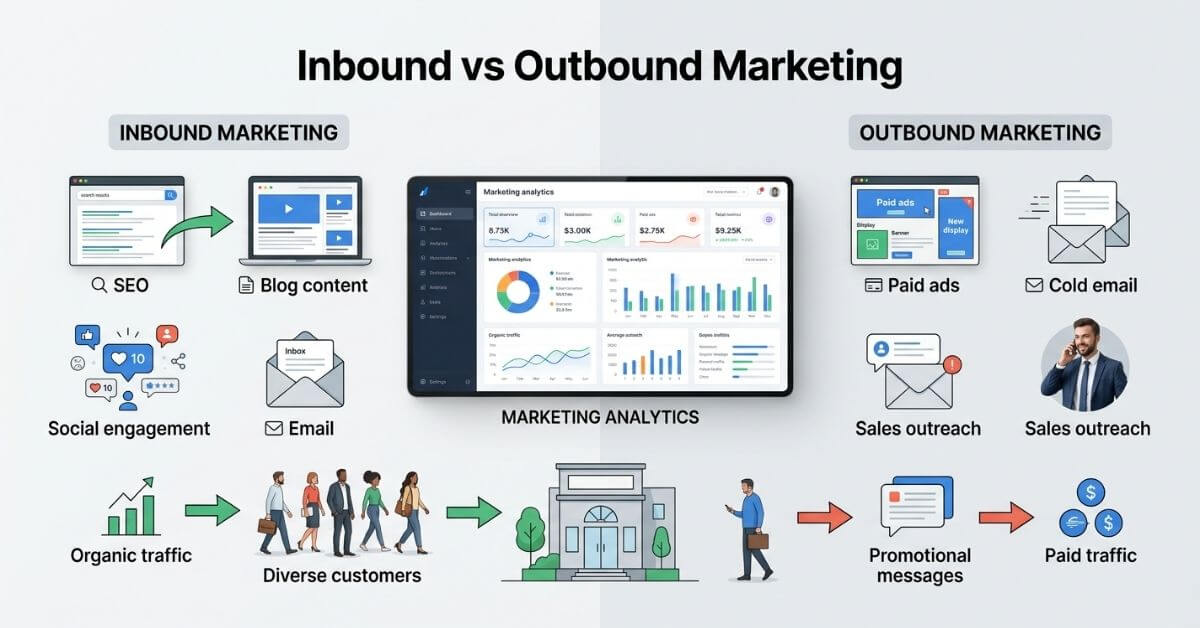
Outbound marketing pushes a message out to a broad audience, hoping some percentage responds. Cold calls, TV ads, and mass emails are classic examples.
Inbound marketing pulls people in by publishing content and experiences they already want. SEO, blogging, and organic social are classic examples.
The one-line version: outbound interrupts, inbound attracts.
What Is Outbound Marketing?
Outbound marketing starts with a list, not an audience. You have contact information (an email list, a phone list, a broadcast time slot) and you push a message to everyone on it, regardless of whether they’ve shown any interest in what you’re selling.
Common outbound channels include:
- Cold calling and outsourced telemarketing
- TV and radio advertisements
- Print ads and direct mail
- Trade shows, seminars, and cold outreach at events
- Cold email blasts to purchased or scraped lists
- Unsolicited display and banner ads
Outbound marketing is still used, but its effectiveness has changed. Response rates have dropped over the years because of spam filters, call-blocking apps, and people getting tired of ads. Outbound still works in certain situations, like enterprise sales with a focused target list or awareness campaigns where reaching many people is more important than getting an immediate response.
What Is Inbound Marketing?
Inbound marketing is about being found by people already looking for what you offer and building trust with helpful content before you try to make a sale.
Common inbound channels include:
- SEO-optimized blog content and long-form guides
- Organic social media and community building
- Lead magnets, gated content, and email nurture sequences
- Webinars and educational video content
- Review sites and word-of-mouth referral programs
HubSpot’s Inbound Methodology: Attract, Engage, Delight
HubSpot created the modern inbound approach, and its current official framework uses three stages instead of the older four-stage version (“Attract, Convert, Close, Delight”) that many older articles, including past versions of this one, still mention.
Attract draws in the right audience with content that establishes your brand as a trustworthy source, not a random interruption.
Engage presents solutions aligned with what that audience actually needs, making them more likely to buy.
Delight supports customers after the sale so they succeed with what they bought, which turns them into referral sources for the next cycle (Source: HubSpot).
HubSpot uses a flywheel model instead of a funnel because happy customers help attract new ones, so the process keeps going after the sale. For teams using AI, HubSpot has also launched Loop Marketing, a four-stage approach (Express, Tailor, Amplify, Evolve) based on inbound ideas but updated for AI-driven personalization and distribution (Source: HubSpot).
Inbound vs Outbound Marketing: Key Differences
| Factor | Outbound Marketing | Inbound Marketing |
| Direction | Marketer reaches out to a broad audience | Audience comes to the business |
| Communication | One-way, interruptive | Two-way, permission-based |
| Cost pattern | Higher upfront cost per campaign | Lower cost over time, compounds with content |
| Targeting | Broad, list-based | Narrow, intent-based |
| Typical channels | Cold calls, TV, radio, print, trade shows | SEO, content, organic social, email nurture |
| Best for | Fast reach, enterprise ABM, brand awareness | Long-term lead generation, lower CAC over time |
| Measurement | Impressions, reach, response rate | Organic traffic, conversion rate, content ROI |
Neither approach is always better. A startup without an audience often needs outbound marketing to get started while inbound content takes time to build up and show results.
Inbound vs Outbound Marketing in B2B vs B2C
B2B and B2C use both approaches, but the mix differs by sales cycle length.
B2B sales cycles are usually longer and involve several decision-makers. Inbound content like case studies, whitepapers, and comparison guides helps educate the buying team before sales talks begin. Outbound in B2B is often targeted outreach, cold emails, or LinkedIn messages to a specific list, not mass marketing.
B2C sales cycles are usually shorter and more emotional. This works well for inbound channels focused on discovery and impulse, like organic social media, influencer content, and paid social ads. B2C outbound channels include broad-reach ads and retail promotions.
Inbound vs Outbound Sales
This is a related but different idea from inbound vs outbound marketing, and it’s important to keep them separate since people often mix up the terms.
Inbound sales means a prospect initiates contact; they fill out a form, book a demo, or reply to a piece of content, and a salesperson follows up on interest that already exists. Outbound sales means a salesperson initiates contact with someone who hasn’t expressed interest yet, through cold calling or cold emailing.
Marketing and sales strategies do not have to be the same. A company might use only inbound marketing, like content and SEO, but still have an outbound sales team reaching out to prospects who found the company through search but never filled out a form.
Is Google Ads Inbound or Outbound Marketing?
There is real debate, but Google Search Ads are more like inbound, while most display ads are more like outbound.
Search ads reach people who are already looking for something specific, so the audience has shown intent, which is the main idea behind inbound. Display and banner ads, on the other hand, interrupt people who are browsing other content, so they are really outbound, even if they are digital.
Whether a channel is digital or traditional doesn’t determine whether it’s inbound or outbound. What matters is intent. A billboard and an untargeted display ad are both outbound. A targeted search ad and a blog post are both inbound, even though one is paid and the other is not.
Is Email Marketing Inbound or Outbound?
It depends on how you built the email list.
If someone subscribed to your emails, signed up for your newsletter, downloaded a free resource, or made a purchase, any email you send them counts as inbound marketing. They chose to hear from you, so your emails should keep offering value if you want to keep their interest.
Email sent to a purchased or scraped list, where the recipient never opted in, is cold email, which is outbound by definition regardless of how well-written or “personalized” it is.
Inbound vs Outbound Outside of Marketing
The terms “inbound” and “outbound” show up in two other business contexts worth a quick, separate mention, since they get searched alongside the marketing definitions but mean something entirely different.
In logistics and supply chain, inbound means materials and goods coming into a business, like from suppliers to a warehouse. Outbound means finished goods leaving the warehouse for customers or retailers. This isn’t about marketing messages; it’s about moving goods or information through the supply chain.
In call centers and customer service, an outbound call is initiated by the business, such as for sales, reminders, or collections. An inbound call is started by the customer, such as for support or order questions. This is similar to the marketing meaning, business-initiated vs. customer-initiated, but it refers only to phone calls, not a full marketing strategy.
Which Should You Use: Inbound, Outbound, or Both?
For most small and mid-sized businesses, inbound is more cost-effective in the long run. Content and SEO keep bringing in leads even after the work is finished, while outbound campaigns stop working as soon as you stop paying.
But pure inbound has a downside; it takes time to build up authority and rankings, so you may not get many leads at first. This is where targeted outbound efforts, like cold outreach or paid ads, can help fill the gap while your inbound content grows.
Successful businesses don’t choose just one approach. They use outbound to get quick results and build awareness, while inbound content grows in the background. Over time, they shift more budget to inbound as it becomes more cost-effective.
Building an Inbound and Outbound Strategy Together
A blended strategy works best when each channel has a clear role, instead of running everything at once without coordination.
Begin by matching your sales cycle length to your available time. If you need revenue soon, in the next 60 to 90 days, and can’t wait for content to rank, put more budget into outbound, like targeted outreach or paid search, while you publish inbound content in the background. If you have more time and a clear niche, invest in inbound early, since its benefits grow the sooner you start.
Next, use what you learn from outbound efforts to improve your inbound content. Sales calls and responses to cold outreach show you the real questions and objections prospects have, which helps you create better blog posts and landing pages than just relying on keyword tools.
Finally, use different success metrics for each approach. Measure outbound by cost per qualified lead and response rate during a set campaign period. Measure inbound by organic traffic growth, conversion rate, and cost per lead over 6 to 12 months, since it builds over time rather than ending with a campaign.
Frequently Asked Questions
Q: What is the difference between inbound and outbound marketing?
A: Outbound marketing pushes a message to a broad audience regardless of interest, using channels like cold calls, TV ads, and mass email. Inbound marketing attracts people already searching for a solution by using content, SEO, and organic channels, and lets them come to you.
Q: What are examples of inbound marketing?
A: SEO-optimized blog content, organic social media, gated lead magnets, email nurture sequences for opted-in subscribers, webinars, and educational video content are all inbound examples, since each relies on the audience choosing to engage rather than being interrupted.
Q: Is Google Ads inbound or outbound marketing?
A: Search ads are closer to inbound, since they target people actively searching for a related term, meaning intent already exists. Display and banner ads are closer to outbound, since they interrupt people browsing unrelated content regardless of interest.
Q: What is inbound vs outbound product marketing?
A: The same core distinction applies at the product level. Inbound product marketing focuses on content that helps prospects discover and evaluate a product on their own (comparison pages, documentation, demos requested by the user), while outbound product marketing involves the team proactively pushing product messaging to target accounts, such as sales enablement content pushed to a specific prospect list.
Q: Is email marketing inbound or outbound?
A: It depends on the list. Email sent to people who opted in is inbound because they gave permission. Email sent to a purchased or scraped list without consent is cold email, which is outbound regardless of how targeted or well-written it is.
Conclusion
The distinction between inbound and outbound marketing is not determined by the channel type, digital or traditional, but rather by audience intent. The key factor is whether the audience has already expressed interest or is being interrupted to respond. For example, both search advertisements and cold emails illustrate that the same channel type can be classified as either inbound or outbound, depending on how the audience is engaged.
Most businesses benefit from employing both inbound and outbound strategies in proportions appropriate to their sales cycle and stage of growth, rather than viewing the decision as a binary choice.
➡️ Also Read: Email Marketing Statistics 2026: Benchmarks, ROI, and Trends
