
ChatGPT Statistics 2026: Users, Revenue, Pricing, and Market Share


ChatGPT is no longer the scrappy research preview that shocked the internet in November 2022. It’s now a product with roughly a billion monthly users, a revenue run rate in the tens of billions, and a confidential IPO filing sitting at the SEC. If you searched for ChatGPT statistics expecting the old “100 million users” headline, that number is almost three years stale.
Here’s what’s actually true in August 2026, pulled from OpenAI’s own disclosures, Reuters reporting, and the NBER research paper OpenAI co-published with Harvard economist David Deming.
I run SuccessPixel, where I track AI tool adoption because it directly affects how creators and solopreneurs make money online. Every stat below is dated and sourced so you can verify it yourself, and I’ll flag any estimates rather than official OpenAI figures.
Key ChatGPT Statistics at a Glance
- ChatGPT had more than 900 million weekly active users as of OpenAI’s own disclosure, with more than 50 million subscribers, per OpenAI’s March 31, 2026 announcement (Source: OpenAI)
- ChatGPT gets 6 times the monthly web visits and mobile sessions of the next-largest AI app, and total time spent on ChatGPT is 4 times the next-largest app and 4 times all other AI apps combined, according to OpenAI’s own figures (Source: OpenAI)
- The ChatGPT app crossed 1 billion global monthly active users in May 2026, the fastest app in history to hit that mark, according to Sensor Tower estimates reported by Reuters on June 2, 2026 (Source: Reuters)
- OpenAI closed a $122 billion funding round on March 31, 2026, at an $852 billion post-money valuation, and reports generating roughly $2 billion in revenue per month as of that announcement, up from $1 billion per quarter at the end of 2024 (Source: OpenAI)
- OpenAI’s audited full-year 2025 revenue came in at $13.07 billion, more than tripling the prior year’s $3.7 billion, per figures reviewed by the Financial Times
- OpenAI filed confidentially for a U.S. IPO on June 8, 2026, reportedly targeting a valuation near $1 trillion
- 30% of ChatGPT consumer usage is work-related, and 70% is personal, according to OpenAI’s own NBER-published research from September 2025
- Six months after signing up, the average ChatGPT user sends 50% more messages per day and has tried twice as many distinct capabilities as they had when they first signed up, according to OpenAI’s own Signals data published June 30, 2026 (Source: OpenAI)
- The latest model family, GPT-5.6, launched on July 9, 2026, with a 1.05-million-token context window
ChatGPT User Statistics: Weekly and Monthly Active Users
Weekly Active Users Growth Timeline
ChatGPT’s weekly active user count is the single most-cited growth metric OpenAI reports, and the climb over the past eighteen months has been steep even by AI industry standards.
- February 2025: 400 million weekly active users
- July 2025: roughly 700 million weekly active users, the figure cited in OpenAI’s NBER research paper
- October 2025: 800 million weekly active users, first reported via an internal memo that CNBC and Reuters obtained
- February 2026: 900 million weekly active users, announced alongside a $110 billion-plus private funding round
- March 2026: OpenAI reaffirmed the 900 million figure and disclosed more than 50 million paying subscribers alongside it
- Late July 2026: The Information reported, citing internal OpenAI figures, that weekly actives were nearing 1 billion, though OpenAI had not confirmed the milestone publicly as of this writing
That’s a doubling of weekly users in exactly twelve months, from 400 million to 900 million. For context, it took Facebook roughly four years to reach 500 million users. ChatGPT covered nearly double that distance in three.
Monthly Active Users and the 1 Billion App Milestone
Weekly actives and monthly app users measure different things, but both point in the same direction. In May 2026, the ChatGPT app surpassed 1 billion monthly active users (MAU) worldwide, based on Sensor Tower’s app install and usage data. (Source: SensorTower’s State of AI 2026 Report)
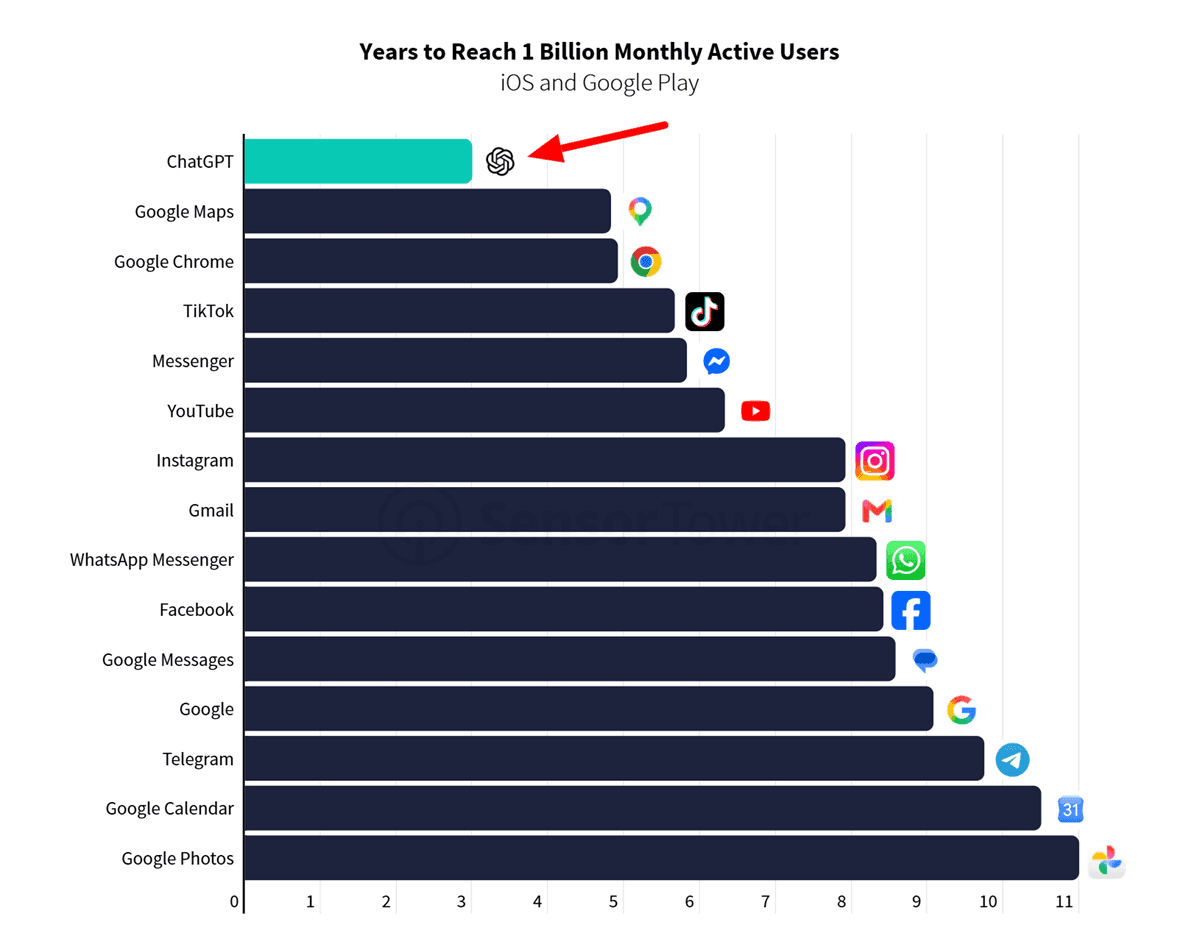
OpenAI first shipped a standalone ChatGPT app in May 2023, so the product needed roughly three years to reach that scale, faster than Google Maps, TikTok, Instagram, or YouTube managed from their own launches, per Sensor Tower’s comparison cited in the same report.
Sensor Tower’s data also gives a useful comparison point for anyone tracking the competitive field: Claude’s app had about 56 million global monthly active users during the same period, growing at roughly 640% year over year, a much faster growth rate off a far smaller base.
Scale isn’t the only thing growing. OpenAI’s own Signals data, published June 30, 2026 and based on a 0.1% sample of users who signed up between October 2025 and May 2026, shows existing users going deeper over time rather than plateauing.
Six months after signup, the average user sends 50% more messages per day than in their first month and has tried roughly twice as many distinct capabilities, based on a 53-category usage classifier OpenAI applies to sampled messages (Source: OpenAI).
That pattern, usage widening and deepening simultaneously rather than users settling into a narrow habit, is part of why WAU growth hasn’t leveled off the way it typically does for a maturing consumer product.
Who Uses ChatGPT? Demographics and Usage Patterns
Gender and Age Breakdown
ChatGPT’s early user base skewed heavily male. That gap has closed faster than almost anyone predicted, and OpenAI’s own June 2026 Signals data confirms the shift has now gone further than the earlier NBER paper suggested.
Usage by users with typically feminine names now represents most usage globally, based on OpenAI’s own name-to-gender classification methodology, with Brazil, Colombia, Poland, and Namibia showing the widest lean toward feminine-name usage and Pakistan, Bangladesh, Angola, DR Congo, and Mali showing the most concentrated masculine-name usage (Source: OpenAI). That’s consistent with, and more current than, the NBER paper’s earlier finding that feminine-name usage crossed 50% by July 2025.
OpenAI’s Signals data doesn’t break out a specific age figure, but the earlier NBER research found usage heavily weighted toward younger adults, with close to half of all messages sent since ChatGPT’s launch coming from users under 26.
Language use has shifted alongside gender. Users primarily communicating in a language other than English now make up more than half of all active users, OpenAI’s largest non-English-usage milestone to date, with Spanish, Portuguese, and Arabic the leading non-English languages. Uzbek, Kazakh, and Burmese posted the fastest-growing usage share of any tracked language since July 2023 (Source: OpenAI).
Countries With the Most ChatGPT Users
The United States remains ChatGPT’s largest market by raw numbers, but the fastest growth is happening elsewhere, and OpenAI’s own regional tracking confirms this has accelerated rather than leveled off.
Weekly active user growth since July 2023 has been fastest, in relative terms, in Africa and Asia, and lower-Human-Development-Index countries have consistently outpaced higher-HDI countries in relative WAU growth over the same window, a pattern OpenAI attributes partly to continued low-cost access through its Free and Go plans (Source: OpenAI).
India has become ChatGPT’s clearest growth story outside the U.S., with reporting through 2026 putting the country at roughly 100 million weekly active users and positioning it as OpenAI’s second-largest market.
What People Actually Use ChatGPT For
This is where most “ChatGPT statistics” articles stop, relying on guesswork. OpenAI actually studied it. The September 2025 NBER paper, based on a privacy-preserving analysis of 1.5 million real conversations, sorted usage into three buckets:
- Asking (49% of messages): users treating ChatGPT as an advisor, seeking information, explanations, or practical guidance rather than asking it to produce a finished output
- Doing (40% of messages): task-oriented work such as drafting text, planning, or writing code, roughly a third of which happens in a work context
- Expressing (11% of messages): personal reflection, exploration, and open-ended conversation with no clear task attached
Three-quarters of all conversations fall under practical guidance, information-seeking, or writing help, with writing specifically being the single most common work-related task. Coding, despite the attention it gets in tech press, remains a comparatively niche share of total consumer usage.
The clearest economic finding here is the work-personal split: 30% of usage is work-related, and 70% is personal, and OpenAI reports that both categories keep growing.
ChatGPT Revenue and Business Statistics
OpenAI Annualized Revenue Growth
OpenAI doesn’t publish quarterly earnings the way a public company does, since it isn’t one yet, but its own funding announcements have gotten increasingly specific about revenue trajectory.
In its March 31, 2026 funding announcement, OpenAI stated directly that it crossed $1 billion in revenue within a year of ChatGPT’s launch, was generating $1 billion per quarter by the end of 2024, and had reached roughly $2 billion in revenue per month by March 2026, a pace the company says is growing four times faster than Alphabet or Meta grew at the equivalent stage of their own history (Source: OpenAI).
CFO Sarah Friar separately disclosed in a January 19, 2026 blog post, reported by Reuters, that annualized revenue crossed $20 billion in 2025, up from $6 billion in 2024.
Audited figures are more conservative than run-rate estimates, as they should be. The Financial Times reviewed OpenAI’s actual 2025 financials and reported full-year revenue of $13.07 billion, with a net loss of roughly $21 billion for the year. Sacra’s separate analysis puts 2025 inference costs at $8.4 billion, projected to rise to $14.1 billion in 2026 as usage scales, which helps explain why a company growing revenue this fast is still burning cash at a historic rate.
Two newer revenue lines are worth tracking on their own. OpenAI’s early advertising pilot inside ChatGPT reached more than $100 million in annualized run rate within six weeks of launch, and Codex, OpenAI’s coding agent, now serves more than 2 million weekly users, up fivefold in three months and still growing more than 70% month over month as of the March 2026 disclosure (Source: OpenAI).
OpenAI Valuation and the IPO Filing
OpenAI’s valuation has roughly doubled annually alongside its revenue. It moved from around $157 billion in late 2024 to a $300 billion-plus round in 2025, then to $852 billion following a $122 billion round OpenAI closed on March 31, 2026, anchored by Amazon, NVIDIA, SoftBank, and continued participation from Microsoft, with more than $3 billion raised from individual investors through bank channels for the first time (Source: OpenAI).
On June 8, 2026, OpenAI confidentially filed paperwork with the SEC for a U.S. IPO, with reporting suggesting the company is targeting a valuation approaching $1 trillion.
Competitive pressure is part of that story. Anthropic filed its own confidential S-1 one week earlier, on June 1, 2026, days after a funding round that Reuters reported made Anthropic more valuable than OpenAI for the first time, at roughly $965 billion against OpenAI’s $852 billion. Anthropic also reported a $47 billion annualized revenue run rate in May 2026, ahead of OpenAI’s comparable figure at the time. (Source: SuccessPixel’s Claude AI Statistics)
Enterprise and Business Adoption
The enterprise side of ChatGPT has scaled just as sharply as the consumer side. As of OpenAI’s most recent disclosures:
- More than 1 million business customers use ChatGPT in some form, a milestone OpenAI said it passed in November 2025
- ChatGPT for Work has surpassed 7 million paid workplace seats, roughly a ninefold increase year over year
- More than 9 million people now use ChatGPT through a paying business account
- Over 50 million people pay for a personal ChatGPT subscription across Plus, Pro, Go, and legacy tiers
ChatGPT Pricing in 2026: Every Plan Compared
OpenAI’s pricing structure has grown from a single $20 Plus tier in 2023 into a full ladder covering casual users up through large enterprise contracts. As of August 2026, current published pricing runs as follows.
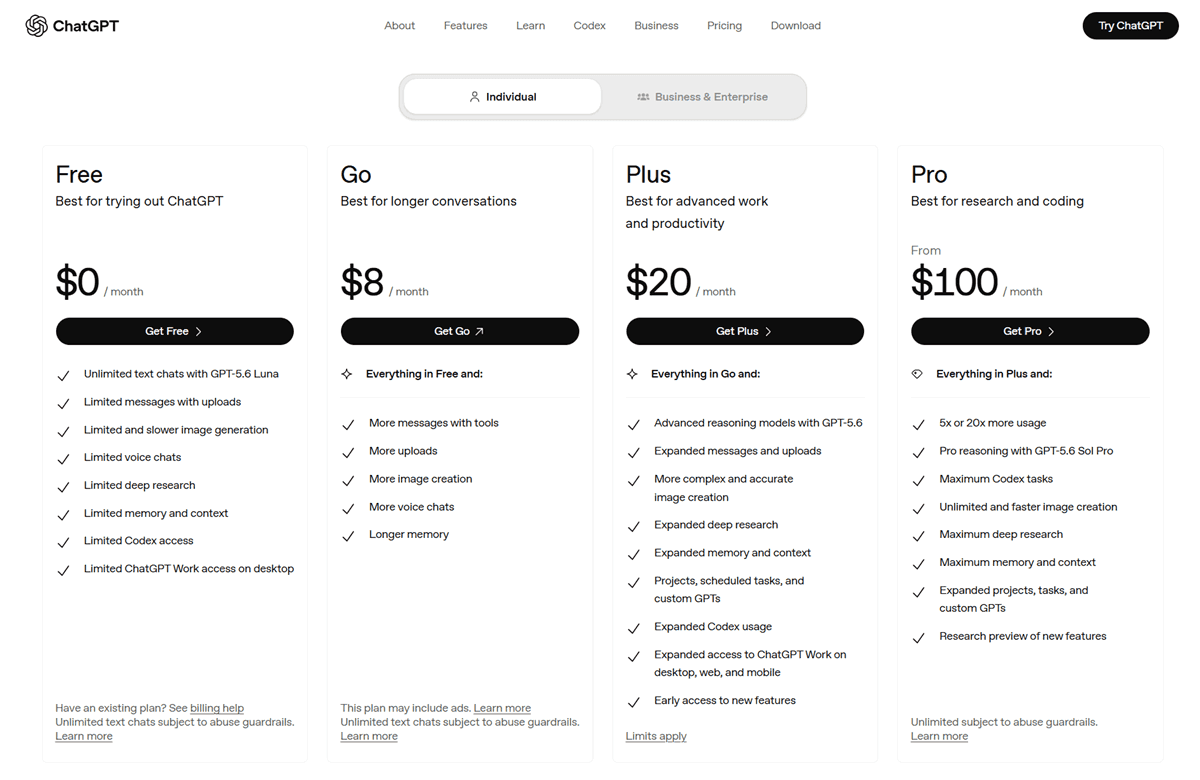
Free costs nothing and now carries ads in the U.S. as of OpenAI’s February 2026 advertising rollout, with capped access to the flagship model before conversations fall back to a lighter one.
ChatGPT Go costs $8 a month and rolled out globally on January 16, 2026, after debuting as a roughly $4 to $5 India-only tier in 2025. It raises message, upload, and image-generation limits well above Free but still excludes Agent mode, Deep Research, and Codex.
ChatGPT Plus remains $20 a month, unchanged since February 2023, and includes Deep Research, Sora video generation, Codex access, and Agent mode alongside the current flagship reasoning model.
ChatGPT Pro now comes in two tiers following an April 9, 2026 split: a $100 tier and the original $200 tier, the latter offering roughly 20 times Plus usage limits and access to the highest-accuracy Pro-class model variant.
ChatGPT Business plan costs $20 per seat per month on annual billing, or $25 monthly, with a two-seat minimum, following an April 2, 2026 price cut from the previous $25/$30 structure. It includes SSO, SOC 2 Type 2 and ISO 27001 compliance, and a default no-training policy on business data.
Enterprise pricing is custom and sales-negotiated. Reported figures cluster around $60 per user per month with a roughly 150-seat minimum, though OpenAI does not publish these numbers officially, so treat any specific enterprise quote as a reported estimate rather than a rate card.
| Plan | Price | Key Limits/Features |
| Free | $0/month | Capped access, ads in the U.S., falls back to a lighter model |
| Go | $8/month | Higher limits than Free; no Agent mode, Deep Research, or Codex |
| Plus | $20/month | Deep Research, Sora, Codex, Agent mode, flagship model |
| Pro | $100/month | ~5x Plus limits |
| Pro (top tier) | $200/month | ~20x Plus limits, highest-accuracy model variant |
| Business | $20–25/seat/month | 2-seat minimum, SSO, SOC 2/ISO 27001, no-training default |
| Enterprise | ~$60/seat/month (est.) | ~150-seat minimum; unofficial, sales-negotiated |
If you’re weighing ChatGPT’s cost against what it can actually save your business, that’s a separate calculation worth running with your own usage numbers rather than a generic industry average, since per-query economics vary enormously by task type and model tier.
If you’re building a business around AI tools rather than just using one, this is exactly the kind of shift Digital Wealth Academy 3.0 is built to help you monetize. Worth a look before you decide which AI subscription is actually worth paying for.
ChatGPT Model and Technology Statistics
GPT-5.6 and the Current Model Lineup
The model actually answering your prompts matters more than the plan name on your invoice, and it changes often. OpenAI’s current flagship family, GPT-5.6, launched on July 9, 2026, after a limited preview that began June 26. It ships in three variants: Sol, the top-capability model for Plus and above; Terra, a balanced mid-tier model; and Luna, the fast, low-cost model that became the default for Free and Go users on August 6, 2026.
All three GPT-5.6 variants share a 1.05-million-token context window with a 128,000-token maximum output, and standard API pricing for Sol runs $5 per million input tokens and $30 per million output tokens, with Terra and Luna priced lower at $2.50/$15 and $1/$6, respectively. That context window is a meaningful jump from GPT-4’s roughly 25,000-word limit in 2023, which many older ChatGPT statistics articles still quote.
Compute Costs and Infrastructure Scale
OpenAI’s compute footprint has scaled in step with usage. CFO Sarah Friar disclosed that the company’s computing capacity rose from 0.6 gigawatts in 2024 to 1.9 gigawatts in 2025, and OpenAI’s API now reportedly processes roughly 15 billion tokens per minute across its developer platform.
Independent estimates from Sacra put full-year inference costs at $8.4 billion for 2025, rising toward $14.1 billion in 2026, which is a big part of why OpenAI remains deeply unprofitable even as revenue climbs past $20 billion annualized.
ChatGPT Market Share vs. Gemini, Claude, and Other AI Chatbots
ChatGPT still dominates the AI chatbot category by absolute scale, but its share is shrinking as competitors scale faster from smaller bases. Similarweb data tracked by multiple industry trackers shows ChatGPT’s worldwide web-traffic share falling from roughly 87% in January 2025 to under 57% by March 2026, and further still to around 53% by May 2026.
The two biggest beneficiaries have been Google’s Gemini, which grew its web-traffic share from around 6% to nearly 28% over the same window, and Anthropic’s Claude, which grew off a much smaller base but at a faster rate. Google’s Gemini app separately reported crossing 900 million monthly active users at Google I/O in May 2026, up from 750 million just three months earlier, putting its headline user count within reach of ChatGPT’s.
None of this means ChatGPT is losing ground in absolute terms. It’s still adding tens of millions of weekly users per month. It means the AI chatbot market has gone from a near-monopoly to a genuinely multi-polar field in about eighteen months, which is worth knowing if you’re building content, tools, or a business that depends on any single one of these platforms staying dominant forever.
ChatGPT Timeline: Key Product Milestones
- November 30, 2022: OpenAI releases ChatGPT as a free research preview
- December 5, 2022: ChatGPT surpasses 1 million users within five days of launch
- January 2023: ChatGPT crosses 100 million users, at the time the fastest consumer app growth on record
- February 2023: ChatGPT Plus launches at $20 a month
- March 14, 2023: GPT-4 rolls out to ChatGPT Plus subscribers
- May 2023: The first standalone ChatGPT iOS app ships
- November 2023: ChatGPT reaches 100 million weekly active users
- August 2025: GPT-5 launches as the new default model
- September 15, 2025: OpenAI publishes its NBER usage research paper with Harvard’s David Deming
- January 16, 2026: ChatGPT Go goes global at $8 a month
- February 2026: ChatGPT crosses 900 million weekly active users
- March 5, 2026: GPT-5.4 launches with a native Computer Use API
- March 31, 2026: OpenAI closes a $122 billion funding round at an $852 billion valuation
- April 9, 2026: ChatGPT Pro splits into $100 and $200 tiers
- June 2, 2026: Reuters reports the ChatGPT app has crossed 1 billion monthly active users
- June 8, 2026: OpenAI confidentially files for a U.S. IPO
- July 9, 2026: GPT-5.6 launches with a 1.05-million-token context window
Frequently Asked Questions About ChatGPT Statistics
Q: How many people use ChatGPT in 2026?
A: ChatGPT had more than 900 million weekly active users as of OpenAI’s February 2026 disclosure, and the ChatGPT app separately crossed 1 billion global monthly active users in May 2026, per Sensor Tower data reported by Reuters.
Q: Is ChatGPT still the most popular AI chatbot?
A: Yes, by a wide margin in absolute users, though its share of total AI chatbot web traffic has fallen from roughly 87% in January 2025 to about 53% by May 2026 as Gemini and Claude have grown faster off smaller bases.
Q: How much revenue does OpenAI make from ChatGPT?
A: OpenAI’s audited 2025 revenue was $13.07 billion, and its annualized revenue run rate had climbed past $20 billion by early 2026, according to CFO Sarah Friar and Reuters reporting.
Q: How much does ChatGPT Plus cost in 2026?
A: ChatGPT Plus is still $20 a month, the same price it’s held since launching in February 2023. Go costs $8, Pro starts at $100, and Business runs $20 to $25 per seat.
Q: What percentage of ChatGPT usage is for work?
A: About 30% of consumer usage is work-related, and roughly 70% is personal, according to OpenAI’s own NBER-published research based on 1.5 million real conversations.
Q: Is OpenAI going public?
A: OpenAI confidentially filed paperwork with the SEC for a U.S. IPO on June 8, 2026, though the company has since signaled it may lean toward a 2027 listing rather than filing publicly in 2026.
Q: What model does ChatGPT use now?
A: ChatGPT’s current flagship model family is GPT-5.6, released July 9, 2026, available in three variants (Sol, Terra, and Luna) with a shared 1.05-million-token context window.
Final Thoughts
The numbers tell a consistent story: ChatGPT went from a research demo to a billion-user platform faster than any consumer product in history, and it did that while bleeding billions of dollars a year to keep the lights on. Both things are true at once, and both matter if you’re trying to build something on top of this wave rather than just watch it from the sidelines.
If AI adoption at this scale is reshaping how people work and search for information, it’s also reshaping how creators and solopreneurs make money.
That’s the entire premise behind Ultimate Branding Course: positioning yourself now, while the field is still this wide open, rather than waiting until it’s crowded.
I’ll keep this page updated as OpenAI reports new numbers. Bookmark it if you need a reliable source for ChatGPT statistics for your own content or research.
➡️ Also Read: AI Statistics 2026: Adoption, Investment, and Industry Trends
